Introduction
Hiring has become one of the most complex challenges organizations face today. The labor market is evolving rapidly, employee expectations are shifting, and technological advancements are changing how businesses attract and retain talent. Companies that rely solely on traditional recruitment methods often struggle to find the right candidates, resulting in longer vacancies, increased turnover, and higher hiring costs.
To build a stronger workforce, organizations must understand the trends, behaviors, and data points that influence employment decisions. Workforce insights provide valuable information that helps employers make smarter recruitment choices, improve employee satisfaction, and strengthen long-term business performance.
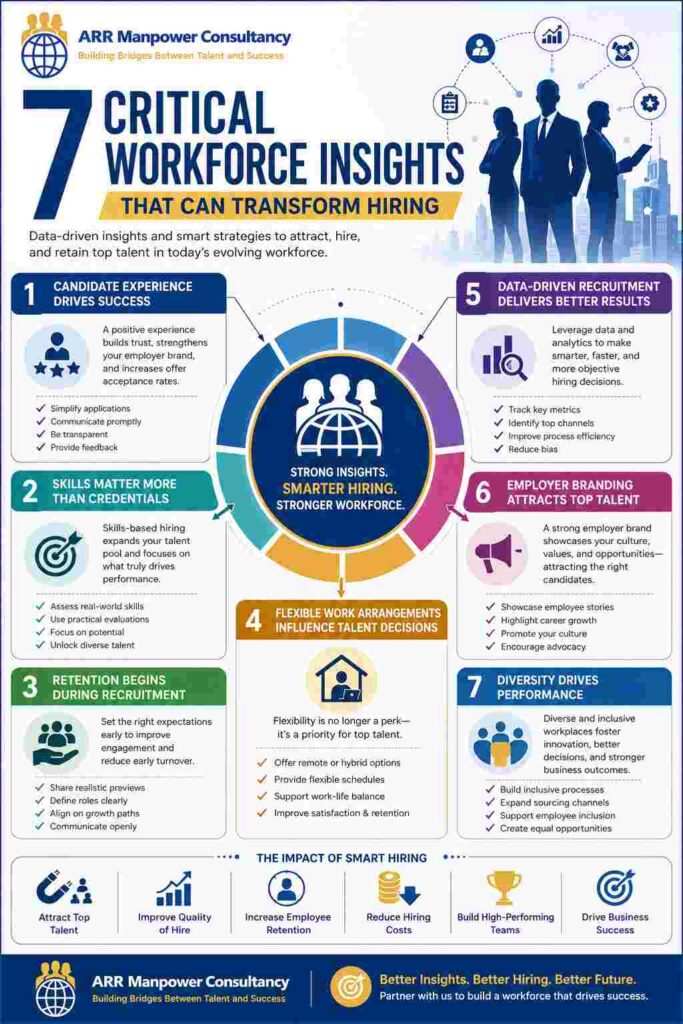
By analyzing workforce patterns and understanding what drives candidates and employees, businesses can develop more effective hiring strategies. The following seven workforce insights can significantly improve recruitment outcomes and help organizations stay competitive in an increasingly dynamic labor market.
https://arrmanpowerconsultancy.com
1. Candidate Experience Directly Impacts Hiring Success
Many employers focus heavily on evaluating candidates but overlook the experience applicants have during the recruitment process. Today’s job seekers often assess organizations just as carefully as employers evaluate them.
A complicated application process, delayed communication, or unclear job descriptions can discourage qualified professionals from continuing with an opportunity. Research consistently shows that candidates value transparency, responsiveness, and respect throughout the hiring journey.
Organizations that create a positive applicant experience often see higher completion rates, stronger employer branding, and better acceptance rates. This includes:
- Simplifying application procedures
- Providing timely updates
- Offering clear job expectations
- Conducting structured interviews
- Delivering constructive feedback when possible
Even candidates who are not selected can become future applicants, customers, or brand advocates if they have a positive interaction with the organization.
Companies that prioritize candidate experience gain a competitive advantage because talented professionals are more likely to engage with employers that demonstrate professionalism and respect.
2. Skills Matter More Than Traditional Credentials
The modern workforce is experiencing a significant shift toward skills-based hiring. While degrees and certifications remain important in some industries, employers increasingly recognize that practical abilities often provide a better indication of job performance.
Many organizations are broadening their talent pools by focusing on demonstrated competencies rather than strict educational requirements. This approach allows businesses to access qualified candidates who may have gained expertise through alternative learning paths, vocational training, online courses, or direct work experience.
Skills-based recruitment offers several benefits:
- Access to a larger candidate pool
- Reduced hiring bottlenecks
- Greater workforce diversity
- Improved role alignment
- Enhanced organizational agility
Employers that evaluate candidates based on capabilities rather than credentials can often identify high-performing individuals who might otherwise be overlooked.
Assessment tools, practical assignments, portfolio reviews, and competency-based interviews can help organizations measure relevant abilities more accurately than resumes alone.
3. Employee Retention Begins During Recruitment
Many businesses treat recruitment and retention as separate functions. In reality, successful employee retention starts long before an individual accepts a job offer.
The expectations established during hiring significantly influence future engagement and job satisfaction. When organizations present an unrealistic picture of a role, new hires may quickly become disappointed and seek opportunities elsewhere.
Workforce data frequently reveals that turnover rates increase when there is a mismatch between candidate expectations and actual job conditions.
Employers can reduce early attrition by:
- Providing realistic job previews
- Clearly defining responsibilities
- Discussing growth opportunities honestly
- Communicating workplace culture accurately
- Setting achievable performance expectations
Candidates appreciate transparency, even when discussing challenges associated with a role. Honest communication helps attract individuals who are genuinely aligned with the position and organizational environment.
A strong recruitment process should focus not only on filling vacancies but also on establishing long-term employment relationships.
4. Flexible Work Arrangements Influence Talent Decisions
The workforce has undergone substantial changes in recent years, particularly regarding workplace flexibility. Remote work, hybrid schedules, and flexible hours have become major considerations for many professionals.
Workforce insights consistently indicate that flexibility is no longer viewed as a temporary benefit. For many candidates, it has become a significant factor in evaluating employment opportunities.
Organizations that understand these preferences can strengthen their recruitment efforts by offering flexible arrangements where operationally feasible.
Benefits often include:
- Improved candidate attraction
- Increased employee satisfaction
- Reduced commuting stress
- Expanded geographic talent access
- Higher retention rates
However, flexibility should be implemented thoughtfully. Employers need clear policies, effective communication channels, and performance management systems that support productivity while maintaining organizational objectives.
Understanding workforce preferences enables businesses to design work environments that align with employee expectations and business needs.
5. Data-Driven Recruitment Produces Better Outcomes
Hiring decisions based solely on intuition can lead to inconsistent results. Modern organizations increasingly rely on workforce analytics to improve recruitment effectiveness.
Data provides valuable insights into recruitment performance, talent availability, candidate behavior, and hiring efficiency. Organizations that measure key recruitment metrics can identify opportunities for continuous improvement.
Important metrics may include:
- Time-to-fill positions
- Cost-per-hire
- Source effectiveness
- Offer acceptance rates
- Employee retention rates
- Quality-of-hire indicators
By analyzing these metrics, employers can determine which recruitment channels deliver the strongest candidates and which stages of the hiring process require optimization.
Data-driven recruitment also helps reduce bias by encouraging objective evaluation criteria. Structured assessments and standardized interview processes contribute to more consistent decision-making.
Businesses that leverage workforce analytics are often better positioned to adapt to labor market changes and make informed hiring investments.
6. Employer Branding Shapes Candidate Attraction
A company’s reputation plays a critical role in recruitment success. Before submitting applications, many professionals research potential employers to understand organizational culture, values, leadership practices, and employee experiences.
Employer branding extends beyond marketing materials. It reflects how current and former employees perceive the organization.
Workforce insights show that strong employer brands often experience:
- Greater application volumes
- Higher-quality candidate pools
- Improved employee engagement
- Stronger retention outcomes
- Reduced recruitment costs
Organizations can strengthen their employer brand by:
- Highlighting employee success stories
- Showcasing workplace culture
- Demonstrating career development opportunities
- Promoting diversity and inclusion efforts
- Encouraging authentic employee advocacy
Transparency is essential. Candidates can often identify discrepancies between promotional messaging and actual workplace experiences. Authenticity builds trust and attracts individuals who align with organizational values.
A compelling employer brand helps businesses differentiate themselves in competitive labor markets and attract top talent more effectively.
7. Workforce Diversity Drives Organizational Performance
Diversity has become a strategic workforce consideration rather than simply a compliance requirement. Organizations increasingly recognize the value that diverse perspectives bring to problem-solving, innovation, and decision-making.
Workforce insights frequently demonstrate that inclusive teams contribute to stronger collaboration and broader thinking. Diverse organizations are often better equipped to understand customer needs and respond to changing market conditions.
Building diversity requires intentional recruitment practices, including:
- Expanding sourcing channels
- Reviewing job descriptions for inclusive language
- Standardizing evaluation criteria
- Training interview teams
- Creating equitable advancement opportunities
Inclusion is equally important. Recruiting diverse candidates is only the first step. Organizations must foster environments where employees feel valued, respected, and empowered to contribute.
When individuals feel a sense of belonging, engagement and performance often improve. This creates positive outcomes for both employees and employers.
Companies that embrace diversity as a strategic priority are better positioned to build resilient and innovative workforces.
How Organizations Can Apply These Insights
Understanding workforce trends is valuable, but meaningful results come from practical implementation. Employers should regularly evaluate recruitment practices and identify opportunities for improvement.
A structured approach may include:
Conduct Workforce Analysis
Review hiring metrics, employee feedback, turnover patterns, and talent acquisition performance. This information provides a foundation for strategic planning.
Align Recruitment With Business Goals
Hiring strategies should support long-term organizational objectives rather than focusing exclusively on immediate vacancies.
Invest in Technology
Modern recruitment tools can streamline sourcing, screening, communication, and analytics, helping organizations make more informed decisions.
Strengthen Hiring Manager Collaboration
Recruitment teams and hiring managers should work closely together to define role requirements, evaluate candidates consistently, and improve decision-making.
Continuously Monitor Results
Workforce conditions evolve rapidly. Regular reviews help organizations adapt their recruitment strategies and remain competitive.
The Future of Hiring
The future of recruitment will be shaped by technological innovation, workforce expectations, demographic shifts, and changing economic conditions. Artificial intelligence, automation, and predictive analytics are already influencing how organizations identify and engage talent.
At the same time, human-centered hiring practices remain essential. Candidates continue to value meaningful work, professional development opportunities, workplace flexibility, and inclusive cultures.
Organizations that combine data-driven insights with authentic human interactions will be better equipped to attract and retain exceptional talent.
Successful hiring is no longer about simply filling positions. It involves building a workforce capable of supporting innovation, growth, and long-term business success.
Conclusion
Hiring has evolved far beyond reviewing resumes and conducting interviews. Organizations must understand the workforce factors that influence candidate behavior, employee engagement, and recruitment performance.
The seven workforce insights discussed in this article—candidate experience, skills-based hiring, retention-focused recruitment, workplace flexibility, data-driven decision-making, employer branding, and workforce diversity—provide a strong foundation for modern hiring success.
Businesses that leverage these insights can improve recruitment efficiency, attract stronger candidates, reduce turnover, and create more resilient teams. As labor markets continue to change, organizations that embrace workforce intelligence will be better positioned to secure the talent needed for sustainable growth and competitive advantage.
By making informed hiring decisions today, companies can build a stronger workforce that supports future success.