Introduction
Hiring the right talent has become one of the most critical challenges for organizations across industries. Traditional recruitment methods often rely heavily on intuition, personal judgment, and subjective evaluations. While experience and instincts have their place, they may not always lead to the most effective hiring outcomes.
Today, businesses have access to vast amounts of workforce data that can transform how recruitment decisions are made. By leveraging analytics, measurable performance indicators, and recruitment metrics, organizations can make informed choices that improve hiring accuracy and long-term workforce success.
Data-driven hiring refers to the practice of using objective information, analytics, and measurable insights to guide recruitment decisions. Instead of relying solely on gut feelings, employers evaluate candidates based on evidence gathered from assessments, performance indicators, skills evaluations, and hiring trends.
This approach is becoming increasingly popular because it helps organizations identify the best candidates while reducing bias, improving efficiency, and enhancing overall business performance. Below are eleven proven benefits of adopting data-driven hiring practices.
https://arrmanpowerconsultancy.com
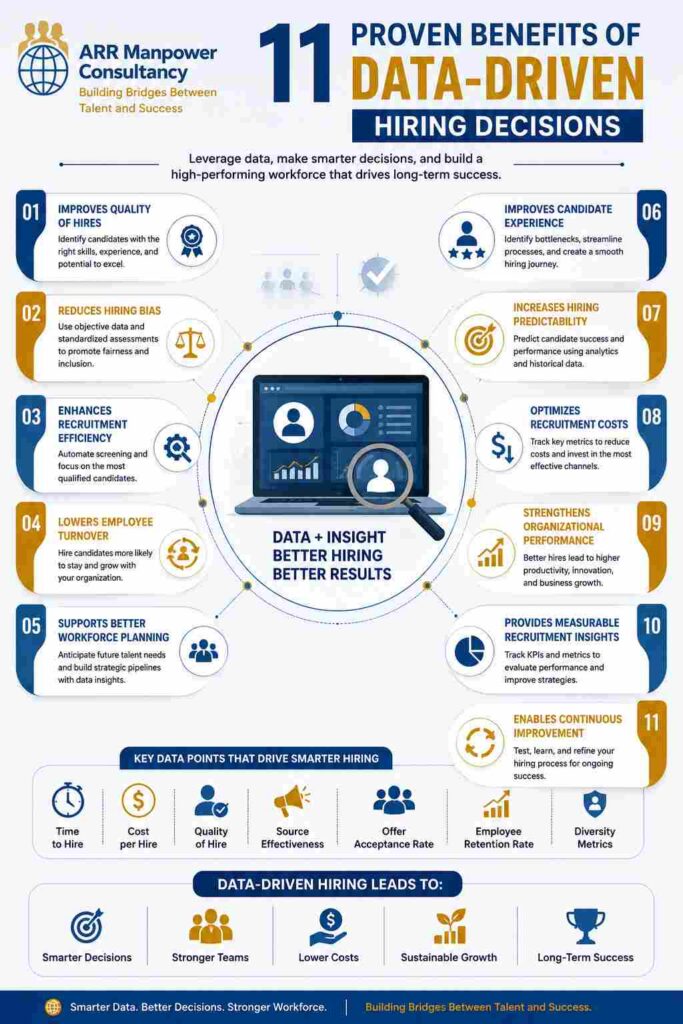
1. Improves Quality of Hires
One of the most significant advantages of using data in recruitment is the ability to improve hiring quality.
Organizations can analyze candidate qualifications, assessment results, previous work achievements, and behavioral indicators to identify individuals who are most likely to succeed in a role. Historical hiring data can also reveal patterns among top-performing employees, allowing recruiters to seek candidates with similar characteristics.
When decisions are based on measurable factors rather than assumptions, businesses increase their chances of selecting candidates who possess the right skills, experience, and cultural fit.
Higher-quality hires often contribute to increased productivity, stronger team performance, and better organizational outcomes.
2. Reduces Hiring Bias
Unconscious bias remains a challenge in many recruitment processes. Personal preferences, assumptions, and stereotypes can unintentionally influence hiring decisions.
Data-driven recruitment helps minimize these risks by focusing attention on objective criteria. Structured assessments, standardized interview scores, and measurable performance indicators create a more consistent evaluation process.
When every candidate is assessed using the same benchmarks, organizations can promote fairness and equal opportunities. This approach supports diversity initiatives and helps build a workforce based on merit rather than subjective impressions.
Reducing bias also strengthens employer reputation and demonstrates a commitment to inclusive hiring practices.
3. Enhances Recruitment Efficiency
Recruitment can be time-consuming, especially when hiring managers must review large numbers of applications.
Analytics tools help streamline candidate screening by identifying applicants who meet specific job requirements. Automated systems can rank candidates based on skills, experience, qualifications, and assessment performance.
This enables recruiters to focus their attention on the most promising individuals rather than spending excessive time reviewing unsuitable applications.
Improved efficiency reduces administrative workloads, shortens hiring timelines, and allows organizations to fill vacancies more quickly without sacrificing candidate quality.
4. Lowers Employee Turnover
Employee turnover can be expensive and disruptive. Replacing employees often requires additional recruitment, onboarding, and training expenses.
Data-driven hiring helps organizations identify candidates who are more likely to remain with the company long term. Recruitment analytics can reveal factors associated with employee retention, such as specific skills, work preferences, career goals, and cultural alignment.
By selecting candidates who match these success indicators, businesses can reduce the likelihood of early departures.
Lower turnover contributes to workforce stability, stronger team cohesion, and reduced recruitment costs over time.
5. Supports Better Workforce Planning
Strategic workforce planning requires a clear understanding of current and future talent needs.
Recruitment data provides valuable insights into hiring trends, talent shortages, skill gaps, and workforce demands. Organizations can analyze this information to forecast future hiring requirements and develop proactive recruitment strategies.
Instead of reacting to staffing shortages, businesses can prepare in advance and build talent pipelines for critical positions.
Better workforce planning ensures that organizations have the right people in place to support growth, innovation, and operational success.
6. Improves Candidate Experience
The candidate experience plays a crucial role in attracting top talent. A slow, inconsistent, or confusing recruitment process can discourage qualified applicants.
Data analytics helps organizations identify bottlenecks and inefficiencies throughout the hiring journey. By tracking application completion rates, interview feedback, communication timelines, and candidate satisfaction metrics, recruiters can continuously improve the process.
Faster responses, transparent communication, and streamlined assessments create a more positive experience for applicants.
Candidates who enjoy a smooth recruitment process are more likely to accept job offers and recommend the organization to others.
7. Increases Hiring Predictability
Predicting future employee success has traditionally been difficult. However, data analysis enables organizations to make more accurate forecasts.
By examining historical recruitment outcomes, employers can identify characteristics associated with strong performance, leadership potential, and long-term success.
Predictive analytics helps determine which candidates are most likely to excel in specific roles. This improves decision-making and reduces uncertainty during recruitment.
Greater predictability allows hiring managers to make confident choices based on evidence rather than speculation.
As a result, organizations can achieve more consistent hiring outcomes and better workforce performance.
8. Optimizes Recruitment Costs
Hiring expenses can quickly accumulate through advertising, agency fees, screening activities, interviews, onboarding, and training.
Data-driven hiring helps organizations monitor recruitment spending and identify areas where resources can be used more effectively.
Recruitment metrics such as cost per hire, source effectiveness, time to fill, and quality of hire provide valuable insights into hiring efficiency.
By understanding which recruitment channels deliver the best results, organizations can allocate budgets more strategically and eliminate unnecessary expenses.
Cost optimization supports sustainable growth while maintaining high recruitment standards.
9. Strengthens Organizational Performance
The quality of an organization’s workforce directly influences business performance.
When recruitment decisions consistently identify talented individuals who align with organizational goals, overall productivity improves. Employees perform better when their skills match job requirements and their strengths are effectively utilized.
Data-informed hiring contributes to stronger teams, improved collaboration, enhanced innovation, and higher customer satisfaction.
Over time, these benefits can significantly impact revenue growth, operational efficiency, and competitive advantage.
Organizations that invest in evidence-based recruitment often achieve stronger business outcomes than those relying solely on traditional hiring methods.
10. Provides Measurable Recruitment Insights
Many organizations struggle to determine whether their hiring strategies are producing desired results.
Recruitment analytics provides measurable insights that help evaluate hiring effectiveness. Key metrics may include:
- Time to hire
- Cost per hire
- Offer acceptance rate
- Candidate quality
- Employee retention rate
- Hiring source performance
- Diversity metrics
Tracking these indicators enables organizations to identify strengths and weaknesses within their recruitment process.
Regular analysis supports continuous improvement and ensures hiring strategies remain aligned with organizational objectives.
Measurable insights also allow recruitment teams to demonstrate the value of their efforts to senior leadership.
11. Enables Continuous Improvement
Successful recruitment requires ongoing refinement and adaptation.
Labor markets, candidate expectations, technology, and workforce requirements continue to evolve. Organizations that collect and analyze hiring data can respond more effectively to these changes.
Recruitment teams can test different sourcing methods, interview techniques, assessment tools, and onboarding approaches while measuring their impact on outcomes.
This creates a cycle of continuous learning and improvement.
Rather than relying on assumptions, organizations can make evidence-based adjustments that enhance recruitment effectiveness over time.
Continuous improvement ensures that hiring practices remain competitive and aligned with changing business needs.
Best Practices for Implementing Data-Driven Hiring
While the benefits are substantial, organizations must adopt the right strategies to maximize success.
Define Clear Hiring Objectives
Establish measurable goals before collecting recruitment data. Objectives may include reducing turnover, improving hiring quality, increasing diversity, or shortening recruitment timelines.
Use Reliable Assessment Tools
Select validated assessments and evaluation methods that accurately measure candidate skills, competencies, and potential.
Track Relevant Metrics
Focus on metrics that directly support business objectives rather than collecting excessive amounts of data.
Maintain Data Accuracy
Ensure recruitment information is complete, consistent, and regularly updated.
Train Hiring Teams
Recruiters and hiring managers should understand how to interpret recruitment analytics and apply insights effectively.
Balance Data with Human Judgment
While analytics provides valuable guidance, human expertise remains important. The most effective hiring decisions combine objective insights with professional evaluation.
Common Challenges and How to Overcome Them
Organizations adopting data-driven recruitment may encounter several challenges.
Data Quality Issues
Incomplete or inaccurate information can lead to poor decisions. Establishing strong data management practices helps maintain reliability.
Resistance to Change
Some hiring managers may prefer traditional recruitment methods. Education and training can demonstrate the value of evidence-based decision-making.
Technology Integration
Implementing analytics tools may require investment and process adjustments. Selecting scalable solutions can simplify adoption.
Privacy Concerns
Candidate data must be collected and managed responsibly. Organizations should comply with relevant privacy regulations and maintain transparency regarding data usage.
Addressing these challenges early supports successful implementation and long-term effectiveness.
Conclusion
Data-driven hiring has transformed the way organizations attract, evaluate, and select talent. By leveraging objective information and recruitment analytics, businesses can make smarter hiring decisions that improve workforce quality and organizational performance.
The benefits extend far beyond simply filling vacancies. Improved hiring quality, reduced bias, lower turnover, enhanced efficiency, stronger workforce planning, and measurable recruitment insights all contribute to sustainable business success.
As competition for skilled talent continues to increase, organizations that embrace evidence-based recruitment practices will be better positioned to identify top candidates, build high-performing teams, and achieve long-term growth.
By integrating analytics into the recruitment process while maintaining a human-centered approach, employers can create a hiring strategy that delivers consistent and measurable results for years to come.