Introduction
In the highly competitive landscape of manpower services, building a stable and predictable revenue stream is no longer optional—it is a strategic necessity. Agencies that rely purely on one-time placements often struggle with inconsistent cash flow, making growth unpredictable and planning difficult. This is where Annual Recurring Revenue (ARR) becomes a game-changer.
ARR represents the predictable revenue a business can expect annually from ongoing client relationships. For manpower consultancies, it is not just about placing candidates but about building long-term partnerships that generate consistent income over time. Companies that successfully implement ARR-focused strategies benefit from higher valuation, improved client retention, and sustainable scalability.
This article explores 13 winning formulas that can help manpower service providers build, optimize, and scale recurring revenue streams effectively.
https://arrmanpowerconsultancy.com/
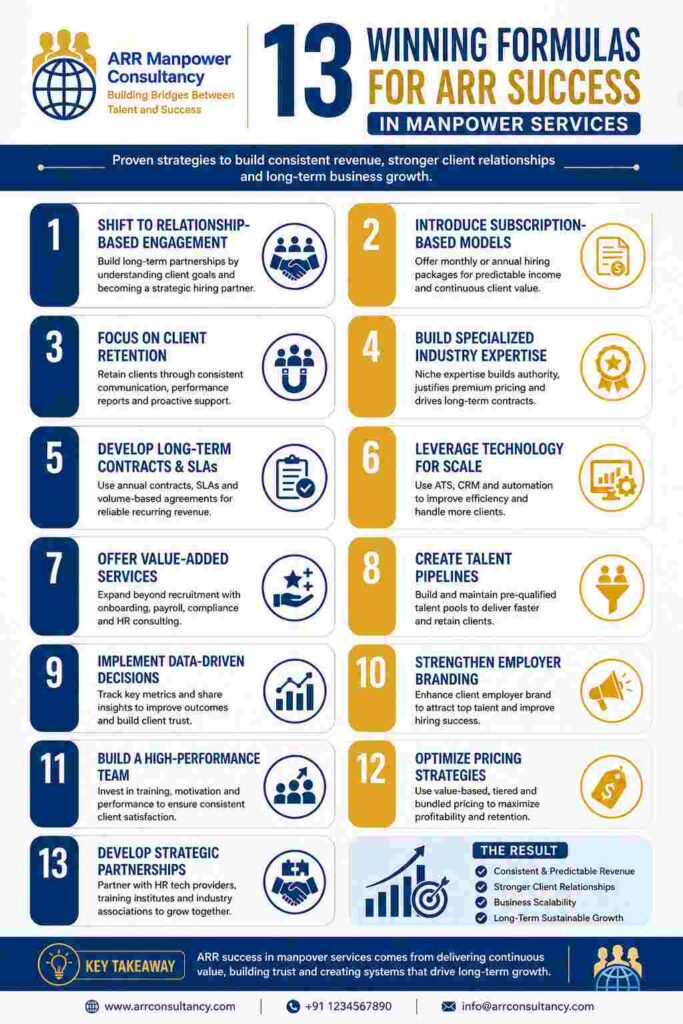
1. Shift from Transactional to Relationship-Based Engagement
Most recruitment firms operate on a transactional model—fill a position, earn a fee, and move on. While this approach generates quick revenue, it lacks sustainability.
A relationship-driven model focuses on long-term collaboration. Instead of acting as a vendor, position your consultancy as a strategic hiring partner. This involves:
- Understanding client business goals
- Offering workforce planning insights
- Providing continuous hiring support
When clients see you as an extension of their HR team, they are more likely to engage in long-term contracts, which directly strengthens recurring revenue.
2. Introduce Subscription-Based Recruitment Models
One of the most effective ways to stabilize income is by offering subscription-based services. Instead of charging per hire, you can create monthly or yearly plans.
Examples include:
- Monthly hiring support packages
- Dedicated recruiter services
- Ongoing talent pipeline management
This model ensures predictable income while offering clients cost transparency and continuous value.
3. Focus on Client Retention Over Acquisition
Acquiring new clients is significantly more expensive than retaining existing ones. Yet many agencies focus heavily on lead generation rather than retention.
To improve retention:
- Maintain regular communication
- Provide performance reports
- Offer proactive hiring solutions
A satisfied client is more likely to renew contracts and expand engagement, contributing consistently to recurring revenue.
4. Build Specialized Industry Expertise
Generalist agencies often face pricing pressure and low client loyalty. Specialization creates authority and differentiation.
Choose a niche such as:
- IT staffing
- Healthcare recruitment
- Manufacturing workforce solutions
When you specialize, clients perceive higher value, which justifies long-term contracts and premium pricing.
5. Develop Long-Term Contracts and SLAs
Service Level Agreements (SLAs) formalize expectations and ensure ongoing collaboration. Instead of project-based engagements, focus on:
- Annual hiring contracts
- Volume-based agreements
- Retained search partnerships
These contracts provide predictable income and strengthen client commitment.
6. Leverage Technology for Scalable Operations
Technology plays a crucial role in building consistent revenue streams. Recruitment software and automation tools can streamline processes and improve efficiency.
Key tools include:
- Applicant Tracking Systems (ATS)
- CRM platforms for client management
- AI-driven sourcing tools
Efficient operations allow you to handle more clients without compromising quality, increasing revenue stability.
7. Offer Value-Added Services
Beyond recruitment, agencies can expand their offerings to create additional recurring income streams.
Examples:
- Employee onboarding support
- Payroll management
- Compliance services
- HR consulting
These services deepen client relationships and increase lifetime value.
8. Create Talent Pipelines in Advance
Waiting for client requirements before sourcing candidates slows down the hiring process and limits scalability.
Instead:
- Build pre-qualified candidate pools
- Maintain active databases
- Engage passive candidates
Having ready talent pipelines enhances delivery speed and client satisfaction, encouraging long-term partnerships.
9. Implement Data-Driven Decision Making
Data is essential for optimizing performance and improving client outcomes.
Track metrics such as:
- Time-to-hire
- Cost-per-hire
- Candidate retention rates
Sharing insights with clients demonstrates professionalism and builds trust, which is critical for recurring contracts.
10. Strengthen Employer Branding Services
Many companies struggle with attracting quality talent due to weak employer branding. This creates an opportunity for manpower agencies.
You can offer:
- Job description optimization
- Employer branding campaigns
- Candidate experience improvements
Helping clients build their brand increases hiring success and strengthens long-term collaboration.
11. Build a High-Performance Recruitment Team
Your internal team directly impacts service quality and client retention.
Focus on:
- Continuous training
- Performance incentives
- Skill development
A strong team delivers consistent results, which encourages clients to maintain ongoing agreements.
12. Optimize Pricing Strategies
Pricing plays a crucial role in revenue consistency. Avoid underpricing services to win clients, as it reduces profitability and sustainability.
Instead:
- Offer tiered pricing models
- Bundle services into packages
- Align pricing with value delivered
Well-structured pricing ensures profitability while supporting recurring revenue models.
13. Develop Strategic Partnerships
Collaborations can significantly expand your reach and service capabilities.
Potential partners include:
- HR software providers
- Training institutes
- Industry associations
Partnerships create new opportunities for client acquisition and long-term contracts.
Challenges in Building Recurring Revenue
While the benefits are clear, implementing these strategies comes with challenges:
- Resistance from clients used to traditional pricing
- Initial investment in systems and processes
- Need for cultural shift within the organization
However, these challenges can be overcome with clear communication, gradual implementation, and a strong value proposition.
Future Trends in Manpower Services
The recruitment industry is evolving rapidly. Agencies that adapt to these trends will be better positioned to build sustainable revenue.
Key trends include:
- Increased use of AI and automation
- Remote workforce hiring
- Demand for flexible staffing solutions
- Growth of gig economy
Aligning your strategy with these trends ensures long-term relevance and growth.
Conclusion
Achieving long-term ARR success in manpower services is not the result of a single strategy, tool, or market advantage. It comes from consistently applying proven formulas that strengthen client relationships, improve workforce quality, and create sustainable revenue streams. As the staffing and recruitment industry becomes increasingly competitive, organizations that focus on recurring value rather than one-time placements will be in the strongest position to grow and thrive.
The 13 winning formulas discussed throughout this article highlight the importance of combining operational excellence with strategic planning. From improving candidate sourcing and retention to leveraging technology and data analytics, every formula contributes to building a more resilient and scalable manpower business. Companies that invest in these areas are better equipped to meet evolving client demands while maintaining profitability and service quality.
One of the most significant drivers of ARR growth is client trust. Businesses that consistently deliver qualified talent, maintain transparent communication, and respond quickly to workforce challenges create stronger partnerships with their clients. These long-term relationships often lead to contract renewals, service expansions, and referral opportunities that generate predictable recurring revenue. In a market where competition is fierce, trust becomes a powerful differentiator.
Equally important is the ability to adapt to changing workforce trends. The rise of remote work, hybrid staffing models, specialized skill requirements, and digital recruitment platforms has transformed the manpower industry. Organizations that embrace innovation and remain flexible can identify new revenue opportunities while staying ahead of competitors. Continuous improvement should be viewed not as an occasional initiative but as an ongoing business philosophy.
Technology also plays a critical role in ARR optimization. Modern applicant tracking systems, CRM platforms, workforce management tools, and AI-powered recruitment solutions help agencies streamline operations and improve decision-making. By automating repetitive tasks and gaining deeper insights into client and candidate behavior, manpower firms can enhance efficiency while delivering greater value to customers. This combination of efficiency and value creation directly supports recurring revenue growth.
Another key factor is employee and candidate satisfaction. Happy employees are more productive, engaged, and likely to remain with client organizations for longer periods. Higher retention rates reduce replacement costs and strengthen client confidence in the staffing provider. When manpower agencies prioritize candidate experience and workforce development, they create a positive cycle that benefits clients, workers, and business performance alike.
ARR success should also be measured through long-term metrics rather than short-term gains. While rapid growth can be attractive, sustainable recurring revenue comes from maintaining strong retention rates, increasing client lifetime value, and continuously improving service quality. Organizations that track these indicators can make more informed decisions and build a foundation for steady expansion.
Ultimately, the future of manpower services belongs to companies that combine strategic thinking, operational efficiency, technological innovation, and customer-centric practices. By implementing these 13 winning formulas with consistency and commitment, staffing firms can strengthen their market position, increase recurring revenue, and create lasting business value. The journey toward ARR success is ongoing, but organizations that prioritize excellence, adaptability, and relationship-building will be well positioned to achieve sustainable growth and long-term profitability in an evolving workforce landscape.
Building consistent and scalable revenue in manpower services requires a shift in mindset, strategy, and execution. The traditional placement-based model is no longer sufficient in a competitive and dynamic market.
By implementing these 13 winning formulas, agencies can transition toward a more stable and predictable business model. The focus should always remain on delivering continuous value, strengthening client relationships, and optimizing operations.
Success in this space is not about short-term wins but about creating a system that generates sustainable growth over time. Agencies that embrace this approach will not only improve their financial stability but also establish themselves as trusted partners in the recruitment ecosystem.