Introduction
In 2026, businesses are no longer judged solely by how much revenue they generate, but by how predictable, scalable, and sustainable that revenue is. This shift has placed Annual Recurring Revenue (ARR) at the center of modern business strategy. Whether in SaaS, staffing, consulting, or subscription-driven services, ARR represents stability, long-term customer value, and operational maturity.
However, simply having recurring revenue streams is not enough. Organizations must continuously refine and optimize their ARR to remain competitive in an increasingly dynamic market. Optimization involves improving customer retention, enhancing pricing structures, reducing churn, and expanding lifetime value—all while maintaining operational efficiency.
This article explores 11 powerful models that organizations can adopt in 2026 to optimize recurring revenue, improve predictability, and drive sustainable growth.
https://arrmanpowerconsultancy.com/
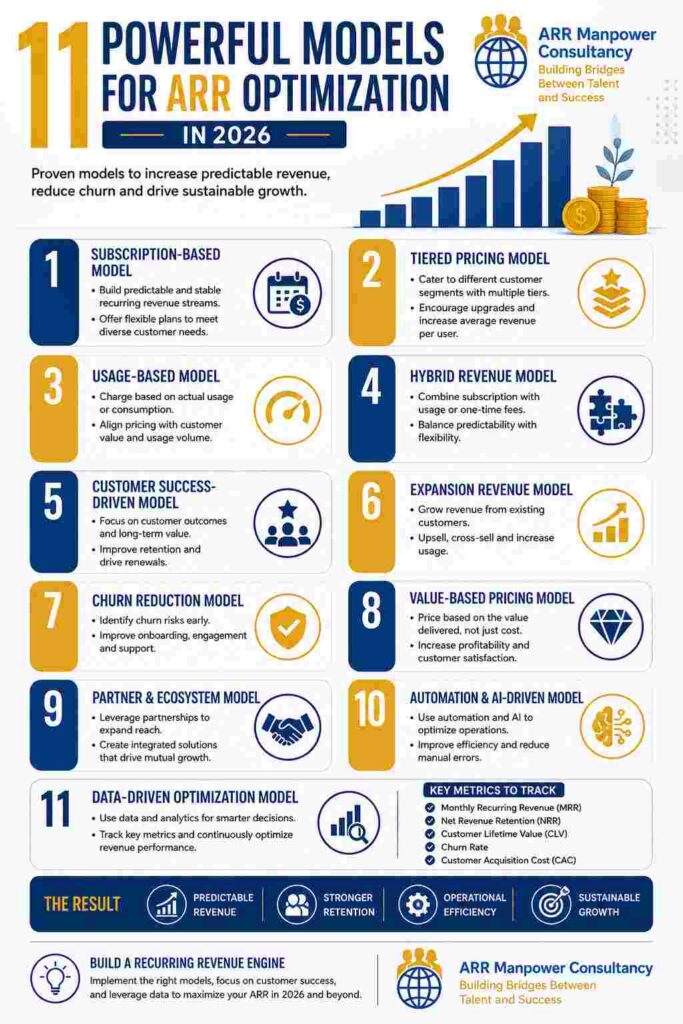
1. Subscription-Based Revenue Model
The subscription model remains one of the most effective frameworks for predictable income. Instead of one-time transactions, customers pay on a recurring basis—monthly, quarterly, or annually.
Key Benefits:
- Predictable cash flow
- Strong customer relationships
- Easier financial forecasting
Optimization Strategy:
Focus on flexible subscription tiers that cater to different customer segments. Introduce entry-level plans for accessibility and premium tiers for high-value clients. Regularly review pricing to align with market demand and value delivery.
2. Tiered Pricing Model
Tiered pricing allows businesses to offer multiple service levels, each with distinct features and pricing.
Why It Works:
Customers have varying needs and budgets. Tiered structures ensure that you capture value across different segments without alienating potential buyers.
Best Practices:
- Clearly differentiate tiers
- Use value-based pricing
- Highlight upgrade incentives
This model encourages upselling and contributes significantly to revenue expansion.
3. Usage-Based (Consumption) Model
In this model, customers pay based on how much they use a product or service.
Advantages:
- Fair pricing perception
- Scalability with customer growth
- Increased adoption
Implementation Tips:
Combine usage-based pricing with a base subscription fee to ensure a minimum revenue baseline while benefiting from growth-driven income.
4. Hybrid Revenue Model
A hybrid model blends multiple pricing strategies—such as subscription plus usage-based components.
Example:
A base monthly fee combined with additional charges for premium features or higher usage.
Why It’s Effective:
It balances predictability with scalability, making it ideal for businesses with diverse customer behaviors.
5. Customer Success-Driven Model
Customer success is no longer a support function—it is a revenue driver.
Core Idea:
Actively help customers achieve their goals using your service, ensuring they continue using and renewing.
Key Tactics:
- Dedicated account managers
- Regular performance reviews
- Proactive problem-solving
Satisfied customers are more likely to renew and expand their contracts, directly impacting recurring income.
6. Expansion Revenue Model
This model focuses on increasing revenue from existing customers rather than acquiring new ones.
Methods:
- Upselling premium services
- Cross-selling complementary solutions
- Increasing usage levels
Impact:
Expansion revenue often has lower acquisition costs and higher profitability compared to new customer acquisition.
7. Churn Reduction Model
Churn is one of the biggest threats to recurring revenue stability. Even a small increase in churn can significantly impact long-term growth.
Strategies to Reduce Churn:
- Improve onboarding experience
- Monitor customer engagement
- Address issues proactively
Metrics to Track:
- Customer retention rate
- Churn rate
- Net revenue retention
Reducing churn is one of the fastest ways to improve overall revenue performance.
8. Value-Based Pricing Model
Instead of pricing based on cost or competition, value-based pricing focuses on the perceived value delivered to the customer.
Benefits:
- Higher profit margins
- Stronger brand positioning
- Better alignment with customer outcomes
How to Implement:
Understand customer pain points and quantify the value your service provides. Price accordingly to reflect that value.
9. Partner and Ecosystem Model
Strategic partnerships can significantly enhance revenue opportunities.
Examples:
- Integration with complementary services
- Referral partnerships
- Co-branded offerings
Advantages:
- Access to new customer segments
- Increased credibility
- Shared growth opportunities
This model is especially effective in industries where collaboration enhances value.
10. Automation and AI-Driven Model
Technology is transforming how businesses manage and optimize recurring revenue.
Applications:
- Automated billing systems
- Predictive analytics for churn
- AI-driven customer insights
Benefits:
- Increased efficiency
- Reduced operational costs
- Data-driven decision-making
Automation allows businesses to scale without proportional increases in resources.
11. Data-Driven Optimization Model
Data is the foundation of effective revenue optimization. Organizations that leverage data insights outperform competitors.
Key Metrics:
- Monthly recurring revenue (MRR)
- Customer lifetime value (CLV)
- Acquisition cost (CAC)
Strategy:
Use analytics tools to track performance, identify trends, and make informed decisions. Continuous optimization based on data ensures long-term success.
Integrating These Models for Maximum Impact
While each model offers unique advantages, the real power lies in combining them strategically.
Example Integration:
- Use subscription and tiered pricing for structure
- Apply customer success strategies for retention
- Leverage data analytics for continuous improvement
A holistic approach ensures that all aspects of recurring revenue are optimized simultaneously.
Challenges in ARR Optimization
Despite its benefits, optimizing recurring revenue comes with challenges:
1. Pricing Complexity
Balancing affordability with profitability can be difficult.
2. Customer Expectations
Modern customers demand flexibility and value.
3. Operational Alignment
Teams must align around recurring revenue goals.
4. Technology Investment
Implementing advanced tools requires upfront investment.
Addressing these challenges requires strategic planning and continuous adaptation.
Future Trends in 2026
The landscape of recurring revenue is evolving rapidly. Key trends include:
1. Hyper-Personalization
Tailored offerings based on customer behavior and preferences.
2. AI Integration
Advanced analytics for predictive decision-making.
3. Flexible Pricing Models
More dynamic and customizable pricing structures.
4. Focus on Customer Experience
Enhanced user experience as a key retention driver.
Businesses that adapt to these trends will be better positioned for long-term growth.
Best Practices for Sustained Growth
To maintain optimized recurring revenue, organizations should follow these best practices:
- Continuously analyze performance metrics
- Invest in customer success initiatives
- Regularly update pricing strategies
- Embrace technological advancements
- Foster strong customer relationships
Consistency and adaptability are key to long-term success.
Conclusion
As businesses move deeper into 2026, ARR optimization is no longer just a financial objective—it has become a strategic growth discipline that influences every aspect of an organization. The most successful companies understand that sustainable recurring revenue is built through a combination of customer-centric strategies, data-driven decision-making, operational efficiency, and continuous innovation. The 11 powerful models discussed throughout this article provide a comprehensive framework for strengthening revenue performance while creating long-term value for both customers and stakeholders.
What makes ARR optimization particularly important today is the increasing competitiveness of modern markets. Customers have more choices than ever before, making retention, engagement, and customer satisfaction critical factors in revenue growth. Organizations that focus solely on acquiring new customers often overlook the significant opportunities hidden within their existing customer base. By implementing proven models such as customer expansion strategies, churn reduction initiatives, value-based pricing, and predictive analytics, businesses can unlock substantial recurring revenue growth without relying exclusively on costly acquisition campaigns.
Technology also plays a major role in ARR optimization. Artificial intelligence, automation, advanced analytics, and customer success platforms enable organizations to identify trends, anticipate customer needs, and make faster, more informed decisions. Companies that embrace these technologies gain a competitive advantage by improving customer experiences, increasing operational efficiency, and uncovering new revenue opportunities. However, technology alone is not enough. Success depends on aligning tools, processes, and people around a shared objective of delivering consistent customer value.
Another important takeaway is that ARR optimization is not a one-time project. Market conditions, customer expectations, and industry trends continue to evolve rapidly. Businesses must regularly evaluate their revenue models, customer journey, pricing structures, and engagement strategies to remain competitive. Continuous monitoring of key metrics such as churn rate, customer lifetime value, net revenue retention, expansion revenue, and customer satisfaction helps organizations identify areas for improvement before challenges become significant obstacles.
Companies that prioritize customer success often achieve the strongest ARR performance. When customers clearly understand the value of a product or service and receive ongoing support, they are more likely to renew, upgrade, and recommend the solution to others. This creates a powerful cycle of retention, expansion, and advocacy that drives sustainable recurring revenue growth year after year.
Ultimately, ARR optimization is about building a resilient business that can thrive regardless of market fluctuations. The organizations that invest in scalable revenue models, strengthen customer relationships, leverage actionable data, and continuously refine their strategies will be best positioned for long-term success. By applying the 11 powerful models outlined in this guide, businesses can create stronger revenue foundations, improve profitability, and accelerate growth in an increasingly dynamic business environment.
The future belongs to organizations that treat ARR as more than a metric. It is a reflection of customer trust, business health, and long-term market relevance. Companies that commit to ongoing ARR optimization today will be better equipped to capture new opportunities, navigate challenges, and achieve sustainable growth throughout 2026 and beyond.
Optimizing recurring revenue in 2026 requires more than just adopting a single strategy. It demands a comprehensive approach that integrates multiple models, aligns teams, and leverages technology.
The 11 powerful models discussed in this article provide a roadmap for businesses aiming to enhance predictability, improve customer retention, and drive sustainable growth. By focusing on value delivery, operational efficiency, and data-driven decision-making, organizations can build a resilient and scalable revenue system.
Ultimately, success in this space is defined by the ability to adapt, innovate, and continuously optimize. Businesses that embrace these principles will not only survive but thrive in the evolving economic landscape.