Introduction
Recruiting the right employees is one of the most important challenges faced by small businesses in India. Whether you run a startup, retail outlet, manufacturing unit, IT company, or service-based organization, your success largely depends on the people you hire. However, limited budgets, competition from larger companies, and changing workforce expectations often make hiring difficult.
Small businesses cannot afford costly hiring mistakes. Every employee contributes significantly to productivity, customer satisfaction, and business growth. Therefore, having an effective hiring strategy is essential.
This guide explores 21 powerful recruitment tips that can help small businesses attract qualified candidates, streamline hiring processes, and build strong teams without overspending.
https://arrmanpowerconsultancy.com
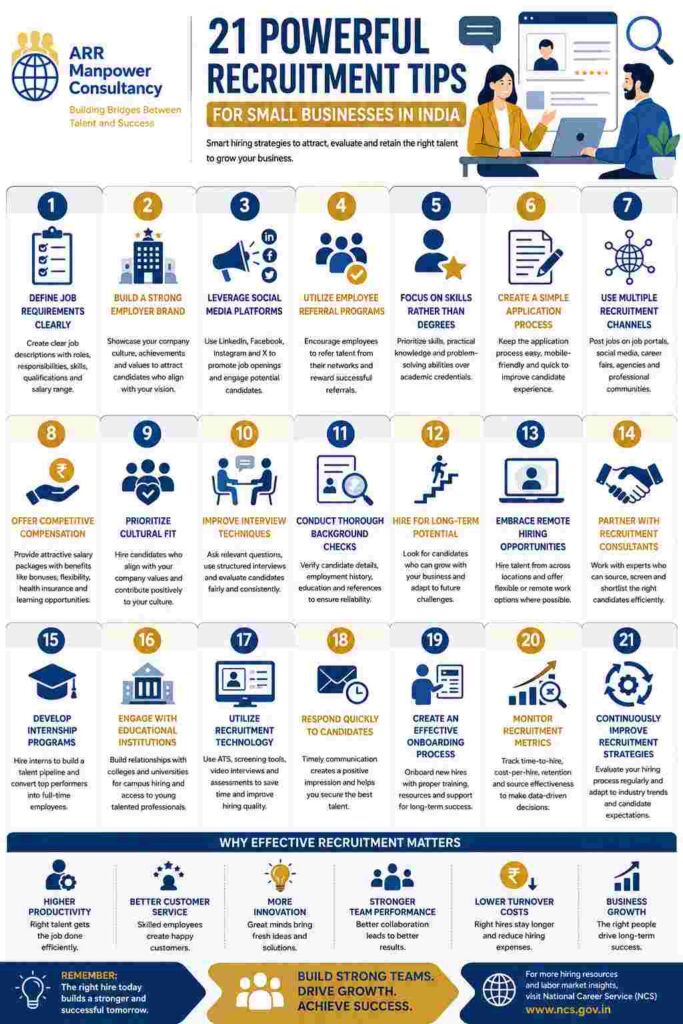
1. Define Job Requirements Clearly
Before starting the hiring process, create a detailed job description.
A well-defined role should include:
- Job title
- Responsibilities
- Required qualifications
- Necessary skills
- Experience expectations
- Salary range
- Work location
Clear job descriptions attract suitable applicants and reduce the number of irrelevant applications.
2. Build a Strong Employer Brand
Many job seekers research companies before applying.
Even if your business is small, you can build credibility by:
- Maintaining a professional website
- Sharing company achievements
- Posting employee success stories
- Highlighting workplace culture
A positive employer image helps attract quality candidates who align with your company values.
3. Leverage Social Media Platforms
Social media has become a powerful hiring tool.
Platforms like:
- X (formerly Twitter)
allow businesses to promote vacancies and engage potential candidates.
Regularly posting job opportunities and company updates can expand your recruitment reach significantly.
4. Utilize Employee Referral Programs
Current employees often know talented professionals within their networks.
Implementing a referral program can:
- Reduce hiring costs
- Improve candidate quality
- Shorten hiring time
- Increase retention rates
Employees generally recommend candidates they trust, making referrals a valuable recruitment channel.
5. Focus on Skills Rather Than Degrees
Many talented individuals possess excellent skills despite lacking prestigious degrees.
Instead of emphasizing educational qualifications alone, evaluate:
- Practical expertise
- Problem-solving abilities
- Technical competency
- Communication skills
Skill-based hiring helps businesses access a larger and more diverse talent pool.
6. Create a Simple Application Process
Lengthy application procedures often discourage candidates.
Keep the process straightforward by:
- Minimizing unnecessary forms
- Allowing mobile applications
- Reducing documentation requirements
- Providing clear instructions
A user-friendly process improves candidate experience and increases application completion rates.
7. Use Multiple Recruitment Channels
Relying on a single hiring platform limits candidate availability.
Diversify sourcing through:
- Job portals
- Social media
- Employee referrals
- Recruitment agencies
- Career fairs
- Professional communities
Multiple channels increase visibility and improve hiring outcomes.
8. Offer Competitive Compensation
Small businesses may not always match large corporate salaries.
However, competitive compensation packages can include:
- Performance bonuses
- Flexible schedules
- Learning opportunities
- Health benefits
- Work-from-home options
Candidates often value overall benefits alongside salary.
9. Prioritize Cultural Fit
Technical skills are important, but cultural compatibility is equally critical.
Employees who align with organizational values typically:
- Collaborate better
- Adapt faster
- Stay longer
- Contribute positively
Assess personality traits and workplace preferences during interviews.
10. Improve Interview Techniques
Structured interviews help make better hiring decisions.
Prepare relevant questions focusing on:
- Experience
- Skills
- Situational responses
- Career goals
Avoid relying solely on first impressions. Consistent evaluation criteria improve fairness and accuracy.
11. Conduct Thorough Background Checks
Verifying candidate information protects your business from potential risks.
Consider checking:
- Employment history
- Educational qualifications
- References
- Professional certifications
Background verification helps ensure authenticity and reliability.
12. Hire for Long-Term Potential
Many employers focus only on immediate needs.
Instead, evaluate whether candidates can:
- Grow with the organization
- Take on future responsibilities
- Learn new skills
- Adapt to changing business requirements
Long-term hires often provide greater value over time.
13. Embrace Remote Hiring Opportunities
Technology enables businesses to hire talent beyond geographical boundaries.
Remote recruitment offers benefits such as:
- Wider talent access
- Reduced office expenses
- Increased flexibility
- Faster hiring
Many skilled professionals now actively seek remote or hybrid opportunities.
14. Partner with Recruitment Consultants
Professional recruitment agencies can simplify hiring.
They assist with:
- Candidate sourcing
- Screening
- Interview coordination
- Talent assessment
For specialized positions, recruitment experts can significantly reduce hiring challenges.
15. Develop Internship Programs
Internships help businesses identify future employees.
Benefits include:
- Access to young talent
- Reduced hiring risk
- Lower recruitment costs
- Early skill development
Many successful employees begin their careers as interns.
16. Engage with Educational Institutions
Colleges and universities are excellent sources of emerging talent.
Building relationships with educational institutions enables:
- Campus recruitment
- Internship opportunities
- Talent pipeline development
- Brand visibility among students
Early engagement helps businesses secure promising candidates before competitors.
17. Utilize Recruitment Technology
Modern hiring tools improve efficiency.
Useful technologies include:
- Applicant Tracking Systems (ATS)
- Resume screening software
- Video interviewing platforms
- Assessment tools
Automation reduces administrative workload and accelerates decision-making.
18. Respond Quickly to Candidates
Delayed communication often results in losing qualified applicants.
Maintain timely interactions by:
- Acknowledging applications promptly
- Scheduling interviews quickly
- Providing updates regularly
- Communicating decisions transparently
Fast responses create a positive candidate experience.
19. Create an Effective Onboarding Process
Recruitment does not end after hiring.
A structured onboarding program helps new employees:
- Understand expectations
- Learn company procedures
- Build relationships
- Become productive faster
Successful onboarding improves retention and employee satisfaction.
20. Monitor Recruitment Metrics
Data-driven hiring helps identify areas for improvement.
Track important metrics such as:
- Time-to-hire
- Cost-per-hire
- Offer acceptance rate
- Employee retention
- Source effectiveness
Regular analysis enables smarter hiring decisions.
21. Continuously Improve Recruitment Strategies
Workforce trends change constantly.
Small businesses should regularly evaluate hiring practices and adapt to:
- Market conditions
- Candidate expectations
- Technological advancements
- Industry requirements
Continuous improvement ensures long-term recruitment success.
Common Recruitment Challenges for Small Businesses in India
While hiring offers growth opportunities, small businesses often face obstacles.
Limited Hiring Budgets
Budget constraints may restrict advertising, technology adoption, and compensation offerings.
Competition from Larger Employers
Established corporations often attract candidates through higher salaries and brand recognition.
Skill Shortages
Certain industries experience shortages of qualified professionals, making recruitment more competitive.
High Employee Turnover
Frequent resignations increase recruitment costs and disrupt business operations.
Lack of Dedicated HR Teams
Many small businesses rely on owners or managers to handle hiring, creating additional workload.
Understanding these challenges helps organizations develop practical solutions.
Best Practices for Successful Hiring
To maximize recruitment effectiveness, businesses should:
- Plan workforce needs in advance
- Maintain talent pipelines
- Build strong candidate relationships
- Use structured evaluations
- Promote workplace flexibility
- Invest in employee development
These practices support sustainable business growth and workforce stability.
Why Recruitment Matters for Business Growth
Hiring decisions directly influence organizational performance.
Effective recruitment contributes to:
Higher Productivity
Skilled employees perform tasks efficiently and deliver better results.
Improved Customer Service
Qualified staff create positive customer experiences and strengthen brand reputation.
Increased Innovation
Talented professionals introduce fresh ideas and problem-solving approaches.
Better Team Performance
Strong hires improve collaboration and workplace morale.
Reduced Turnover Costs
Selecting the right candidates minimizes replacement expenses and training investments.
For small businesses, every hiring decision has a substantial impact on overall success.
Conclusion
Recruiting top talent remains one of the most critical responsibilities for small businesses in India. Although challenges such as limited budgets, talent shortages, and competition from larger organizations can complicate hiring efforts, adopting the right strategies can produce outstanding results. By focusing on clear job descriptions, employer branding, employee referrals, skills-based assessments, technology-driven recruitment, and effective onboarding, businesses can attract and retain high-quality employees.
Implementing these 21 powerful recruitment tips will help small organizations build stronger teams, improve productivity, and achieve sustainable growth. As the Indian job market continues to evolve, businesses that prioritize smart hiring practices will gain a significant competitive advantage. Consistent evaluation and refinement of recruitment strategies ensure that organizations remain prepared to attract the right talent, support business objectives, and create long-term success in an increasingly dynamic employment landscape.
In addition, recruitment should be viewed as a strategic investment rather than merely an operational requirement. Every successful hire contributes to the long-term strength of the organization by bringing new skills, fresh perspectives, and increased efficiency to daily operations. Small businesses that prioritize thoughtful hiring practices are better positioned to adapt to market changes, meet customer expectations, and achieve sustainable expansion.
Building a strong workforce requires consistency and patience. Employers should focus on creating a positive candidate experience throughout the hiring journey, from the initial application to onboarding and ongoing employee development. Candidates who feel respected and valued during the recruitment process are more likely to accept offers and become engaged team members.
It is also important for business owners to stay informed about emerging workforce trends. Flexible work arrangements, digital recruitment tools, skill-based hiring, and employee well-being initiatives are increasingly influencing candidate decisions. Organizations that embrace these trends can improve their ability to attract talented professionals in a competitive market.
Furthermore, retaining employees should be considered an extension of successful recruitment. Providing growth opportunities, recognizing achievements, encouraging collaboration, and fostering a supportive workplace culture can significantly improve employee loyalty and reduce turnover. A stable workforce allows businesses to maintain productivity while minimizing the costs associated with frequent hiring.
Ultimately, effective recruitment is not about filling vacancies quickly; it is about finding individuals who can contribute meaningfully to business goals and grow alongside the organization. By continuously refining hiring strategies and investing in people, small businesses in India can build resilient teams that drive innovation, profitability, and long-term success in an ever-evolving business environment.