Introduction
Recruitment has evolved significantly over the last decade. Organizations are no longer relying solely on spreadsheets, email chains, and paper resumes to manage hiring activities. As businesses compete for top talent in a highly competitive market, the need for efficient recruitment technology has become increasingly important. One of the most valuable tools available to recruiters and hiring managers today is an Applicant Tracking System (ATS).
An Applicant Tracking System is software designed to streamline and automate various stages of the hiring process. From receiving applications and screening candidates to scheduling interviews and maintaining talent databases, an ATS helps organizations manage recruitment activities more effectively.
Companies of all sizes, from startups to multinational corporations, are adopting these systems to improve hiring outcomes. By reducing administrative burdens and enhancing candidate management, an ATS allows recruiters to focus on strategic hiring decisions rather than repetitive manual tasks.
This article explores seven critical benefits of using Applicant Tracking Systems and explains how they contribute to faster, smarter, and more efficient recruitment.
https://arrmanpowerconsultancy.com
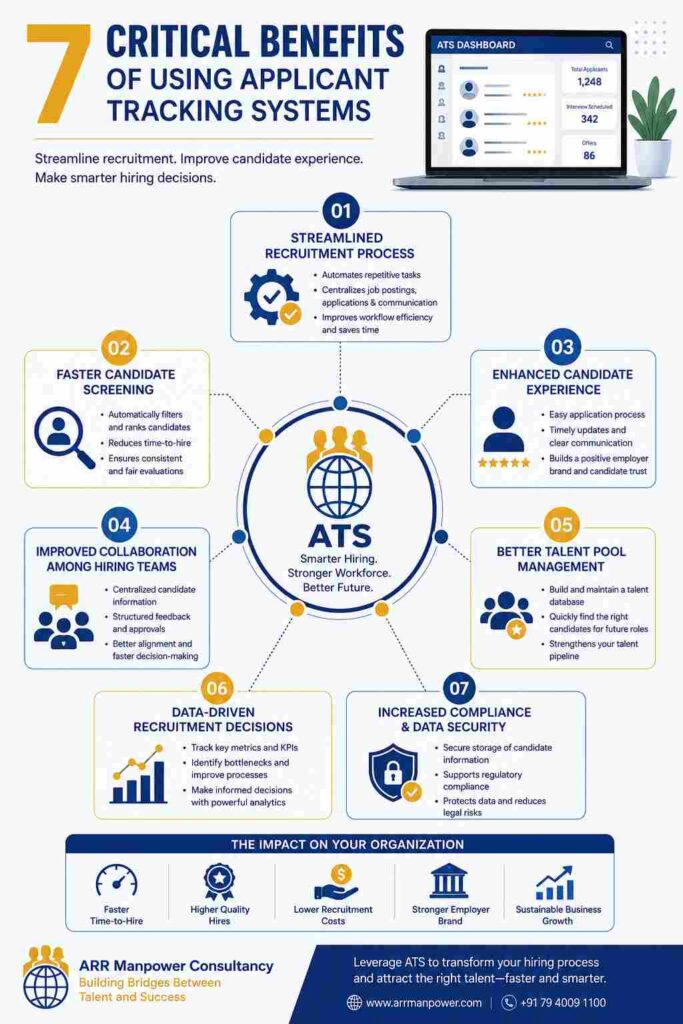
1. Streamlined Recruitment Process
One of the most significant advantages of implementing an ATS is the ability to streamline the entire recruitment workflow.
Traditional hiring often involves manually reviewing resumes, tracking candidate communications, and coordinating interviews through multiple platforms. These activities can consume considerable time and create opportunities for errors.
An ATS centralizes recruitment activities within a single platform. Recruiters can post job openings, receive applications, review resumes, and communicate with candidates from one dashboard. This streamlined approach reduces administrative complexity and improves workflow efficiency.
Automation features further simplify recruitment by handling repetitive tasks such as:
- Resume collection
- Candidate categorization
- Interview scheduling
- Email notifications
- Status updates
As a result, recruiters spend less time on manual processes and more time evaluating qualified candidates.
Organizations that hire frequently particularly benefit from this efficiency, as the system can manage large volumes of applications without compromising organization or accuracy.
2. Faster Candidate Screening
Recruiters often receive hundreds of applications for a single vacancy. Reviewing each resume manually can delay hiring decisions and increase workload significantly.
An ATS helps accelerate candidate screening by automatically sorting and ranking applicants based on predefined criteria.
Recruiters can establish filters such as:
- Education level
- Years of experience
- Technical skills
- Certifications
- Industry background
The system identifies candidates who meet job requirements and presents them for review, reducing the time needed to locate qualified applicants.
This automated screening process offers several advantages:
Reduced Time-to-Hire
Organizations can identify suitable candidates much faster, shortening the recruitment cycle and minimizing vacancies.
Improved Consistency
Every application is evaluated according to the same criteria, helping ensure fairness and consistency throughout the selection process.
Better Resource Allocation
Recruiters can dedicate more attention to interviewing and engaging top candidates instead of spending hours reviewing unsuitable applications.
By enabling faster screening, an ATS helps organizations secure high-quality talent before competitors do.
3. Enhanced Candidate Experience
Candidate experience plays a crucial role in employer branding and recruitment success. Applicants often form opinions about a company based on their hiring journey.
Lengthy response times, poor communication, and confusing application processes can discourage talented professionals from pursuing opportunities.
An ATS helps create a more positive and professional experience for candidates.
Simplified Applications
Many systems offer user-friendly application portals that allow candidates to submit resumes quickly and track their application status.
Automated Communication
Candidates receive timely updates regarding:
- Application receipt
- Interview invitations
- Assessment schedules
- Hiring decisions
These automated communications reduce uncertainty and keep applicants informed throughout the process.
Faster Responses
Because recruiters can process applications more efficiently, candidates receive feedback sooner, improving overall satisfaction.
A positive recruitment experience not only attracts top talent but also strengthens the organization’s reputation in the marketplace.
Even candidates who are not selected may retain a favorable impression when communication remains professional and transparent.
4. Improved Collaboration Among Hiring Teams
Successful hiring often requires collaboration between recruiters, hiring managers, department heads, and executives.
Without a centralized system, communication can become fragmented across emails, spreadsheets, and meetings. This lack of coordination may lead to delays, misunderstandings, and inconsistent candidate evaluations.
An ATS improves collaboration by providing a shared platform where all stakeholders can access candidate information.
Centralized Candidate Profiles
Team members can review:
- Resumes
- Interview notes
- Assessment results
- Feedback forms
- Communication history
Having all information available in one location ensures everyone works with the same data.
Structured Feedback Collection
Hiring managers can submit evaluations directly within the system, making it easier to compare candidate assessments and make informed decisions.
Greater Transparency
Recruitment progress becomes visible to all authorized users, reducing confusion and enhancing accountability.
Improved collaboration leads to faster decisions, stronger candidate evaluations, and more successful hiring outcomes.
5. Better Talent Pool Management
Recruitment is not only about filling current vacancies. Organizations also need to prepare for future hiring needs.
Many qualified applicants may not be selected for a particular position but could be excellent candidates for future opportunities.
An ATS helps organizations build and maintain comprehensive talent databases.
Centralized Candidate Storage
Applicant information remains securely stored within the system, making it easy to retrieve profiles when new openings arise.
Searchable Candidate Database
Recruiters can search the talent pool using various criteria, including:
- Skills
- Experience
- Certifications
- Geographic location
- Industry expertise
This capability enables organizations to quickly identify potential candidates without starting every search from scratch.
Talent Pipeline Development
Recruiters can nurture relationships with promising candidates through ongoing engagement and communication.
Building a strong talent pipeline reduces future recruitment costs and accelerates hiring for critical roles.
Organizations that effectively manage talent pools gain a competitive advantage by maintaining access to qualified professionals whenever hiring needs emerge.
6. Data-Driven Recruitment Decisions
Modern recruitment increasingly relies on analytics and measurable performance indicators.
Without reliable data, organizations may struggle to identify hiring challenges or evaluate recruitment effectiveness.
An ATS provides valuable insights through reporting and analytics features.
Recruitment Metrics Tracking
Organizations can monitor important metrics such as:
- Time-to-fill
- Time-to-hire
- Source effectiveness
- Candidate conversion rates
- Interview-to-offer ratios
These metrics help recruiters understand which strategies produce the best results.
Identification of Bottlenecks
Analytics can reveal stages where delays occur, allowing teams to improve recruitment efficiency.
For example, if interview scheduling consistently slows hiring, organizations can implement process improvements to address the issue.
Better Strategic Planning
Data-driven insights support informed decision-making regarding workforce planning, recruitment budgets, and talent acquisition strategies.
By leveraging analytics, organizations can continuously optimize their hiring processes and improve recruitment outcomes.
7. Increased Compliance and Data Security
Recruitment involves handling large amounts of sensitive candidate information, including personal details, employment history, educational records, and contact information.
Managing this information manually can increase compliance risks and expose organizations to data security concerns.
An ATS helps address these challenges through structured data management and security controls.
Secure Data Storage
Most systems provide secure databases with encryption, user permissions, and controlled access to candidate information.
These features help protect sensitive data from unauthorized access.
Compliance Support
Many ATS platforms include tools that assist organizations in meeting employment regulations and data protection requirements.
Examples include:
- Consent management
- Data retention controls
- Audit trails
- Equal opportunity reporting
Reduced Documentation Errors
Automated recordkeeping minimizes mistakes that may occur when information is stored across multiple spreadsheets or documents.
Maintaining compliance is essential for protecting organizational reputation and avoiding potential legal complications.
A secure recruitment environment also helps build trust among candidates and stakeholders.
How Applicant Tracking Systems Support Business Growth
Beyond improving recruitment efficiency, an ATS contributes directly to broader business objectives.
Effective hiring influences productivity, employee retention, customer satisfaction, and organizational performance. When recruitment processes operate smoothly, companies can fill critical positions faster and reduce disruptions caused by vacancies.
An ATS supports growth by:
- Accelerating workforce expansion
- Improving hiring quality
- Reducing recruitment costs
- Enhancing employer branding
- Supporting workforce planning
As organizations scale, recruitment complexity increases. A robust hiring platform provides the structure needed to manage growth without overwhelming recruitment teams.
Whether hiring ten employees annually or thousands, businesses benefit from greater consistency and operational efficiency.
Choosing the Right Applicant Tracking System
While the advantages are substantial, organizations should carefully evaluate available solutions before implementation.
Important considerations include:
Ease of Use
Recruiters and hiring managers should be able to navigate the system without extensive training.
Integration Capabilities
The platform should integrate with existing HR systems, job boards, communication tools, and onboarding software.
Customization Options
Organizations should be able to tailor workflows, reporting features, and hiring stages to match their specific requirements.
Scalability
The solution should accommodate future growth and changing recruitment needs.
Customer Support
Reliable technical assistance helps ensure successful adoption and long-term performance.
Selecting the right platform maximizes return on investment and ensures the organization gains the full benefits of recruitment automation.
Conclusion
Applicant Tracking Systems have become an essential component of modern talent acquisition strategies. They help organizations streamline recruitment workflows, accelerate candidate screening, improve communication, enhance collaboration, build stronger talent pipelines, generate valuable hiring insights, and maintain compliance with regulatory requirements.
As hiring demands continue to evolve, organizations must adopt technologies that improve efficiency without sacrificing candidate quality or experience. An ATS provides the structure, automation, and visibility needed to achieve these goals while supporting long-term business growth.
Companies that leverage recruitment technology effectively position themselves to attract top talent, make informed hiring decisions, and remain competitive in an increasingly challenging labor market. Investing in an Applicant Tracking System is not simply a technology upgrade—it is a strategic step toward building a stronger, more agile workforce for the future.