Introduction
Recruitment is more than just filling vacant positions. It is a strategic business function that directly influences productivity, innovation, customer satisfaction, and long-term profitability. Every organization depends on skilled employees to achieve business goals, but many companies struggle to attract, evaluate, and retain the right talent. When hiring processes become inefficient, organizations face delays, increased costs, lower employee morale, and missed growth opportunities due to recruitment problems.
Many businesses focus heavily on sales, marketing, and operations while overlooking the importance of building a strong workforce. However, every business success story begins with hiring capable professionals who align with company objectives and culture. Poor recruitment decisions not only affect individual departments but also create ripple effects throughout the organization.
Modern businesses face intense competition for skilled professionals. Candidates now have multiple employment options and expect a smooth hiring experience, competitive compensation, career growth opportunities, and an inclusive workplace. Organizations that fail to adapt to changing hiring expectations often lose top talent to competitors.
Understanding common recruitment problems is the first step toward building a stronger workforce and supporting sustainable business expansion. Below are eight major recruitment problems that frequently hinder business growth and practical ways to overcome them.
https://arrmanpowerconsultancy.com
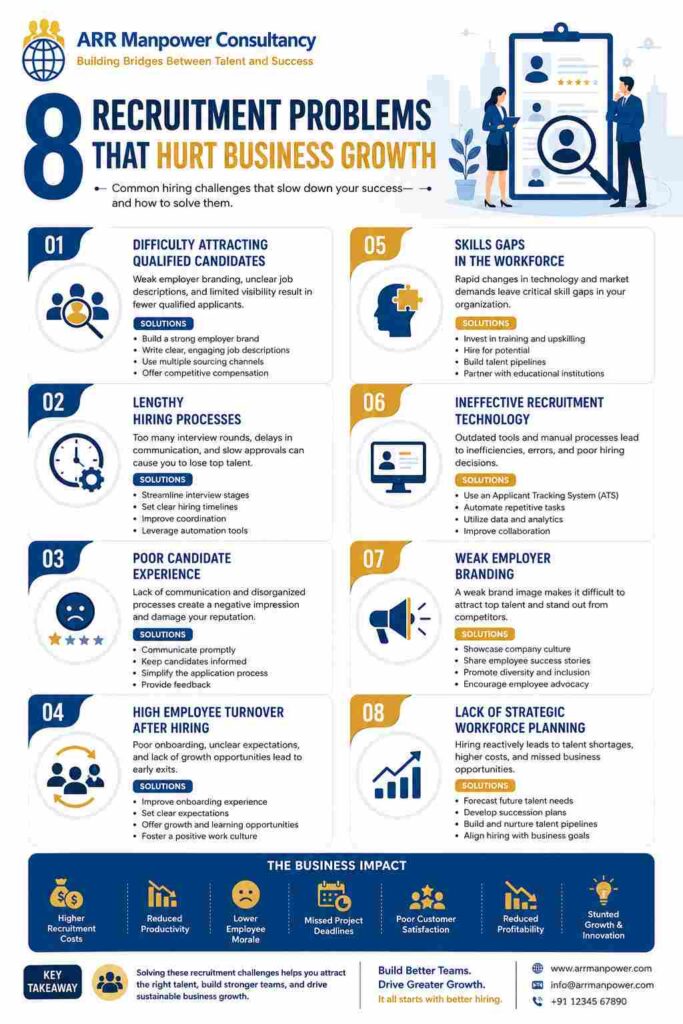
1. Difficulty Attracting Qualified Candidates
One of the biggest recruitment problems organizations face is attracting candidates with the required skills and experience. Many industries experience talent shortages, making it difficult to find professionals who meet job requirements.
Several factors contribute to this issue, including unclear job descriptions, weak employer branding, limited visibility on job platforms, and unrealistic expectations regarding qualifications.
When organizations fail to attract qualified candidates, hiring managers often settle for less suitable applicants. This can reduce productivity, increase training costs, and negatively affect overall performance.
How to solve it
- Create detailed and engaging job descriptions.
- Build a strong employer brand.
- Promote company culture across digital platforms.
- Use multiple recruitment channels.
- Offer competitive salaries and benefits.
- Develop relationships with educational institutions and industry communities.
2. Recruitment Problems Due to Lengthy Hiring Processes
A slow hiring process is another major obstacle to business growth. Many organizations require multiple approval stages, repeated interviews, and delayed decision-making before extending an offer.
Top candidates rarely remain available for long. Skilled professionals often receive several offers within days, and delays can result in losing exceptional talent.
Lengthy recruitment also impacts existing employees who must handle additional workloads while positions remain vacant.
Common causes include
- Too many interview rounds
- Delayed communication
- Poor coordination between HR and hiring managers
- Manual recruitment processes
- Slow approval systems
Solutions
Businesses should streamline interview stages, automate scheduling, define clear hiring timelines, and maintain regular communication with applicants throughout the recruitment process.
3. Poor Candidate Experience
Candidates evaluate employers just as employers evaluate candidates. A negative hiring experience can damage an organization’s reputation and discourage future applications.
Common complaints include:
- Lack of communication
- Long waiting periods
- Confusing application procedures
- Disorganized interviews
- No feedback after interviews
Even rejected candidates can become future customers, business partners, or applicants. A poor experience may influence public reviews and employer ratings.
Improving candidate experience
Organizations should:
- Respond promptly to applications.
- Keep candidates informed.
- Respect interview schedules.
- Simplify application forms.
- Provide constructive feedback whenever possible.
Positive candidate experiences strengthen employer reputation and improve future hiring success.
4. High Employee Turnover After Hiring
Recruitment does not end once an offer is accepted. Many organizations experience high turnover because new employees leave within the first year.
Frequent turnover creates recurring hiring expenses, reduces team stability, and interrupts business operations.
Reasons employees leave include:
- Poor onboarding
- Unrealistic job expectations
- Limited career development
- Weak leadership
- Poor workplace culture
- Inadequate compensation
How businesses can reduce turnover
Effective onboarding programs, mentorship initiatives, continuous learning opportunities, and regular employee engagement surveys help improve retention and protect recruitment investments.
5. Skills Gaps in the Workforce
Rapid technological advancement has created significant skills gaps across industries. Businesses often struggle to find candidates who possess both technical expertise and soft skills.
Emerging technologies, automation, artificial intelligence, cloud computing, and digital transformation have changed workforce requirements faster than educational systems can adapt.
Hiring employees without essential competencies can reduce productivity and slow innovation.
Addressing skills shortages
Organizations should:
- Invest in employee training.
- Build internal talent pipelines.
- Hire based on potential rather than only experience.
- Partner with educational institutions.
- Offer certification and development programs.
Continuous learning helps businesses remain competitive while reducing dependency on external hiring.
6. Ineffective Recruitment Technology
Many companies still rely on outdated hiring methods such as spreadsheets, manual resume screening, and disconnected communication systems.
These approaches increase administrative work and make it difficult to identify qualified applicants efficiently.
Without modern recruitment technology, organizations may experience:
- Missed applications
- Poor candidate tracking
- Slow communication
- Duplicate work
- Limited hiring analytics
Modern recruitment solutions
Applicant Tracking Systems (ATS), AI-assisted resume screening, interview scheduling tools, and recruitment analytics improve hiring efficiency while reducing administrative burden.
Technology also enables HR teams to focus on strategic decision-making rather than repetitive administrative tasks.
7. Weak Employer Branding
Employer branding significantly influences hiring success. Candidates increasingly research organizations before applying for positions.
A weak employer brand may result from:
- Limited online presence
- Negative employee reviews
- Poor social media engagement
- Lack of career development stories
- Inconsistent company messaging
When organizations fail to showcase their workplace culture, talented professionals may choose competitors with stronger reputations.
Building a strong employer brand
Businesses should:
- Share employee success stories.
- Highlight workplace culture.
- Promote diversity and inclusion.
- Showcase career growth opportunities.
- Encourage employee advocacy.
- Maintain active communication across professional networks.
A positive employer reputation attracts better candidates while lowering long-term hiring costs.
8. Lack of Strategic Workforce Planning
Many businesses recruit only when vacancies occur instead of planning future workforce requirements.
Reactive hiring often leads to rushed recruitment decisions, increased costs, and difficulty filling critical positions.
Strategic workforce planning helps organizations anticipate future hiring needs based on:
- Business expansion
- Market trends
- Retirement projections
- New projects
- Technology adoption
- Seasonal workforce demands
Best practices
Organizations should:
- Analyze workforce data regularly.
- Forecast future skill requirements.
- Develop succession plans.
- Build talent pipelines.
- Maintain relationships with potential candidates before vacancies arise.
Proactive workforce planning supports long-term business growth while reducing recruitment pressure.
The Business Impact of Recruitment Challenges
Recruitment problems affect far more than the HR department. Poor hiring practices influence every aspect of organizational performance.
Some of the most significant business consequences include:
- Increased recruitment costs
- Reduced employee productivity
- Lower customer satisfaction
- Missed project deadlines
- Higher employee burnout
- Declining innovation
- Poor workplace morale
- Reduced profitability
Every vacant position represents lost productivity and additional pressure on existing employees. Over time, repeated hiring challenges can weaken an organization’s competitive advantage.
Best Practices for Building a Strong Recruitment Strategy
Successful organizations treat recruitment as an ongoing strategic investment rather than a reactive administrative task.
Key best practices include:
- Create a clear employer value proposition.
- Write accurate job descriptions.
- Maintain a positive candidate experience.
- Invest in recruitment technology.
- Build internal talent development programs.
- Encourage employee referrals.
- Monitor hiring metrics.
- Strengthen employer branding.
- Improve onboarding processes.
- Align hiring strategies with business objectives.
Businesses that continuously refine their hiring strategies are better positioned to attract skilled professionals and support sustainable growth.
Conclusion
Recruitment remains one of the most influential factors in determining long-term business success. While organizations often invest heavily in technology, marketing, and operational improvements, sustainable growth ultimately depends on hiring and retaining talented people. Every recruitment challenge—from attracting qualified candidates and reducing lengthy hiring cycles to improving employer branding and workforce planning—has a direct impact on organizational performance, employee engagement, and customer satisfaction.
Ignoring these challenges can result in increased hiring costs, reduced productivity, delayed projects, higher turnover, and missed business opportunities. On the other hand, companies that adopt strategic hiring practices create stronger teams, improve operational efficiency, and gain a competitive advantage in their industry.
An effective recruitment strategy is built on clear planning, efficient processes, positive candidate experiences, modern hiring technology, and continuous workforce development. Organizations should regularly evaluate their hiring methods, measure recruitment performance, and adapt to changing market demands to remain attractive to skilled professionals.
Business growth is driven by people, and every successful employee begins with a successful hiring decision. By identifying and resolving these eight recruitment problems, organizations can build resilient teams, strengthen their employer reputation, reduce recruitment costs, and position themselves for long-term success in an increasingly competitive talent market.
Investing in better hiring practices today creates a stronger workforce that supports innovation, productivity, and sustainable business growth for years to come. Organizations that prioritize continuous improvement in their hiring processes are better equipped to respond to changing workforce demands and market conditions.
Regularly reviewing recruitment metrics, gathering candidate feedback, and investing in employee development create a cycle of ongoing improvement. Ultimately, businesses that view recruitment as a strategic investment rather than a routine task will be more successful in attracting exceptional talent, improving retention, fostering innovation, and achieving consistent, sustainable growth in an increasingly competitive global marketplace.
Strong leadership commitment, collaborative hiring practices, and a people-first approach further strengthen recruitment outcomes, enabling organizations to build resilient teams that drive innovation, operational excellence, customer satisfaction, and long-term business success.