Introduction
The construction industry is undergoing one of the biggest transformations in its history. Rapid technological advancements, changing workforce expectations, sustainability initiatives, and increasing infrastructure investments are reshaping how companies hire and retain talent. As projects become more complex and deadlines grow tighter, organizations must rethink their hiring strategies to secure skilled professionals capable of delivering quality work.
Recruitment in construction is no longer limited to filling vacancies when they arise. Instead, forward-thinking organizations are building long-term talent pipelines, investing in employee development, and adopting digital recruitment methods to stay ahead of the competition. Companies that understand emerging hiring patterns can reduce recruitment costs, improve employee retention, and strengthen project performance.
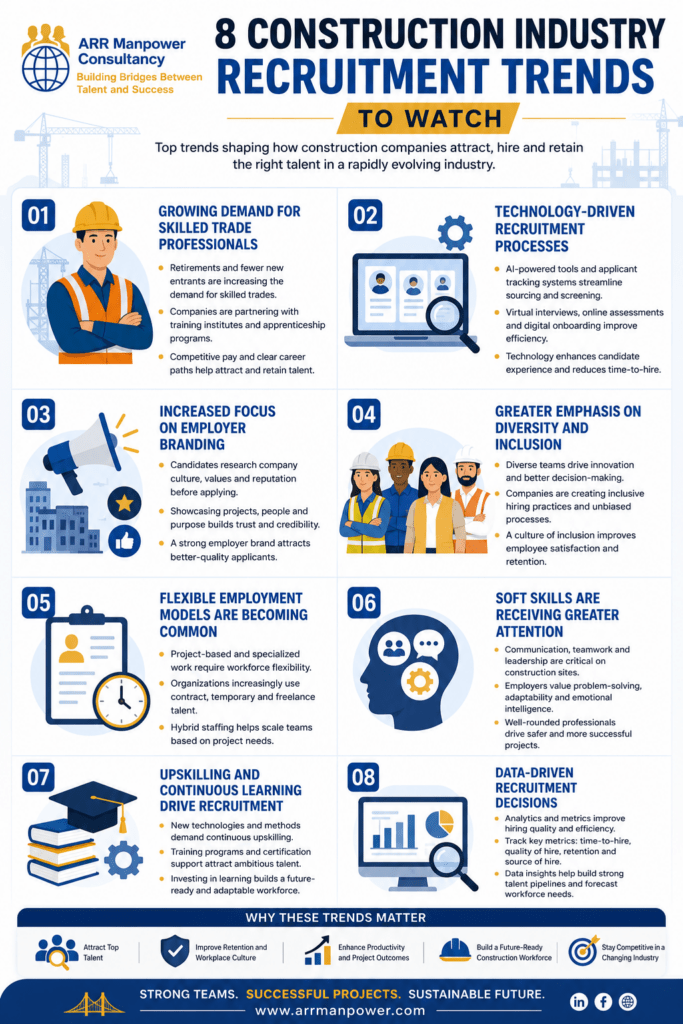
Below are eight construction industry recruitment trends that every employer should watch and incorporate into their hiring strategy.
https://arrmanpowerconsultancy.com
1. Growing Demand for Skilled Trade Professionals in Construction Industry
The demand for qualified tradespeople continues to rise as experienced workers retire and fewer young professionals enter skilled trades. Electricians, plumbers, carpenters, welders, heavy equipment operators, and site supervisors remain among the most sought-after professionals across the industry.
Construction companies are finding it increasingly difficult to fill these positions using traditional recruitment methods. As a result, organizations are partnering with vocational schools, apprenticeship programs, and technical institutes to build a sustainable workforce.
Employers are also improving compensation packages, offering structured career progression, and providing certification support to attract qualified candidates. Companies that invest in workforce development are more likely to secure reliable talent before competitors.
2. Technology-Driven Recruitment Processes
Digital transformation has significantly changed recruitment across the construction sector. Manual hiring methods are gradually being replaced by automated recruitment platforms that simplify candidate sourcing and screening.
Artificial intelligence-powered applicant tracking systems help recruiters identify qualified candidates faster by analyzing resumes based on predefined job requirements. Automated interview scheduling, online assessments, and digital onboarding also reduce administrative workload.
Construction firms are increasingly using virtual interviews, mobile recruitment applications, and cloud-based hiring systems to connect with candidates from different locations. These technologies reduce hiring timelines while improving the overall candidate experience.
Companies embracing digital recruitment tools can respond quickly to labor shortages and maintain a competitive advantage.
3. Increased Focus on Employer Branding
Today’s job seekers evaluate employers before applying for open positions. They research company culture, employee benefits, workplace safety, career development opportunities, and online reviews.
Construction businesses are investing more resources into employer branding to attract top talent. They showcase completed projects, employee success stories, safety achievements, and community initiatives across websites and social media platforms.
A strong employer brand builds trust among candidates and differentiates companies in a competitive hiring market. Organizations that communicate their values and workplace culture effectively often receive higher-quality applications and experience improved employee retention.
Transparency throughout the recruitment process further strengthens employer reputation and candidate confidence.
4. Greater Emphasis on Diversity and Inclusion
The construction workforce has traditionally been dominated by a limited demographic. However, companies increasingly recognize the value of creating diverse teams that bring different perspectives, experiences, and problem-solving abilities.
Organizations are expanding recruitment efforts to attract women, military veterans, individuals with disabilities, and professionals from diverse cultural backgrounds. Inclusive hiring practices create stronger workplace collaboration while addressing labor shortages.
Many employers are reviewing job descriptions to eliminate biased language, implementing structured interview processes, and providing diversity training for hiring managers.
Inclusive workplaces also improve innovation, employee satisfaction, and long-term organizational performance.
5. Flexible Employment Models Are Becoming Common
Construction companies are moving beyond traditional full-time hiring models. Project-based work, seasonal demands, and specialized construction activities require greater workforce flexibility.
Organizations increasingly rely on contract professionals, temporary workers, freelance specialists, and project consultants to address changing labor requirements.
Hybrid staffing models allow businesses to maintain a stable core workforce while scaling teams according to project demands. Recruitment agencies specializing in construction staffing play an important role by providing access to pre-qualified professionals when immediate hiring needs arise.
Flexible hiring strategies help companies reduce labor shortages without significantly increasing long-term employment costs.
6. Soft Skills Are Receiving Greater Attention
Technical expertise remains essential, but employers now place equal importance on interpersonal abilities.
Construction professionals frequently collaborate with architects, engineers, subcontractors, suppliers, and clients. Strong communication, leadership, adaptability, and teamwork directly influence project success.
Recruiters increasingly evaluate candidates based on their ability to solve problems, manage conflicts, and adapt to changing project conditions.
Site supervisors and project managers are particularly expected to demonstrate emotional intelligence alongside technical competence. Organizations that hire professionals with balanced technical and interpersonal skills often achieve better productivity and stronger workplace relationships.
7. Upskilling and Continuous Learning Drive Recruitment
The rapid adoption of new construction technologies has created a growing need for continuous learning.
Modern projects increasingly involve Building Information Modeling (BIM), drones, robotics, modular construction, prefabrication, and digital project management platforms. Employers seek professionals willing to develop new technical capabilities throughout their careers.
Many companies now promote training programs during recruitment to attract ambitious candidates. Internal learning platforms, certification sponsorships, safety training, and leadership development programs make employers more attractive.
Candidates are increasingly choosing organizations that invest in professional growth rather than offering only competitive salaries.
Businesses that prioritize learning create adaptable workforces capable of meeting future industry demands.
8. Data-Driven Recruitment Decisions
Construction recruitment is becoming more analytical than ever before.
Instead of relying solely on recruiter intuition, organizations now monitor hiring metrics to improve recruitment performance. Common indicators include:
- Time-to-hire
- Cost-per-hire
- Candidate quality
- Employee retention rates
- Source of hire
- Offer acceptance rates
These insights help recruitment teams identify the most effective sourcing channels and optimize hiring strategies.
Predictive workforce planning also enables companies to anticipate labor requirements before major projects begin. Rather than reacting to shortages, employers proactively build talent pipelines that reduce project delays.
Data-driven recruitment supports better hiring decisions while improving workforce planning and operational efficiency.
How Construction Companies Can Prepare for Future Recruitment
The construction labor market will continue evolving as technology, sustainability, and workforce expectations change. Employers should adopt a proactive hiring approach instead of waiting until positions become vacant.
Several best practices can strengthen recruitment efforts:
- Build relationships with educational institutions.
- Invest in employee referral programs.
- Improve employer branding.
- Offer competitive compensation and benefits.
- Prioritize workplace safety.
- Provide career advancement opportunities.
- Use recruitment technology effectively.
- Measure hiring performance through recruitment analytics.
Organizations that continuously improve these areas are better positioned to attract skilled professionals and reduce long-term hiring challenges.
The Role of Recruitment Partners
Specialized recruitment firms have become valuable partners for construction businesses experiencing talent shortages.
Recruitment experts maintain extensive candidate networks and understand industry-specific hiring requirements. They can identify qualified professionals more efficiently than general hiring methods while reducing recruitment timelines.
Recruitment partners also assist with executive search, contract staffing, permanent placement, salary benchmarking, and workforce planning. Their industry knowledge helps employers secure professionals with the right technical qualifications and cultural fit.
Working with experienced recruitment specialists allows construction companies to focus on project delivery while maintaining access to skilled talent.
Conclusion
Construction recruitment is evolving rapidly as businesses adapt to changing workforce dynamics, digital innovation, and increasing project complexity. Organizations that embrace modern hiring practices will be better equipped to secure skilled professionals in an increasingly competitive labor market.
From technology-enabled recruitment and data-driven decision-making to diversity initiatives and continuous employee development, these trends highlight the future direction of construction hiring. Companies that remain flexible, invest in their employer brand, and prioritize workforce development will build stronger teams capable of delivering successful projects.
Keeping pace with these eight construction industry recruitment trends is not simply about filling open positions. It is about creating a resilient workforce that supports sustainable growth, improves project outcomes, and strengthens long-term business success.
As the industry continues to expand through infrastructure development, commercial projects, residential construction, and green building initiatives, competition for experienced professionals will only become more intense.
Businesses that delay modernizing their hiring practices risk losing qualified candidates to organizations that offer better career opportunities, advanced technologies, and supportive workplace cultures. Recruitment is no longer a standalone HR function; it has become a strategic business priority that directly influences productivity, profitability, and client satisfaction.
Employers should also recognize that successful recruitment extends beyond the initial hiring process. Retaining skilled employees through competitive compensation, ongoing training, mentorship programs, recognition initiatives, and clear career advancement opportunities is equally important.
A stable and engaged workforce reduces turnover costs, preserves institutional knowledge, and enhances collaboration across construction projects. Companies that foster a culture of continuous improvement and employee well-being are more likely to build loyal teams capable of delivering consistent results.
Furthermore, staying informed about emerging recruitment trends enables organizations to anticipate future workforce challenges instead of reacting to them. Whether adopting artificial intelligence for candidate sourcing, strengthening diversity and inclusion efforts, expanding apprenticeship programs, or leveraging workforce analytics, proactive businesses can create sustainable talent pipelines that support long-term growth.
By combining innovative recruitment strategies with a people-first approach, construction companies can position themselves as employers of choice in a highly competitive market. Ultimately, organizations that invest in attracting, developing, and retaining top talent today will be better prepared to navigate industry changes, meet evolving client expectations, and achieve lasting success in the years ahead.