Introduction
In today’s competitive business environment, organizations face increasing challenges in attracting, hiring, and retaining top talent. Rapid technological advancements, changing workforce expectations, and growing skills shortages have transformed recruitment into a complex and strategic function. Companies can no longer rely solely on traditional hiring methods to meet their workforce demands. Instead, many organizations are turning to recruitment partnerships to gain a competitive advantage and build stronger teams.
A recruitment partnership goes beyond the conventional relationship between an employer and a staffing provider. It is a collaborative approach in which recruitment experts work closely with businesses to understand their goals, culture, workforce requirements, and long-term growth plans. Through this partnership, organizations gain access to specialized expertise, extensive talent networks, and strategic hiring solutions that support business success.
As companies strive to remain agile and competitive, recruitment partnerships have become a valuable tool for securing the right talent at the right time. Whether an organization is expanding into new markets, launching innovative projects, or addressing workforce shortages, a trusted recruitment partner can play a critical role in achieving hiring objectives.
This article explores seven key reasons why recruitment partnerships drive success and how businesses can benefit from adopting a collaborative hiring approach.
https://arrmanpowerconsultancy.com
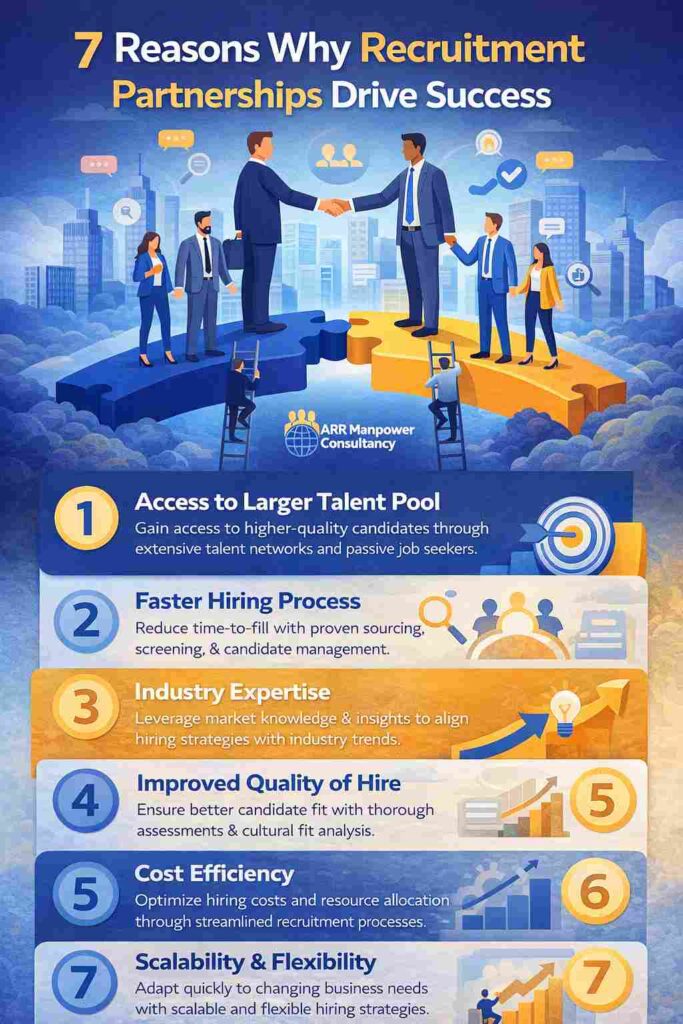
1. Access to a Larger and Higher-Quality Talent Pool
One of the most significant advantages of a recruitment partnership is access to a broader network of qualified candidates. Many of the most talented professionals are not actively searching for new opportunities. These passive candidates may be open to the right role but are unlikely to respond to traditional job advertisements.
Recruitment specialists maintain extensive talent databases and professional networks built over years of industry experience. They actively engage with professionals across various sectors and stay connected with individuals who possess specialized skills and expertise.
By leveraging these networks, organizations can reach candidates who may otherwise remain inaccessible. This expanded access significantly improves the quality of applicants and increases the likelihood of finding individuals who align with both technical requirements and organizational culture.
Furthermore, recruitment partners continuously update their talent pipelines, ensuring that businesses have access to skilled professionals whenever hiring needs arise. This proactive approach helps organizations stay ahead in highly competitive labor markets.
2. Faster Hiring Processes and Reduced Time-to-Fill
Vacant positions can have a considerable impact on productivity, employee morale, and business performance. Extended hiring cycles often lead to delayed projects, increased workloads for existing staff, and lost revenue opportunities.
A recruitment partnership helps organizations streamline the hiring process by utilizing proven sourcing methods, advanced screening techniques, and efficient candidate management systems. Recruitment professionals are experienced in identifying suitable candidates quickly and accurately, reducing the time required to fill open positions.
Because recruitment specialists already maintain active talent pools, they can present qualified candidates much faster than internal hiring teams starting from scratch. Their expertise in conducting preliminary assessments also ensures that only the most suitable candidates move forward in the process.
As a result, businesses can minimize hiring delays, maintain operational continuity, and secure top talent before competitors have the opportunity to do so.
3. Industry Expertise and Market Knowledge
Recruitment is not simply about matching resumes with job descriptions. Successful hiring requires a deep understanding of industry trends, labor market conditions, salary benchmarks, and emerging skill requirements.
Recruitment partners bring valuable market intelligence that helps organizations make informed hiring decisions. Their specialized knowledge enables them to identify talent trends, understand candidate expectations, and provide strategic recommendations tailored to specific industries.
For example, sectors such as information technology, healthcare, engineering, finance, and manufacturing often face unique workforce challenges. Recruitment specialists who focus on these industries possess insights into current hiring demands, skill shortages, and compensation standards.
This expertise allows organizations to create realistic hiring strategies, develop competitive offers, and position themselves effectively in the talent market. By understanding industry dynamics, businesses can attract stronger candidates and avoid costly hiring mistakes.
4. Improved Quality of Hire
Hiring the wrong candidate can be expensive and disruptive. Poor hiring decisions often result in reduced productivity, increased turnover, training costs, and potential damage to team dynamics.
A strong recruitment partnership focuses on delivering candidates who are not only technically qualified but also aligned with the organization’s values, culture, and long-term objectives. Recruitment professionals use comprehensive assessment methods to evaluate candidates thoroughly before presenting them to employers.
These evaluations may include:
- Skills assessments
- Behavioral interviews
- Reference checks
- Cultural fit analysis
- Career motivation reviews
By conducting detailed screening processes, recruitment partners reduce the likelihood of mismatches and improve hiring outcomes.
Quality hires contribute positively to organizational performance, integrate more effectively into teams, and remain engaged for longer periods. This leads to higher retention rates, improved productivity, and stronger business results over time.
5. Cost Efficiency and Better Resource Allocation
Many organizations assume that handling recruitment internally is the most cost-effective approach. However, internal hiring efforts often involve significant expenses related to job advertising, sourcing tools, screening activities, interview coordination, onboarding, and employee turnover.
A recruitment partnership can help businesses optimize these costs by providing efficient hiring solutions that reduce administrative burdens and minimize recruitment-related risks.
Recruitment specialists invest in advanced sourcing technologies, talent databases, assessment tools, and industry research. Businesses gain access to these resources without incurring the full cost of purchasing and maintaining them independently.
Additionally, reducing time-to-hire and improving candidate quality lowers the financial impact of vacancies and employee turnover. Organizations can focus their internal resources on core business activities while recruitment experts manage talent acquisition responsibilities.
This strategic allocation of resources enables companies to achieve better hiring outcomes while maintaining operational efficiency.
6. Scalability and Workforce Flexibility
Business needs can change rapidly due to market expansion, seasonal demand, project-based work, mergers, or economic shifts. Organizations often require the flexibility to scale their workforce up or down in response to changing conditions.
A recruitment partnership provides the agility needed to adapt to these fluctuations effectively. Recruitment professionals can quickly source candidates for permanent, temporary, contract, or project-based roles depending on organizational requirements.
During periods of rapid growth, recruitment partners help businesses build teams efficiently without overwhelming internal HR departments. Similarly, organizations facing temporary staffing demands can access qualified professionals for short-term assignments without long-term commitments.
This flexibility is particularly valuable in industries where workforce requirements can change unexpectedly. Recruitment partners enable businesses to respond to market opportunities and challenges with confidence while maintaining productivity and service quality.
By supporting scalable hiring strategies, recruitment partnerships contribute to sustainable organizational growth and resilience.
7. Strategic Long-Term Talent Planning
Successful organizations recognize that talent acquisition is not just a short-term activity. It is a critical component of long-term business strategy. Companies that plan proactively for future workforce needs are better positioned to achieve growth objectives and maintain competitive advantages.
A recruitment partnership supports strategic workforce planning by helping organizations anticipate future hiring requirements, identify potential skill gaps, and develop talent acquisition roadmaps.
Recruitment specialists work closely with business leaders to understand organizational goals and forecast future workforce demands. This collaborative approach enables businesses to prepare for expansion, leadership succession, technological transformation, and evolving market conditions.
Long-term talent planning offers several benefits:
- Reduced recruitment emergencies
- Stronger succession planning
- Enhanced workforce stability
- Improved employee retention
- Greater organizational agility
Rather than reacting to staffing shortages, organizations can build proactive hiring strategies that support sustainable growth and business continuity.
How Recruitment Partnerships Strengthen Employer Branding
Beyond direct hiring benefits, recruitment partnerships also play an important role in strengthening employer branding. In today’s digital age, candidates often evaluate an organization’s reputation before applying for positions.
Recruitment specialists act as ambassadors for the companies they represent. They communicate organizational values, culture, career opportunities, and workplace benefits to prospective candidates.
A positive candidate experience during the recruitment process enhances the company’s reputation in the talent market. Candidates who receive professional communication, timely feedback, and transparent information are more likely to view the organization favorably.
Strong employer branding attracts higher-quality applicants, improves candidate engagement, and supports long-term talent acquisition success.
Choosing the Right Recruitment Partner
While the advantages are substantial, selecting the right recruitment partner is essential. Organizations should evaluate potential partners based on several factors:
Industry Experience
Choose a recruitment provider with expertise in your specific sector and a proven understanding of industry hiring challenges.
Talent Network Strength
Assess the quality and breadth of the partner’s candidate database and professional connections.
Recruitment Methodology
Review sourcing strategies, screening processes, and assessment techniques to ensure alignment with organizational needs.
Communication and Collaboration
Effective partnerships require transparency, responsiveness, and ongoing communication.
Performance Metrics
Consider measurable outcomes such as placement success rates, retention statistics, and client satisfaction levels.
A well-chosen recruitment partner becomes an extension of the organization’s talent acquisition function and contributes significantly to business growth.
Conclusion
The ability to attract and retain exceptional talent has become a defining factor in organizational success. As hiring challenges continue to evolve, businesses need more than traditional recruitment methods to remain competitive. Recruitment partnerships provide access to wider talent pools, faster hiring processes, specialized expertise, improved candidate quality, cost efficiencies, workforce flexibility, and long-term strategic planning.
By working collaboratively with experienced recruitment professionals, organizations can build stronger teams, reduce hiring risks, and align talent acquisition with business objectives. These partnerships transform recruitment from a transactional activity into a strategic advantage that supports growth, innovation, and long-term success.
As the competition for skilled professionals intensifies, companies that invest in strong recruitment partnerships will be better equipped to secure the talent needed to thrive in an increasingly dynamic and competitive marketplace.