Introduction
In today’s competitive business environment, finding the right talent has become one of the biggest challenges organizations face. Companies across industries are under constant pressure to hire skilled professionals quickly while maintaining quality and controlling costs. The recruitment process can be time-consuming, resource-intensive, and often unpredictable. This is where staffing experts play a crucial role.
Staffing professionals specialize in identifying, evaluating, and placing qualified candidates in positions that match organizational requirements. Their expertise, industry knowledge, and extensive networks help businesses overcome hiring challenges while ensuring access to high-quality talent. Whether a company is seeking permanent employees, temporary workers, contract professionals, or executive-level leaders, staffing specialists provide valuable support throughout the recruitment journey.
Many organizations are increasingly partnering with staffing firms to streamline their hiring processes and improve workforce management. From reducing hiring timelines to improving candidate quality, the benefits are substantial. Understanding these advantages can help businesses make informed decisions about their recruitment strategies.
Below are eleven powerful reasons why organizations choose staffing experts to meet their workforce needs.
https://arrmanpowerconsultancy.com
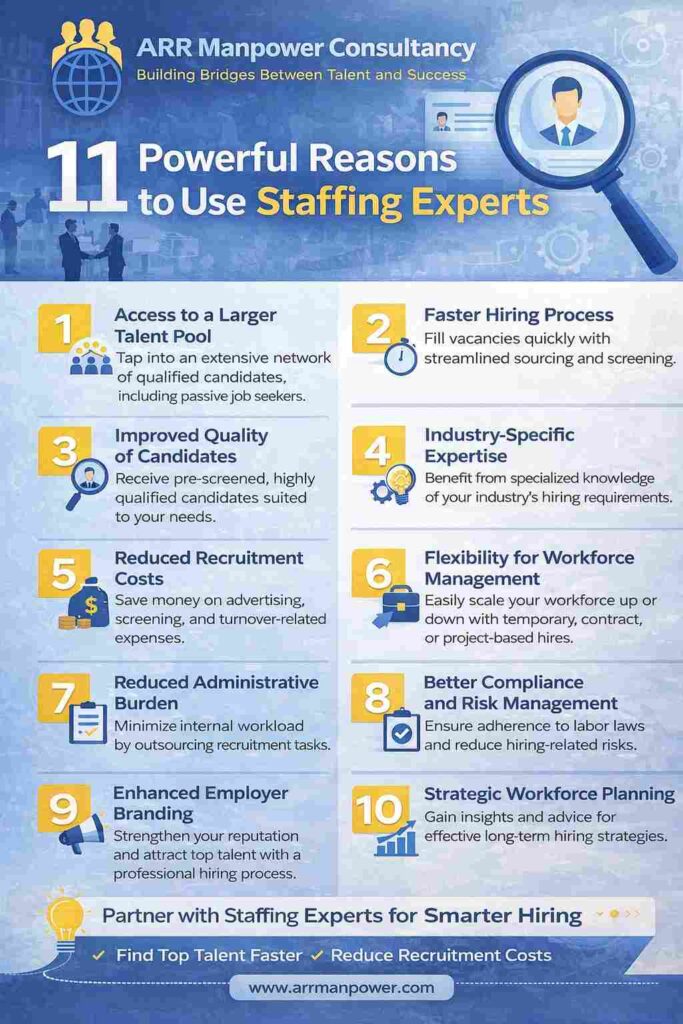
1. Access to a Larger Talent Pool
One of the most significant advantages of working with staffing experts is access to a vast network of qualified candidates. Recruitment specialists continuously build relationships with professionals across various industries and skill levels.
Many highly skilled candidates are not actively searching for jobs through public job boards. Staffing professionals maintain databases of passive candidates who may be open to new opportunities when approached with the right role.
This expanded reach allows employers to connect with individuals who would otherwise remain inaccessible through traditional recruitment methods. As a result, organizations gain access to a broader selection of qualified professionals, increasing the likelihood of finding the perfect fit.
2. Faster Hiring Process
Vacant positions can negatively impact productivity, employee morale, and overall business performance. Every day a role remains unfilled may result in missed opportunities and increased workloads for existing staff.
Staffing experts help accelerate the recruitment process through established sourcing strategies, candidate databases, and efficient screening procedures. Because they already have connections with potential candidates, they can quickly identify suitable individuals for open positions.
By handling candidate sourcing, resume reviews, interviews, and preliminary assessments, staffing specialists significantly reduce the time required to fill vacancies. This enables businesses to maintain operational continuity and achieve hiring goals more efficiently.
3. Improved Quality of Candidates
Hiring mistakes can be costly. Selecting the wrong employee often leads to reduced productivity, training expenses, and additional recruitment efforts when replacement becomes necessary.
Staffing experts use proven evaluation methods to assess candidates beyond their resumes. They analyze technical skills, experience, cultural compatibility, communication abilities, and long-term potential.
Their specialized screening processes help ensure that only qualified individuals move forward in the hiring pipeline. This thorough evaluation increases the chances of successful placements and contributes to stronger organizational performance.
4. Industry-Specific Expertise
Different industries require unique skills, certifications, and experience levels. Staffing professionals often specialize in specific sectors such as healthcare, information technology, manufacturing, finance, engineering, or administration.
Their deep understanding of industry trends and hiring requirements enables them to identify candidates who possess the necessary qualifications. They stay informed about evolving workforce demands, salary expectations, and emerging skill sets.
This expertise allows organizations to benefit from informed recruitment strategies that align with industry standards and business objectives.
5. Reduced Recruitment Costs
Many organizations assume that handling recruitment internally is more cost-effective. However, hidden expenses associated with advertising, candidate screening, interviewing, onboarding, and turnover can quickly accumulate.
Staffing experts help reduce these costs by streamlining the hiring process and minimizing the risk of poor hiring decisions. Their efficient sourcing methods eliminate the need for extensive advertising campaigns and prolonged recruitment efforts.
Additionally, finding the right candidate the first time reduces turnover-related expenses and contributes to long-term workforce stability.
6. Flexibility for Workforce Management
Business needs can fluctuate due to seasonal demand, project requirements, market conditions, or organizational growth. Maintaining workforce flexibility is essential for adapting to changing circumstances.
Staffing experts provide access to temporary, contract, project-based, and permanent talent solutions. Organizations can scale their workforce up or down based on operational needs without committing to long-term employment arrangements.
This flexibility helps businesses remain agile while controlling labor costs and responding effectively to market demands.
7. Reduced Administrative Burden
Recruitment involves numerous administrative tasks, including job postings, resume screening, interview coordination, reference checks, background verification, and onboarding documentation.
Managing these responsibilities internally can consume valuable time and resources. Staffing experts handle many of these administrative functions, allowing internal teams to focus on strategic business priorities.
By reducing the workload associated with recruitment, organizations can improve efficiency and allocate resources more effectively.
8. Better Compliance and Risk Management
Employment laws and regulations continue to evolve, making compliance a critical concern for employers. Failure to follow legal requirements can result in penalties, lawsuits, and reputational damage.
Staffing professionals stay updated on employment legislation, labor regulations, and industry-specific compliance standards. They help ensure that recruitment practices align with applicable legal requirements.
For temporary and contract placements, staffing firms often manage payroll administration, worker classification, and employment documentation, reducing risk for client organizations.
This support provides peace of mind and helps businesses maintain compliance throughout the hiring process.
9. Enhanced Employer Branding
A company’s reputation as an employer significantly influences its ability to attract top talent. Candidates often evaluate organizations based on their hiring experiences and interactions during recruitment.
Staffing experts act as representatives of the organizations they serve. They communicate job opportunities professionally, provide timely updates, and maintain positive candidate relationships.
A smooth and respectful recruitment experience enhances employer branding and strengthens the organization’s reputation in the talent market. This positive perception can improve future hiring success and support long-term growth objectives.
10. Strategic Workforce Planning
Successful recruitment goes beyond filling immediate vacancies. Organizations must anticipate future workforce needs and develop strategies that support long-term business goals.
Staffing experts provide valuable market insights, talent availability data, and workforce planning recommendations. They help organizations identify skill gaps, forecast hiring requirements, and prepare for future expansion.
By leveraging these insights, businesses can create proactive recruitment strategies rather than reacting to staffing challenges after they arise.
Strategic workforce planning improves organizational resilience and positions companies for sustainable success.
11. Focus on Core Business Activities
Recruitment is essential, but it should not distract organizations from their primary objectives. Internal teams often spend significant time managing hiring activities, which can reduce focus on revenue generation, customer service, product development, and operational improvement.
Staffing experts assume responsibility for much of the recruitment workload, enabling business leaders and managers to concentrate on core functions.
This partnership allows organizations to maintain productivity while ensuring that talent acquisition remains effective and efficient. By outsourcing recruitment responsibilities to experienced professionals, companies can achieve better results without overextending internal resources.
How Staffing Experts Add Value Across Different Business Sizes
Small Businesses
Small organizations often operate with limited resources and may not have dedicated recruitment teams. Staffing experts provide access to professional hiring support without requiring significant internal investment.
They help small businesses compete for talent by identifying qualified candidates and simplifying recruitment processes.
Mid-Sized Companies
Growing organizations frequently experience rapid hiring needs. Staffing specialists assist with scaling workforce operations while maintaining candidate quality and recruitment efficiency.
Their support allows expanding businesses to manage growth more effectively.
Large Enterprises
Large organizations often face complex hiring challenges involving multiple departments, locations, and workforce categories. Staffing experts provide specialized recruitment solutions that support large-scale talent acquisition initiatives.
Their expertise contributes to consistency, compliance, and workforce optimization across the organization.
Common Situations Where Staffing Experts Deliver Exceptional Results
Organizations frequently benefit from staffing support in situations such as:
- Rapid business expansion
- Seasonal workforce increases
- Specialized skill requirements
- Executive-level recruitment
- Temporary project staffing
- High-volume hiring initiatives
- Remote workforce recruitment
- Workforce restructuring
In these scenarios, staffing professionals provide targeted solutions that address specific hiring challenges while maintaining operational efficiency.
Choosing the Right Staffing Partner
To maximize recruitment success, organizations should carefully evaluate potential staffing partners. Important considerations include:
- Industry experience
- Recruitment methodology
- Candidate screening processes
- Market reputation
- Communication practices
- Client support capabilities
- Placement success rates
- Scalability of services
Selecting the right partner ensures alignment with organizational goals and improves the likelihood of successful hiring outcomes.
Conclusion
The modern hiring landscape demands speed, precision, flexibility, and expertise. Organizations that rely solely on traditional recruitment methods often struggle to keep pace with evolving workforce demands and increasing competition for talent.
Staffing experts provide valuable solutions that help businesses overcome recruitment challenges while improving hiring outcomes. Their access to extensive talent networks, industry knowledge, screening capabilities, and workforce planning expertise enables organizations to attract and retain high-quality professionals.
From reducing hiring timelines and controlling recruitment costs to enhancing workforce flexibility and ensuring compliance, the advantages are clear. Businesses of all sizes can benefit from partnering with experienced staffing professionals who understand the complexities of talent acquisition.
As competition for skilled professionals continues to intensify, organizations that leverage staffing expertise gain a strategic advantage in building strong, capable, and future-ready teams. Investing in professional recruitment support is not simply a hiring decision—it is a long-term strategy for sustainable growth and organizational success.