Introduction
The hiring landscape is evolving faster than ever, pushing organizations to rethink how they attract and retain top talent. Economic uncertainty, rapid technological advancement, skills shortages, and changing workforce expectations have made recruitment more challenging than in previous years. As a result, many businesses are turning to recruitment outsourcing to streamline hiring processes, reduce costs, and improve the quality of hires.
Recruitment outsourcing is no longer viewed as a temporary solution for filling vacancies. Instead, it has become a strategic partnership that enables organizations to build agile hiring processes while focusing on their core business operations. Companies of all sizes are leveraging external recruitment experts to access specialized talent, implement advanced hiring technologies, and create better candidate experiences.
Understanding the latest trends can help businesses stay ahead in a competitive talent market. Here are ten recruitment outsourcing trends that are shaping the future of hiring.
https://arrmanpowerconsultancy.com
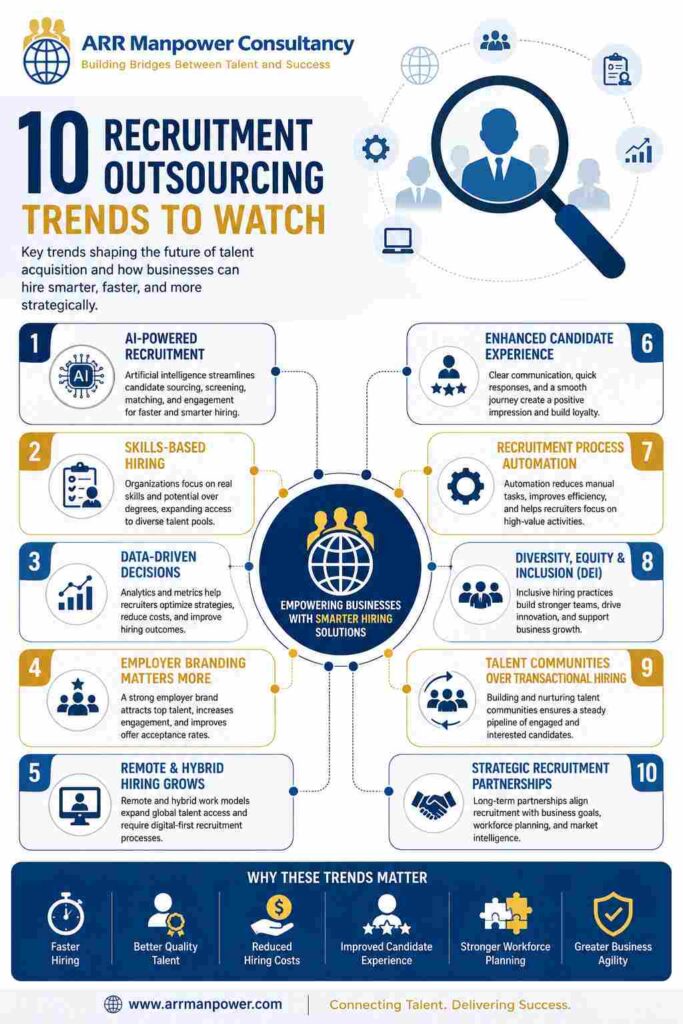
1. Artificial Intelligence is Becoming a Core Recruitment Tool
Artificial intelligence (AI) has transformed the hiring process by automating repetitive recruitment tasks. Outsourcing providers increasingly use AI-powered solutions to screen resumes, match candidates with job descriptions, schedule interviews, and answer applicant queries through chatbots.
AI significantly reduces the time recruiters spend reviewing applications while improving hiring accuracy. Machine learning algorithms analyze candidate profiles based on skills, qualifications, and experience, allowing recruiters to focus on evaluating the most suitable applicants.
However, successful hiring still requires human judgment. Recruitment specialists combine AI-driven insights with personal interactions to assess cultural fit, communication skills, and long-term potential.
2. Skills-Based Hiring is Replacing Traditional Qualification Filters
Organizations are placing greater emphasis on practical skills rather than educational credentials alone. Employers recognize that candidates with relevant abilities often outperform individuals selected solely because of academic qualifications.
Recruitment outsourcing partners are redesigning hiring strategies by incorporating:
- Skills assessments
- Technical evaluations
- Portfolio reviews
- Job simulations
- Practical assignments
This approach expands the available talent pool while improving workforce diversity and reducing hiring bias. It also enables businesses to identify candidates capable of delivering immediate value.
3. Data-Driven Recruitment Decisions are Growing
Modern hiring relies heavily on analytics. Recruitment outsourcing firms now provide detailed recruitment metrics that help organizations optimize hiring strategies.
Important hiring metrics include:
- Time-to-fill
- Cost-per-hire
- Candidate conversion rates
- Interview success rates
- Offer acceptance rates
- Employee retention
- Source of hire
These insights enable companies to understand which recruitment channels perform best and where improvements are needed. Data-driven recruitment also helps forecast future hiring requirements based on business growth.
4. Employer Branding Has Become a Recruitment Priority
Candidates evaluate employers just as employers evaluate candidates. Organizations with strong employer brands attract more qualified applicants and experience lower hiring costs.
Recruitment outsourcing providers increasingly assist companies in strengthening employer branding through:
- Career page optimization
- Employee testimonials
- Social media recruitment campaigns
- Job advertisement improvements
- Candidate communication strategies
A positive employer image builds trust, encourages applications, and improves offer acceptance rates.
Companies investing in employer branding often experience stronger employee engagement and lower turnover after hiring.
5. Remote and Hybrid Hiring Continues to Expand
Remote work has permanently changed recruitment strategies. Businesses are no longer limited by geographical boundaries when searching for talent.
Recruitment outsourcing partners help organizations manage global hiring through:
- Virtual interviews
- Online assessments
- Digital onboarding
- International compliance support
- Cross-border recruitment
Remote recruitment allows organizations to access specialized professionals who may not be available locally. It also gives candidates greater flexibility when considering employment opportunities.
As hybrid work models continue to evolve, outsourced recruiters play a vital role in identifying candidates who can succeed in distributed work environments.
6. Candidate Experience is Becoming a Competitive Advantage
Candidates expect fast communication, transparency, and professional interactions throughout the hiring process. Poor experiences can damage an employer’s reputation and discourage future applications.
Recruitment outsourcing providers improve candidate experience by:
- Responding quickly to applications
- Providing regular updates
- Simplifying interview scheduling
- Offering constructive feedback
- Creating smooth onboarding experiences
A positive hiring journey increases candidate satisfaction and strengthens long-term employer reputation.
Even candidates who are not selected may recommend an organization if they have a respectful recruitment experience.
7. Recruitment Process Automation is Increasing Efficiency
Automation is eliminating many repetitive administrative recruitment tasks.
Recruitment outsourcing firms now automate activities such as:
- Resume collection
- Candidate database management
- Interview scheduling
- Email communication
- Document verification
- Background screening coordination
Automation improves recruiter productivity while reducing human errors. Instead of spending time on administrative work, recruiters can focus on relationship building and strategic hiring.
Organizations also benefit from faster hiring cycles and improved operational efficiency.
8. Diversity, Equity, and Inclusion are Driving Hiring Strategies
Building diverse teams has become a business priority rather than simply a compliance requirement. Companies recognize that diverse workplaces encourage innovation, stronger decision-making, and improved organizational performance.
Recruitment outsourcing providers support diversity initiatives by:
- Expanding sourcing channels
- Using inclusive job descriptions
- Reducing unconscious hiring bias
- Standardizing interview processes
- Tracking diversity recruitment metrics
Inclusive hiring practices create opportunities for candidates from different backgrounds while strengthening organizational culture.
Businesses that prioritize diversity often attract broader talent pools and improve employee retention.
9. Talent Communities are Replacing One-Time Recruitment
Hiring is shifting from reactive recruitment to proactive talent engagement.
Instead of searching for candidates only when positions become available, outsourcing providers help organizations build talent communities consisting of:
- Previous applicants
- Passive candidates
- Industry professionals
- Referral networks
- Former employees
Maintaining regular communication with these talent pools allows organizations to fill future vacancies more quickly.
Talent communities reduce recruitment costs while improving hiring quality because recruiters already have relationships with qualified candidates.
10. Strategic Recruitment Partnerships are Replacing Transactional Hiring
Organizations increasingly view recruitment outsourcing providers as long-term strategic partners instead of temporary staffing vendors.
Strategic partnerships involve collaboration on:
- Workforce planning
- Hiring forecasts
- Market intelligence
- Salary benchmarking
- Talent acquisition strategy
- Recruitment technology implementation
This collaborative approach enables organizations to respond quickly to changing business needs while maintaining consistent hiring quality.
Long-term recruitment partnerships also create greater alignment between recruitment goals and overall business objectives.
How Businesses Can Prepare for These Trends
Adapting to changing recruitment practices requires continuous improvement. Organizations should regularly review hiring strategies, evaluate recruitment performance, and embrace technologies that enhance efficiency without sacrificing the human element.
Working closely with experienced recruitment outsourcing partners enables businesses to remain flexible during periods of rapid workforce change. Companies should also invest in employer branding, employee development, and candidate engagement to strengthen their long-term talent acquisition strategy.
By combining technology, analytics, and human expertise, organizations can build recruitment processes that deliver better hiring outcomes while reducing operational costs.
Benefits of Following Recruitment Outsourcing Trends
Keeping pace with recruitment outsourcing trends provides several long-term advantages:
- Faster hiring cycles
- Improved candidate quality
- Reduced recruitment costs
- Enhanced employer reputation
- Better workforce planning
- Increased hiring flexibility
- Stronger compliance with hiring regulations
- Access to wider talent pools
- Higher employee retention
- Improved overall recruitment efficiency
Organizations that embrace modern recruitment practices position themselves to compete successfully for highly skilled professionals.
Conclusion
The future of hiring is becoming increasingly strategic, technology-driven, and candidate-focused. Recruitment outsourcing continues to evolve beyond traditional staffing support by offering organizations advanced hiring technologies, specialized expertise, workforce planning, and long-term recruitment solutions.
From artificial intelligence and automation to skills-based hiring, employer branding, diversity initiatives, and remote recruitment, these trends are reshaping how companies attract and retain talent. Businesses that proactively adopt these developments will be better equipped to overcome hiring challenges, improve workforce quality, and support sustainable business growth.
As competition for skilled professionals continues to increase, organizations that embrace innovation and build strong recruitment partnerships will gain a significant advantage in securing the talent needed for future success.
Looking ahead, organizations should view recruitment outsourcing as an investment rather than simply an operational expense. A reliable outsourcing partner brings market expertise, access to broader talent networks, and scalable hiring solutions that can adapt to changing business demands. Whether a company is expanding into new markets, managing seasonal hiring spikes, or recruiting for highly specialized roles, outsourcing provides the flexibility needed to respond quickly without compromising hiring quality.
Businesses should also remember that successful recruitment extends beyond filling open positions. It involves building long-term talent pipelines, strengthening employer reputation, improving workforce diversity, and creating positive experiences for every candidate. These factors contribute directly to employee engagement, retention, and overall organizational performance.
As technology continues to advance, the balance between automation and human expertise will become even more important. While digital tools can streamline recruitment workflows and improve efficiency, experienced recruiters remain essential for evaluating soft skills, cultural fit, and long-term potential.
Companies that combine innovative recruitment technologies with personalized hiring strategies will be better positioned to attract top talent in an increasingly competitive employment market. By staying informed about emerging recruitment outsourcing trends and continuously refining their hiring approach, organizations can build resilient teams that support sustainable growth, innovation, and long-term business success.
Furthermore, organizations that regularly evaluate their recruitment strategies and collaborate closely with outsourcing partners can respond more effectively to evolving workforce demands. Continuous improvement, informed decision-making, and a commitment to candidate-centric hiring will ensure businesses remain competitive, resilient, and prepared to attract exceptional talent in an ever-changing global employment landscape.