Introduction
Recruitment has evolved dramatically over the past decade. Organizations no longer compete solely on products, services, or pricing; they compete for talent. The ability to attract and hire high-performing professionals often determines whether a business thrives or struggles in an increasingly competitive marketplace.
Industry-leading companies understand that hiring is not just a human resources function. It is a strategic initiative that directly impacts productivity, innovation, customer satisfaction, and long-term growth. As a result, top organizations continuously refine their hiring strategies to secure the best candidates before competitors do.
Successful employers use a combination of technology, data analysis, employer branding, and candidate-focused practices to improve hiring outcomes. These methods help them identify qualified individuals, streamline selection processes, and create positive experiences for applicants.
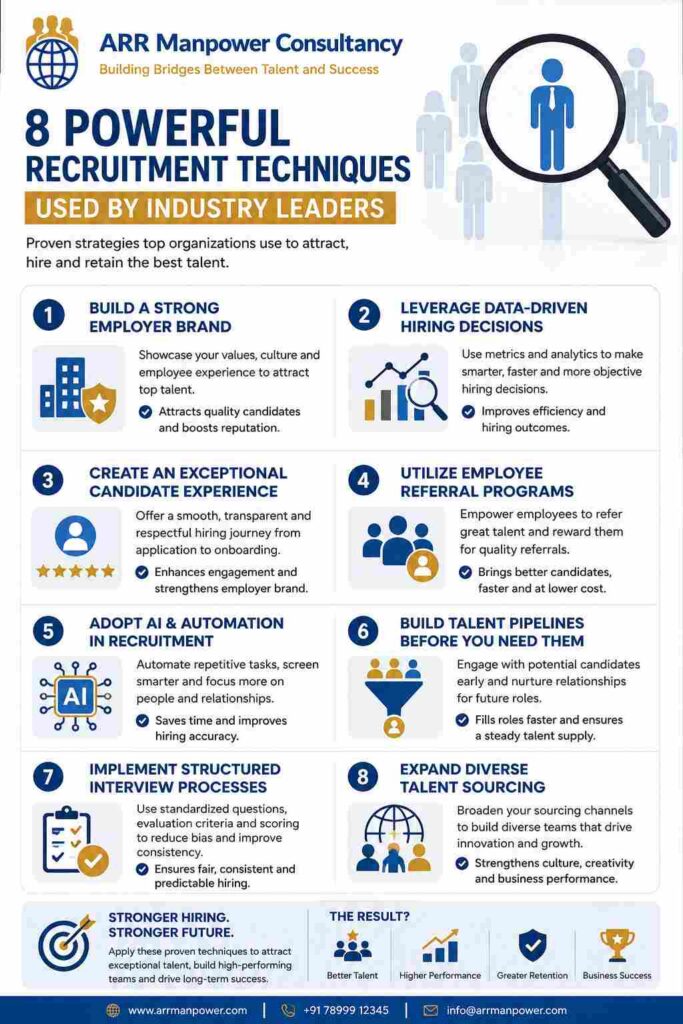
In this article, we explore eight powerful recruitment techniques used by industry leaders and explain how organizations of all sizes can implement them to strengthen their talent acquisition efforts.
https://arrmanpowerconsultancy.com
1. Building a Strong Employer Brand
One of the most effective hiring techniques used by successful companies is developing a compelling employer brand.
A strong employer brand communicates the organization’s values, culture, mission, and employee experience. Candidates increasingly research companies before applying, making reputation a critical factor in attracting top talent.
Leading organizations showcase their workplace culture through:
- Employee testimonials
- Social media content
- Career pages
- Workplace awards
- Community initiatives
- Professional development programs
When candidates perceive a company as a desirable workplace, they are more likely to apply and engage throughout the hiring process.
Benefits of Employer Branding
- Attracts higher-quality applicants
- Reduces hiring costs
- Improves offer acceptance rates
- Enhances employee retention
- Strengthens market reputation
Organizations that invest in employer branding often create a sustainable competitive advantage in talent acquisition.
2. Leveraging Data-Driven Hiring Decisions
Industry leaders rely heavily on data rather than intuition when making hiring decisions.
Data-driven recruitment involves collecting and analyzing metrics throughout the hiring lifecycle. This approach helps organizations identify bottlenecks, improve efficiency, and make informed decisions.
Common recruitment metrics include:
- Time-to-hire
- Cost-per-hire
- Source effectiveness
- Candidate conversion rates
- Offer acceptance rates
- Employee retention statistics
By analyzing these metrics, organizations can determine which channels deliver the best candidates and where improvements are needed.
Why Data Matters
Hiring decisions based solely on personal judgment can introduce bias and inconsistency. Data provides objective insights that help employers evaluate candidates more accurately and predict future success.
Companies using analytics often experience better hiring outcomes and stronger workforce performance.
3. Creating an Exceptional Candidate Experience
Top-performing organizations understand that every applicant is also a potential customer, advocate, or future employee.
A positive candidate experience can significantly impact an organization’s ability to attract talent.
Industry leaders focus on:
- Clear communication
- Fast response times
- Transparent hiring processes
- Respectful interviews
- Constructive feedback
Candidates appreciate knowing where they stand throughout the hiring journey. Frequent updates and professional interactions help maintain engagement and build trust.
Key Elements of Candidate Experience
Simplified Application Process
Lengthy application forms often discourage qualified professionals from completing submissions.
Timely Communication
Prompt responses demonstrate professionalism and respect for applicants’ time.
Interview Preparation
Providing information about interview stages and expectations helps candidates perform confidently.
Organizations that prioritize candidate experience often receive stronger reviews and attract more referrals.
4. Utilizing Employee Referral Programs
Employee referral programs remain one of the most effective talent acquisition methods available.
Current employees often understand company culture, performance expectations, and role requirements. As a result, they can recommend individuals who are likely to succeed within the organization.
Industry leaders encourage referrals through:
- Incentive programs
- Recognition initiatives
- Referral bonuses
- Internal communication campaigns
Advantages of Employee Referrals
- Faster hiring processes
- Improved cultural alignment
- Higher retention rates
- Reduced recruitment costs
- Better candidate quality
Research consistently shows that referred employees often perform well and stay longer with organizations.
By establishing structured referral programs, companies can expand their talent networks and improve hiring efficiency.
5. Adopting Artificial Intelligence and Automation
Technology has transformed modern recruitment practices.
Industry-leading organizations use artificial intelligence and automation tools to streamline repetitive tasks and improve decision-making.
Common applications include:
- Resume screening
- Candidate matching
- Interview scheduling
- Chatbot communication
- Predictive analytics
These technologies allow recruiters to focus more time on relationship building and strategic hiring activities.
Benefits of AI-Powered Hiring
Increased Efficiency
Automation significantly reduces administrative workload.
Faster Candidate Screening
Advanced systems can quickly identify candidates who meet specific qualifications.
Improved Consistency
Technology helps standardize evaluation processes and reduce human error.
While AI offers many advantages, successful organizations balance automation with human judgment to ensure fair and meaningful hiring decisions.
6. Developing Talent Pipelines Before Positions Open
Industry leaders do not wait until vacancies arise before searching for talent.
Instead, they proactively build talent pipelines consisting of qualified professionals who may be suitable for future opportunities.
Talent pipeline development involves:
- Networking events
- Professional communities
- Industry conferences
- University partnerships
- Social media engagement
- Candidate relationship management
This proactive approach reduces hiring delays and ensures organizations have access to skilled professionals when positions become available.
Long-Term Benefits
Organizations with established talent pipelines can:
- Fill vacancies faster
- Reduce sourcing costs
- Improve workforce planning
- Access specialized expertise
- Strengthen succession planning
Building relationships before hiring needs arise creates a valuable talent reservoir for future growth.
7. Implementing Structured Interview Processes
Structured interviews are a hallmark of effective recruitment strategies.
Unlike unstructured conversations, structured interviews use standardized questions and evaluation criteria for all candidates.
Industry leaders design interviews around job-related competencies and measurable skills.
Components of Structured Interviews
Consistent Questions
Every candidate answers the same core questions.
Defined Evaluation Criteria
Interviewers assess responses using predetermined scoring systems.
Competency-Based Assessment
Questions focus on behaviors, experiences, and skills relevant to job performance.
Benefits of Structured Interviews
- Greater consistency
- Improved fairness
- Reduced bias
- Better predictive accuracy
- Stronger hiring decisions
Organizations that implement structured interviews often achieve more reliable and objective candidate evaluations.
8. Expanding Access Through Diverse Talent Sourcing
Leading companies recognize that diversity drives innovation, creativity, and business performance.
As a result, they actively seek candidates from diverse backgrounds, experiences, and perspectives.
Diverse talent sourcing involves expanding recruitment efforts beyond traditional channels.
Examples include:
- Community partnerships
- Educational institutions
- Professional associations
- Specialized job boards
- Industry groups
- Workforce development programs
Why Diversity Matters
A diverse workforce can contribute to:
- Enhanced innovation
- Improved problem-solving
- Better customer understanding
- Increased adaptability
- Stronger organizational performance
Industry leaders understand that diverse teams often generate broader perspectives and more effective solutions.
By widening sourcing efforts, organizations gain access to larger talent pools and strengthen workplace inclusion.
Best Practices for Implementing These Recruitment Techniques
Organizations seeking to improve hiring outcomes should consider the following best practices:
Align Hiring with Business Goals
Talent acquisition strategies should support long-term organizational objectives.
Invest in Recruiter Training
Well-trained recruiters can evaluate candidates more effectively and provide better experiences.
Continuously Measure Results
Tracking performance metrics helps identify strengths and areas for improvement.
Embrace Technology Thoughtfully
Technology should enhance human decision-making rather than replace it entirely.
Focus on Relationships
Strong candidate relationships often lead to higher engagement and successful hiring outcomes.
Combining these practices with the techniques discussed above can significantly improve recruitment effectiveness.
Conclusion
Recruitment has become a strategic business function that directly influences organizational success. Industry leaders consistently outperform competitors because they approach talent acquisition with purpose, innovation, and long-term planning.
The most successful organizations focus on building strong employer brands, leveraging data, enhancing candidate experiences, encouraging employee referrals, utilizing technology, developing talent pipelines, implementing structured interviews, and expanding diverse sourcing efforts.
These eight powerful recruitment techniques help companies attract exceptional professionals, improve hiring quality, and create stronger workforces. Organizations that adopt these strategies can position themselves for sustainable growth while gaining a significant advantage in today’s competitive talent market.
As workforce expectations continue to evolve, businesses that embrace modern hiring practices will be better equipped to secure top talent and achieve long-term success.
In addition, organizations must recognize that hiring excellence is not achieved through a single initiative. It requires continuous improvement, regular evaluation of processes, and a willingness to adapt to changing market conditions. The expectations of job seekers are evolving rapidly, influenced by technology, workplace flexibility, career development opportunities, and organizational culture. Companies that stay ahead of these trends are more likely to attract highly skilled professionals who can contribute to long-term business objectives.
Another important factor is collaboration between leadership teams, hiring managers, and talent acquisition professionals. When all stakeholders share a common vision for workforce growth, hiring decisions become more strategic and aligned with organizational goals. This alignment helps ensure that new employees not only possess the required technical skills but also fit the company’s culture and future direction.
Furthermore, investing in people-focused hiring practices creates benefits that extend far beyond filling open positions. Strong talent acquisition strategies contribute to employee engagement, improved retention, stronger team performance, and enhanced organizational reputation. Every successful hire has the potential to drive innovation, improve customer experiences, and strengthen overall business performance.
Ultimately, companies that view recruitment as an ongoing investment rather than a short-term necessity are better positioned to build resilient and high-performing teams. By consistently applying these proven techniques and refining their approach over time, organizations can create a sustainable talent advantage that supports growth, competitiveness, and long-term success in an increasingly dynamic business environment.