Introduction
Recruitment is no longer just a support function—it is a core driver of business success. In today’s competitive and rapidly evolving market, organizations cannot afford to treat hiring as a routine administrative process. The people you bring into your organization directly influence productivity, culture, innovation, and long-term growth.
However, despite the importance of hiring, many companies unknowingly make critical recruitment mistakes that silently hinder their growth. These errors don’t just delay hiring—they lead to poor performance, increased costs, low employee retention, and weakened organizational culture.
This is where a structured, strategic approach to hiring becomes essential. Businesses that partner with experienced manpower consultants often gain a competitive edge by avoiding common pitfalls and implementing smarter hiring practices.
In this article, we’ll explore seven critical recruitment errors that could be damaging your business growth—and how expert guidance can help you overcome them effectively.
https://arrmanpowerconsultancy.com/
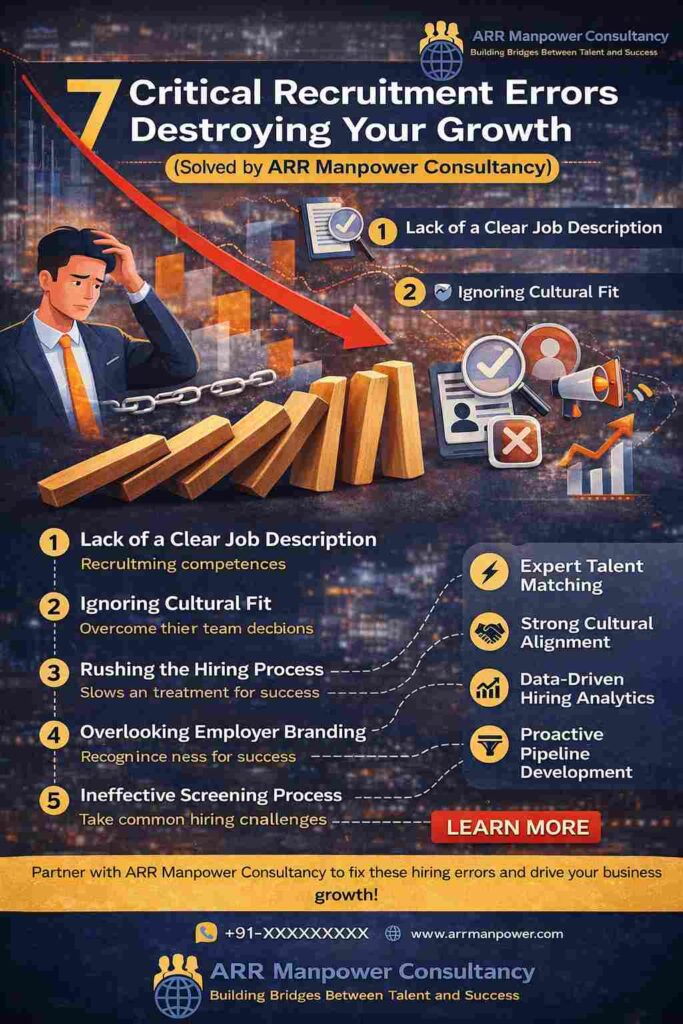
1. Lack of a Clear Job Description
The Problem
One of the most common recruitment mistakes is starting the hiring process without a clearly defined job role. Many organizations post vague job descriptions that fail to communicate expectations, responsibilities, or required skills.
This leads to:
- Irrelevant applications
- Confusion among candidates
- Poor role alignment
- Increased hiring time
When candidates don’t fully understand the role, they either don’t apply or apply without being suitable.
Impact on Business Growth
Hiring the wrong candidate due to unclear expectations can result in:
- Low productivity
- Increased training costs
- Early resignations
- Team inefficiencies
Over time, this slows down business operations and impacts overall growth.
The Solution
A structured recruitment approach focuses on:
- Clearly defined job roles
- Specific skill requirements
- Measurable expectations
- Alignment with business goals
Professional manpower consultants ensure that job descriptions are not only clear but also optimized to attract the right talent.
2. Ignoring Cultural Fit
The Problem
Many companies focus heavily on technical skills and qualifications while completely ignoring cultural fit. A candidate may have an excellent resume but may not align with your company’s values, work style, or team dynamics.
Impact on Business Growth
Ignoring cultural fit can result in:
- Workplace conflicts
- Poor team collaboration
- Decreased morale
- High employee turnover
Even highly skilled employees can become liabilities if they disrupt team harmony.
The Solution
An effective recruitment strategy evaluates:
- Personality traits
- Communication style
- Work ethics
- Adaptability
By assessing both technical and cultural compatibility, businesses can build stronger, more cohesive teams.
3. Rushing the Hiring Process
The Problem
When companies urgently need employees, they often rush the hiring process. Quick decisions are made without proper screening, background checks, or skill evaluation.
Impact on Business Growth
Hasty hiring decisions can lead to:
- Poor employee performance
- Increased replacement costs
- Frequent hiring cycles
- Loss of productivity
The cost of hiring the wrong person is significantly higher than taking the time to hire the right one.
The Solution
A structured hiring process includes:
- Multi-stage interviews
- Skill assessments
- Reference verification
- Thoughtful decision-making
Experienced consultants help streamline hiring without compromising quality, ensuring you get the right candidate efficiently.
4. Overlooking Employer Branding
The Problem
In today’s digital world, candidates research companies before applying. Organizations that neglect their employer brand struggle to attract top talent.
A weak employer brand includes:
- Poor online presence
- Negative employee reviews
- Lack of transparency
- Unclear company values
Impact on Business Growth
Without a strong employer brand:
- Top candidates avoid your company
- Hiring becomes more expensive
- Talent acquisition slows down
- Competitors gain an advantage
The Solution
A strong employer brand helps:
- Attract high-quality candidates
- Build trust with job seekers
- Improve hiring efficiency
- Strengthen company reputation
Professional recruitment partners often guide businesses in presenting themselves effectively to the talent market.
5. Ineffective Screening Process
The Problem
Many organizations rely on outdated or inconsistent screening methods. This includes:
- Resume-only evaluation
- Unstructured interviews
- Lack of skill testing
As a result, hiring decisions are often based on incomplete information.
Impact on Business Growth
Poor screening leads to:
- Hiring unqualified candidates
- Increased training requirements
- Reduced team performance
- Higher attrition rates
The Solution
A modern screening process involves:
- Structured interviews
- Skill-based assessments
- Behavioral analysis
- Data-driven evaluation
With a refined screening approach, businesses can make more accurate hiring decisions.
6. Ignoring Data and Recruitment Metrics
The Problem
Many companies do not track recruitment performance. Without data, it becomes difficult to identify what’s working and what’s not.
Commonly ignored metrics include:
- Time-to-hire
- Cost-per-hire
- Candidate drop-off rate
- Offer acceptance rate
Impact on Business Growth
Lack of data leads to:
- Inefficient hiring processes
- Increased recruitment costs
- Missed opportunities for improvement
The Solution
Data-driven recruitment helps:
- Optimize hiring strategies
- Reduce costs
- Improve efficiency
- Enhance candidate experience
Manpower experts often use analytics to refine hiring processes and deliver better results.
7. Failing to Build a Talent Pipeline
The Problem
Many businesses hire only when there is an immediate need. This reactive approach leads to rushed decisions and limited options.
Impact on Business Growth
Without a talent pipeline:
- Hiring becomes time-consuming
- Quality of candidates decreases
- Business operations may suffer delays
The Solution
A proactive hiring approach includes:
- Maintaining a database of potential candidates
- Building long-term relationships with talent
- Continuous sourcing
This ensures that when a position opens, qualified candidates are readily available.
The Role of Strategic Recruitment in Business Growth
Effective recruitment is not just about filling positions—it’s about building a workforce that drives innovation, productivity, and long-term success.
Organizations that adopt strategic hiring practices experience:
- Higher employee retention
- Better team performance
- Reduced hiring costs
- Stronger organizational culture
Why Expert Guidance Makes a Difference
Navigating the complexities of recruitment requires expertise, time, and resources. Many businesses struggle to manage all aspects of hiring efficiently while focusing on their core operations.
Working with experienced recruitment professionals provides:
- Access to a larger talent pool
- Industry-specific hiring expertise
- Streamlined processes
- Improved hiring accuracy
This allows businesses to focus on growth while ensuring they have the right people in place.
Future Trends in Recruitment
The recruitment landscape continues to evolve with advancements in technology and changing workforce expectations.
Key trends include:
- AI-driven hiring processes
- Remote workforce expansion
- Skills-based hiring
- Increased focus on diversity and inclusion
Businesses that adapt to these trends will stay ahead in the competition for top talent.
Conclusion
Recruitment is far more than a routine hiring function—it is a strategic driver of business growth, productivity, and long-term success. While many organizations focus heavily on sales, marketing, and operations, they often underestimate the impact that hiring mistakes can have on overall performance. The reality is that even a single poor hiring decision can result in lost productivity, increased turnover costs, damaged team morale, and missed business opportunities.
The seven recruitment errors discussed in this article are among the most common challenges faced by growing businesses. From unclear job descriptions and rushed hiring decisions to ineffective candidate screening and poor onboarding practices, these mistakes can quietly slow business momentum and create obstacles that become increasingly difficult to overcome over time. Companies that fail to address these issues often find themselves trapped in a cycle of constant hiring, training, and employee replacement.
The good news is that every one of these recruitment challenges can be prevented with the right strategy, expertise, and hiring process. By implementing structured recruitment practices, leveraging industry knowledge, and focusing on candidate quality rather than speed alone, businesses can build stronger teams that contribute directly to sustainable growth. Effective recruitment not only fills vacancies but also strengthens company culture, improves employee retention, and enhances overall organizational performance.
This is where ARR Manpower Consultancy makes a significant difference. With extensive recruitment experience, industry-specific hiring expertise, and a commitment to matching the right talent with the right opportunities, ARR Manpower Consultancy helps businesses avoid costly recruitment mistakes and achieve better hiring outcomes. Whether your organization is looking to hire skilled professionals, expand operations, or build a high-performing workforce, a strategic recruitment partner can save valuable time, reduce hiring risks, and improve long-term results.
In today’s competitive business environment, talent remains one of the most valuable assets any organization can possess. Companies that prioritize smart recruitment decisions position themselves for stronger growth, higher productivity, and greater market success. Rather than treating recruitment as a short-term necessity, businesses should view it as an investment in their future.
By recognizing and eliminating these critical recruitment errors, organizations can create a more efficient hiring process, attract top talent, and build teams capable of driving lasting success. The sooner businesses address these challenges, the sooner they can unlock their full growth potential and gain a competitive advantage in an increasingly demanding marketplace.
Recruitment mistakes can silently damage your business growth, often without immediate visibility. From unclear job roles to ineffective screening and lack of planning, these errors can lead to long-term challenges.
However, with the right strategies and structured hiring practices, these issues can be effectively resolved.
By focusing on clarity, culture, data, and proactive planning, organizations can transform their recruitment process into a powerful growth engine.
Avoiding these seven critical errors is not just about improving hiring—it’s about building a stronger, more resilient organization ready for future success.