Introduction
Hiring the right talent has always been one of the most critical challenges for any organization. In today’s fast-moving and highly competitive job market, the process has become even more complex. Companies are no longer just competing on salaries—they are competing on culture, flexibility, growth opportunities, and purpose.
Yet, despite having access to advanced tools and platforms, many organizations still struggle to find candidates who truly fit their needs. Traditional hiring methods often fall short because they fail to adapt to changing workforce expectations and evolving business demands.
This is where smart hiring strategies come into play. Instead of relying on outdated approaches, successful companies are using innovative, data-driven, and people-focused techniques to attract and retain top talent.
In this article, we’ll explore eight powerful hiring tricks that actually work—practical, proven methods that can transform your recruitment process and help you build a stronger workforce.
https://arrmanpowerconsultancy.com/
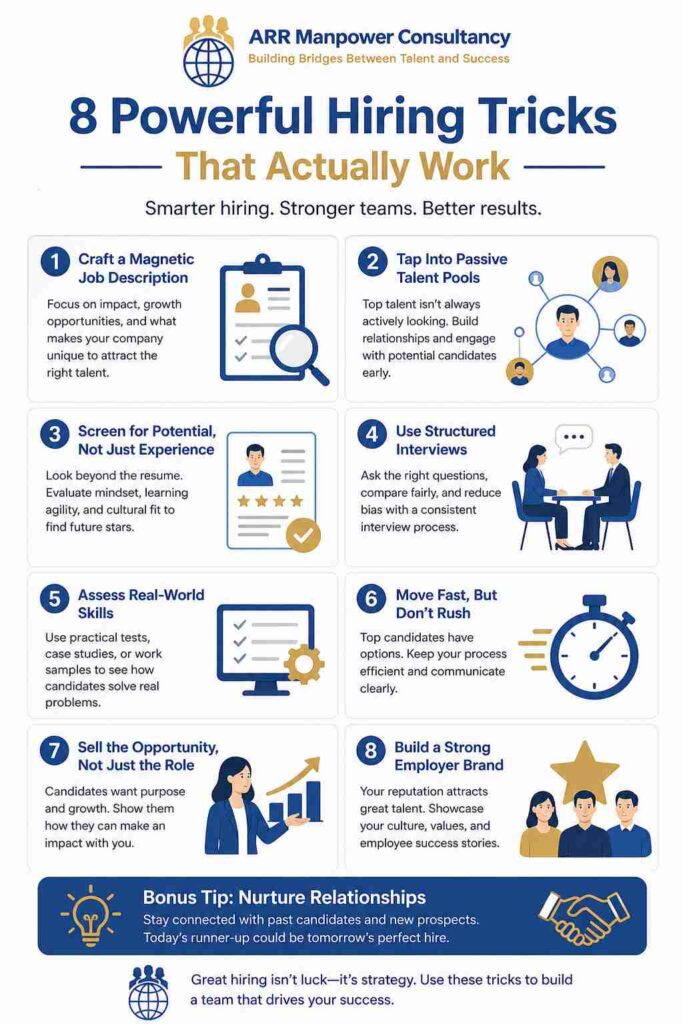
1. Focus on Skills Over Degrees
One of the biggest shifts in modern hiring is the move away from degree-based filtering toward skill-based evaluation.
For years, employers relied heavily on academic qualifications to shortlist candidates. However, degrees don’t always reflect real-world capabilities. Many highly skilled individuals may not have traditional educational backgrounds, while some degree holders may lack practical expertise.
Why This Works
Focusing on skills allows you to:
- Tap into a wider talent pool
- Identify candidates with real problem-solving abilities
- Reduce bias in the hiring process
How to Implement
Instead of listing strict educational requirements, try:
- Including skill-based assessments
- Using practical tests or assignments
- Evaluating portfolios or past projects
This approach ensures that you hire people who can actually perform the job, not just those who look good on paper.
2. Write Job Descriptions That Attract, Not Filter
Many companies unknowingly lose great candidates because their job descriptions are too rigid, lengthy, or unrealistic.
A typical job posting often includes an overwhelming list of requirements that discourages potential applicants, especially those who may not meet 100% of the criteria but are still capable.
Why This Works
A well-crafted job description:
- Encourages more qualified candidates to apply
- Reflects your company culture
- Sets clear expectations
How to Improve
- Focus on must-have skills instead of “nice-to-have”
- Use simple and engaging language
- Highlight growth opportunities and benefits
- Clearly define the role’s impact
Remember, a job description is not just a checklist—it’s your first marketing pitch to potential employees.
3. Leverage Employee Referrals Effectively
Employee referrals remain one of the most powerful hiring tools, yet many organizations underutilize them.
Your current employees already understand your company culture and expectations, making them excellent sources for recommending suitable candidates.
Why This Works
Referral candidates tend to:
- Fit better culturally
- Perform well
- Stay longer with the company
Best Practices
- Offer incentives for successful referrals
- Simplify the referral process
- Encourage employees to share openings on social media
- Recognize and reward participation
A strong referral program can significantly reduce hiring time and improve quality.
4. Use Structured Interviews
Unstructured interviews often lead to inconsistent evaluations and biased decisions. Different candidates are asked different questions, making it difficult to compare them fairly.
Structured interviews solve this problem by standardizing the process.
Why This Works
They:
- Improve consistency
- Reduce unconscious bias
- Provide better insights into candidate capabilities
How to Implement
- Prepare a set of predefined questions
- Use a scoring system
- Train interviewers for consistency
- Focus on behavioral and situational questions
This method ensures that every candidate is evaluated on the same criteria, leading to more informed decisions.
5. Build a Strong Employer Brand
Candidates today research companies before applying. They look at reviews, social media presence, and overall reputation.
A strong employer brand can make a huge difference in attracting top talent.
Why This Works
A positive brand:
- Builds trust
- Attracts high-quality candidates
- Reduces hiring costs
How to Strengthen Your Brand
- Share employee success stories
- Showcase workplace culture
- Maintain an active online presence
- Respond to reviews professionally
When people see your organization as a great place to work, they’re more likely to apply—even without aggressive outreach.
6. Speed Up the Hiring Process
A slow hiring process is one of the biggest reasons companies lose top talent. Skilled candidates often receive multiple offers, and delays can cost you the best hires.
Why This Works
A faster process:
- Improves candidate experience
- Increases offer acceptance rates
- Reduces drop-offs
How to Improve Speed
- Streamline interview rounds
- Use technology for scheduling
- Provide quick feedback
- Avoid unnecessary approvals
Efficiency doesn’t mean rushing—it means eliminating delays that don’t add value.
7. Prioritize Candidate Experience
Hiring is not just about evaluating candidates—it’s also about how candidates perceive your company.
A poor experience can damage your reputation and discourage future applications.
Why This Works
A positive candidate experience:
- Enhances your brand image
- Encourages referrals
- Builds long-term relationships
Ways to Improve
- Communicate clearly and regularly
- Respect candidate time
- Provide feedback when possible
- Keep the process transparent
Even candidates who aren’t selected should leave with a positive impression of your organization.
8. Use Data to Make Better Decisions
Data-driven hiring is no longer optional—it’s essential. Relying solely on intuition can lead to inconsistent and biased outcomes.
Why This Works
Data helps you:
- Identify successful hiring patterns
- Improve efficiency
- Reduce bias
What to Track
- Time-to-hire
- Cost-per-hire
- Source of hire
- Candidate conversion rates
How to Use It
Analyze trends and adjust your strategies accordingly. For example, if referrals yield better candidates, invest more in that channel.
Data provides clarity, allowing you to continuously refine your hiring approach.
The Future of Hiring
The hiring landscape is evolving rapidly. Technology, remote work, and changing employee expectations are reshaping how organizations approach recruitment.
Companies that adapt to these changes will have a significant advantage in attracting and retaining top talent.
Key trends to watch include:
- AI-driven recruitment tools
- Remote hiring practices
- Skills-based hiring models
- Greater emphasis on diversity and inclusion
Staying ahead requires a willingness to innovate and rethink traditional methods.
Common Hiring Mistakes to Avoid
While implementing new strategies, it’s equally important to avoid common pitfalls:
- Overcomplicating the hiring process
- Ignoring cultural fit
- Relying too much on resumes
- Failing to communicate with candidates
- Delaying decision-making
Avoiding these mistakes can significantly improve your hiring outcomes.
Final Thoughts
Successful hiring is not about luck—it is about using proven strategies that help businesses identify, attract, and retain the right talent. The 8 powerful hiring tricks discussed in this article demonstrate that effective recruitment goes far beyond simply posting a job advertisement and waiting for applications to arrive. Companies that invest time in refining their hiring process often gain a significant competitive advantage through stronger teams, higher productivity, and lower employee turnover.
At Arr Manpower Consultancy, we understand that every organization has unique workforce requirements. Whether a company is looking for entry-level staff, experienced professionals, technical specialists, or executive leaders, the right hiring approach can make all the difference. By clearly defining job roles, leveraging multiple recruitment channels, conducting structured interviews, assessing cultural fit, and maintaining a strong candidate experience, businesses can dramatically improve their hiring outcomes.
The modern job market is constantly evolving, making it essential for employers to stay ahead of recruitment trends. Candidates today have more options than ever before, and top talent is often available for only a short period. Organizations that act quickly, communicate effectively, and make data-driven hiring decisions are more likely to secure the best candidates before competitors do.
Another key takeaway is that recruitment should be viewed as a long-term investment rather than a short-term task. Every successful hire contributes to organizational growth, customer satisfaction, and overall business performance. Conversely, poor hiring decisions can lead to increased costs, lost productivity, and frequent replacement cycles. This is why partnering with experienced recruitment professionals can provide tremendous value throughout the hiring journey.
Arr Manpower Consultancy remains committed to helping businesses simplify the recruitment process while connecting them with qualified and dependable candidates. By applying these powerful hiring tricks consistently, employers can build stronger teams, reduce recruitment challenges, and create a workforce capable of driving sustainable success. The right people are the foundation of every successful organization, and with the right hiring strategy in place, businesses can confidently achieve their growth goals and future ambitions.
With strategic recruitment expertise, businesses can secure talent that fuels innovation, growth, and success.
Hiring is not just a process—it’s a strategic function that directly impacts business success. The right team can drive innovation, improve productivity, and strengthen your organization’s competitive edge.
The eight hiring tricks discussed in this article are not just theories—they are practical methods that have proven to deliver results. By focusing on skills, improving candidate experience, leveraging data, and building a strong employer brand, you can transform your recruitment efforts.
The key is consistency. Implement these strategies thoughtfully, measure their impact, and continuously refine your approach.
In the end, successful hiring is about finding the right people, at the right time, for the right roles—and creating an environment where they can thrive.
https://www.shrm.org/resourcesandtools/pages/default.aspx
https://data360.worldbank.org/en/indicator/VDEM_CORE_V2XCL_DMOVE