Introduction
Recruitment is no longer just about filling vacancies—it is a strategic function that directly impacts business growth, productivity, and long-term profitability. Companies that invest in the right hiring practices often see measurable returns in the form of improved employee performance, reduced turnover, and stronger organizational culture.
However, many businesses still struggle with inefficient hiring processes, high recruitment costs, and mismatched candidates. This is where powerful recruitment methods come into play. By applying proven strategies, organizations can not only attract top talent but also ensure that every hiring decision contributes to a positive return on investment (ROI).
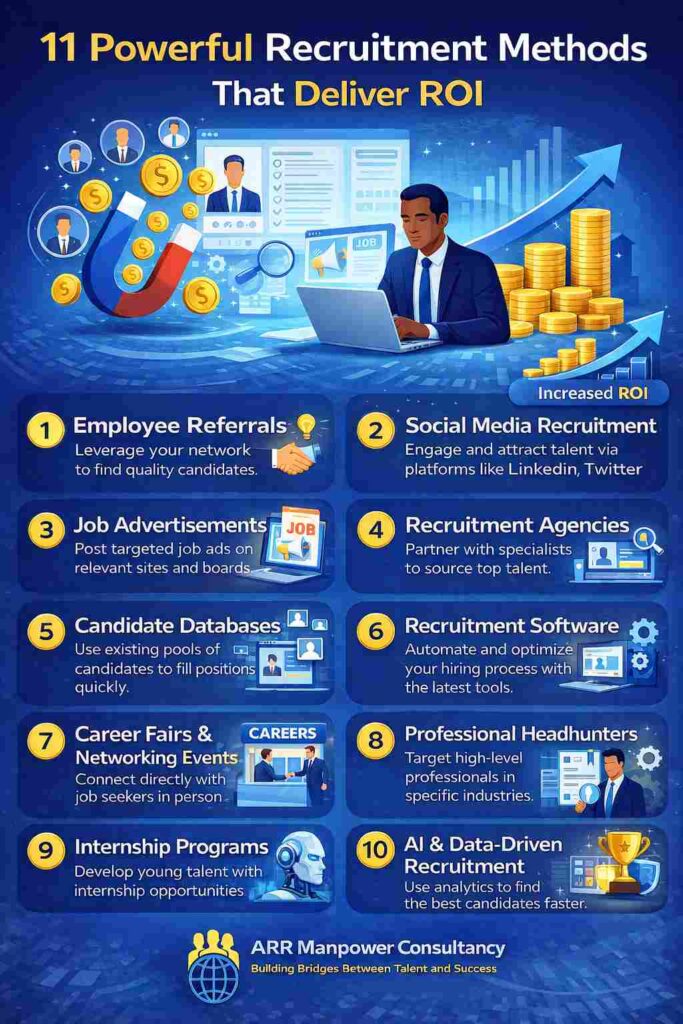
In this article, we explore 11 powerful recruitment methods that help businesses maximize ROI while building a strong, future-ready workforce.
https://arrmanpowerconsultancy.com/
1. Strategic Workforce Planning
One of the most effective ways to improve hiring outcomes is to start with a clear workforce plan. Instead of reacting to immediate vacancies, companies should forecast their talent needs based on business goals.
Strategic workforce planning helps organizations:
- Identify skill gaps early
- Align hiring with long-term objectives
- Avoid unnecessary recruitment costs
When businesses plan ahead, they reduce last-minute hiring pressure and make more thoughtful decisions, leading to better ROI.
2. Employer Branding
A strong employer brand attracts high-quality candidates without excessive spending on advertising. Job seekers today research companies before applying, and a positive reputation can significantly influence their decision.
Key elements of strong employer branding include:
- Transparent company culture
- Employee testimonials
- Clear career growth opportunities
Organizations that invest in their brand often experience lower cost-per-hire and higher retention rates.
3. Data-Driven Recruitment
Using data to guide hiring decisions is one of the most impactful methods for improving ROI. Instead of relying on intuition, recruiters can analyze metrics such as:
- Time-to-hire
- Cost-per-hire
- Candidate conversion rates
- Source effectiveness
Data-driven recruitment enables continuous improvement and helps businesses focus on strategies that deliver real results.
4. Leveraging Technology and Automation
Modern recruitment tools streamline the hiring process, saving both time and resources. Applicant tracking systems (ATS), AI-powered screening tools, and automated scheduling platforms can significantly enhance efficiency.
Benefits include:
- Faster candidate screening
- Reduced manual workload
- Improved accuracy in shortlisting
Automation allows HR teams to focus on strategic tasks rather than repetitive administrative work.
5. Employee Referral Programs
Employee referrals remain one of the most reliable sources of quality hires. Candidates referred by current employees tend to:
- Fit better with company culture
- Stay longer
- Perform more effectively
Implementing a structured referral program with incentives can reduce hiring costs and improve overall recruitment success.
6. Targeted Job Advertising
Instead of posting job openings on every platform, businesses should focus on targeted channels where their ideal candidates are most active.
This includes:
- Industry-specific job boards
- Professional networking platforms
- Niche communities
Targeted advertising increases the likelihood of attracting relevant candidates, improving both efficiency and ROI.
7. Structured Interview Process
An unstructured interview process often leads to inconsistent hiring decisions. A structured approach ensures fairness and better evaluation of candidates.
Best practices include:
- Standardized questions
- Scoring systems
- Panel interviews
This method reduces bias and improves the accuracy of hiring decisions, leading to better long-term outcomes.
8. Skill-Based Assessments
Resumes do not always reflect a candidate’s true capabilities. Skill-based assessments provide a more accurate measure of performance potential.
Examples include:
- Technical tests
- Case studies
- Practical assignments
By focusing on actual skills, companies can hire candidates who are better suited for the role, improving productivity and ROI.
9. Building Talent Pipelines
A talent pipeline is a pool of pre-qualified candidates who can be approached when a position opens. This proactive approach reduces time-to-hire and ensures continuity in hiring.
Benefits of maintaining a talent pipeline:
- Faster recruitment cycles
- Reduced dependency on external sourcing
- Better candidate quality
Organizations that invest in talent pipelines are always prepared for future hiring needs.
10. Partnering with Recruitment Experts
Collaborating with experienced recruitment agencies or consultants can significantly enhance hiring outcomes. These experts have access to wider networks and specialized knowledge.
Advantages include:
- Faster access to qualified candidates
- Industry-specific expertise
- Reduced hiring risks
This partnership often leads to higher-quality hires and improved ROI.
11. Continuous Improvement and Feedback
Recruitment should be an evolving process. Companies that regularly review and refine their hiring strategies achieve better results over time.
Steps for continuous improvement:
- Collect feedback from candidates and hiring managers
- Analyze recruitment metrics
- Identify areas for optimization
By learning from each hiring cycle, organizations can continuously enhance their recruitment effectiveness.
Measuring Recruitment ROI
To ensure that recruitment methods are delivering results, businesses must track ROI. This involves comparing the cost of hiring with the value generated by employees.
Key indicators include:
- Employee performance
- Retention rates
- Productivity levels
- Revenue contribution
A strong recruitment strategy not only reduces costs but also drives long-term business growth.
Common Recruitment Challenges (and How to Overcome Them)
Even with the best strategies, companies may face challenges such as:
1. Talent Shortage
Solution: Expand sourcing channels and invest in training programs.
2. High Turnover
Solution: Focus on cultural fit and employee engagement.
3. Lengthy Hiring Processes
Solution: Use automation and streamline workflows.
4. Poor Candidate Experience
Solution: Improve communication and transparency.
Addressing these challenges is essential for maintaining a strong recruitment ROI.
Future Trends in Recruitment
The recruitment landscape is constantly evolving. Businesses that stay ahead of trends can maintain a competitive edge.
Some key trends include:
- AI-driven hiring
- Remote recruitment
- Skills-based hiring models
- Diversity and inclusion initiatives
Adapting to these trends ensures long-term success in talent acquisition.
Conclusion
As the recruitment landscape continues to evolve in 2026, organizations can no longer rely on a single hiring strategy to attract and retain top talent. The most successful companies understand that recruitment is not just a hiring function—it is a strategic business investment that directly influences productivity, employee retention, company culture, and long-term growth. By implementing the right combination of recruitment methods, businesses can significantly improve hiring outcomes while maximizing their return on investment (ROI).
The recruitment methods discussed in this guide demonstrate that there is no one-size-fits-all approach. Employee referrals remain a powerful source of high-quality candidates, while social media recruiting helps organizations reach passive talent pools that traditional job boards often miss. AI-powered recruitment tools streamline time-consuming tasks, allowing recruiters to focus on building meaningful candidate relationships. At the same time, campus recruitment, recruitment agencies, talent communities, and employer branding continue to play critical roles in creating a sustainable talent pipeline.
What separates high-performing organizations from their competitors is their ability to measure and optimize recruitment performance continuously. Tracking key metrics such as cost-per-hire, quality-of-hire, time-to-fill, candidate satisfaction, and employee retention enables companies to identify which recruitment channels generate the strongest results. Data-driven recruitment decisions help reduce hiring costs while increasing the likelihood of securing candidates who contribute value over the long term.
Another important factor is candidate experience. In a highly competitive talent market, candidates often evaluate employers just as carefully as employers evaluate them. A transparent hiring process, timely communication, and a positive interview experience can significantly enhance an organization’s reputation. Even candidates who are not selected may become future applicants, customers, or brand advocates if they have a favorable experience throughout the recruitment journey.
Technology will continue to reshape recruitment practices, but human connection remains essential. While automation can accelerate sourcing, screening, and scheduling, recruiters and hiring managers must still focus on building trust, assessing cultural fit, and understanding the unique aspirations of each candidate. The most effective recruitment strategies successfully balance technological efficiency with genuine human engagement.
Looking ahead, organizations that embrace innovation, invest in employer branding, and diversify their recruitment channels will be better positioned to attract top-tier talent. Labor markets are becoming increasingly dynamic, with remote work, global hiring opportunities, and changing workforce expectations creating both challenges and opportunities for employers. Companies that adapt quickly to these shifts will gain a significant competitive advantage.
Ultimately, recruitment success in 2026 is not about filling vacancies as quickly as possible—it is about finding the right people who can drive business success, support organizational goals, and contribute to a thriving workplace culture. By strategically implementing these powerful recruitment methods and continuously refining hiring processes based on performance data, businesses can build stronger teams, reduce turnover, and achieve sustainable growth. The organizations that prioritize smart, ROI-focused recruitment today will be the ones that lead their industries tomorrow.
Furthermore, companies that consistently invest in modern recruitment strategies, workforce planning, and talent development initiatives will create a stronger employer reputation, attract exceptional professionals, and maintain long-term organizational resilience in an increasingly competitive global marketplace.
Recruitment is a critical driver of business success, and the methods used can significantly impact ROI. By implementing strategic, data-driven, and efficient hiring practices, organizations can attract top talent while minimizing costs.
The 11 powerful recruitment methods discussed in this article provide a comprehensive framework for improving hiring outcomes. From workforce planning to continuous improvement, each method plays a vital role in building a strong and productive workforce.
Businesses that prioritize effective recruitment strategies will not only enhance their hiring success but also achieve sustainable growth in the long run.
https://www.linkedin.com/pulse/9-powerful-truths-jobs-germany-2026-avoid-costly-consultancy-obavc