Introduction
Recruitment has evolved significantly over the last decade. Human Resources teams are expected to attract qualified candidates, shorten hiring cycles, improve candidate experiences, and make data-driven decisions—all while managing increasing workloads. Traditional hiring methods often struggle to keep pace with these demands, creating the need for smarter and more efficient solutions.
This is where recruitment automation tools play a crucial role. These platforms help HR professionals streamline repetitive hiring tasks, reduce administrative burdens, and focus more on strategic talent acquisition activities. From candidate sourcing and resume screening to interview scheduling and onboarding, automation can transform the way organizations hire.
In this article, we explore nine effective recruitment automation tools that help HR teams improve productivity, enhance candidate engagement, and build stronger hiring processes.
https://arrmanpowerconsultancy.com
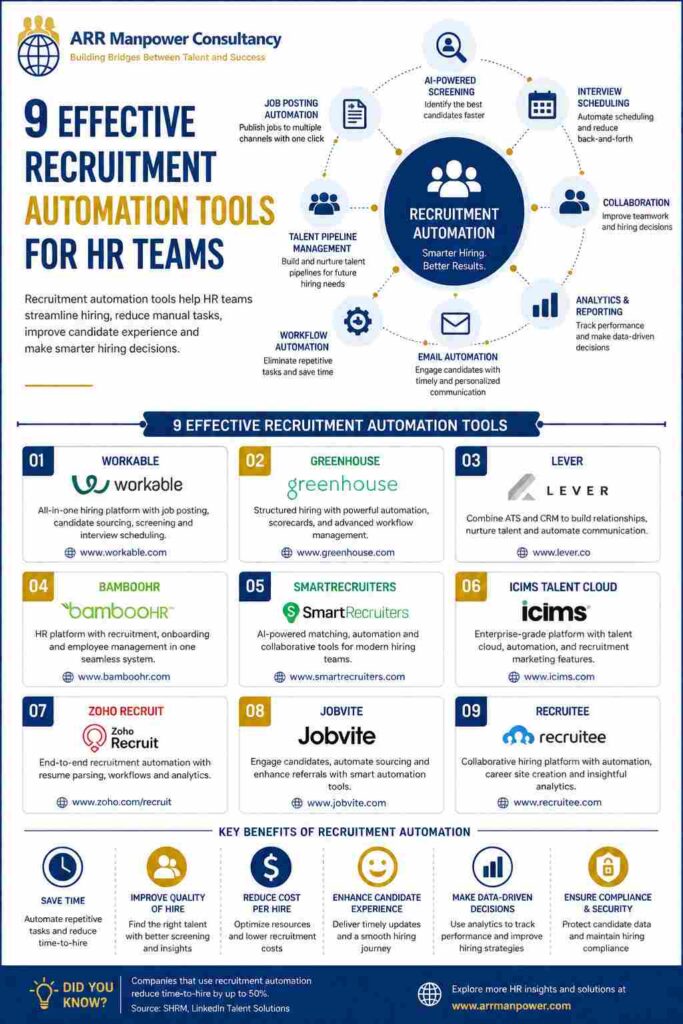
Why Recruitment Automation Matters
Hiring the right talent is one of the most important responsibilities within an organization. However, manual recruitment processes often consume considerable time and resources. Recruiters frequently spend hours reviewing resumes, coordinating interviews, sending follow-up emails, and updating candidate records.
Automation helps solve these challenges by handling repetitive tasks with greater speed and consistency. Organizations that embrace modern hiring technology can benefit from:
- Faster recruitment cycles
- Improved candidate experiences
- Reduced administrative workload
- Better hiring decisions through analytics
- Increased recruiter productivity
- Enhanced collaboration among hiring teams
As competition for skilled professionals continues to grow, companies that use automation effectively often gain an advantage in attracting top talent.
1. Workable
Workable is a widely used hiring platform designed to help organizations manage every stage of the recruitment process from a single dashboard.
Key Features
- Job posting across multiple job boards
- Candidate sourcing tools
- Automated resume screening
- Interview scheduling capabilities
- Recruitment analytics and reporting
- Collaborative hiring workflows
Benefits for HR Teams
Workable simplifies recruitment by centralizing hiring activities. Recruiters can publish openings to numerous channels simultaneously, reducing the effort required to attract applicants. The platform also helps hiring managers collaborate more effectively through shared evaluations and feedback systems.
Organizations that need a scalable recruitment solution often find Workable particularly useful because it supports growing hiring demands without increasing administrative complexity.
2. Greenhouse
Greenhouse is a recruitment platform known for its structured hiring approach and advanced workflow automation.
Key Features
- Automated candidate tracking
- Interview planning and scheduling
- Scorecards and evaluation tools
- Diversity hiring support
- Talent pipeline management
- Integration with various HR systems
Benefits for HR Teams
Greenhouse helps standardize recruitment processes across departments. Structured interview frameworks enable more consistent candidate evaluations, reducing bias and improving decision-making quality.
The platform’s automation features help recruiters manage large applicant volumes while maintaining a positive candidate experience throughout the hiring journey.
3. Lever
Lever combines applicant tracking and candidate relationship management capabilities into a single recruitment platform.
Key Features
- Automated candidate nurturing
- Pipeline management
- Email automation
- Interview coordination
- Talent relationship tracking
- Recruitment analytics
Benefits for HR Teams
Lever allows recruiters to build and maintain long-term relationships with potential candidates. Automated communication features help organizations stay connected with talent pools even when immediate hiring opportunities are unavailable.
The platform’s emphasis on relationship-building supports proactive recruitment strategies that can reduce future hiring challenges.
4. BambooHR
BambooHR is known primarily as an HR management platform, but it also includes valuable recruitment automation capabilities.
Key Features
- Applicant tracking functionality
- Automated job posting
- Candidate communication tools
- Interview management
- Offer letter generation
- Onboarding support
Benefits for HR Teams
BambooHR provides a seamless transition from recruitment to employee onboarding. Since hiring information remains within a unified system, HR departments can minimize manual data entry and administrative errors.
Organizations seeking an all-in-one HR solution often appreciate BambooHR’s ability to connect hiring activities with broader workforce management functions.
5. SmartRecruiters
SmartRecruiters offers enterprise-level recruitment technology focused on delivering a modern hiring experience.
Key Features
- AI-powered candidate matching
- Automated interview scheduling
- Collaborative hiring tools
- Mobile recruitment capabilities
- Candidate engagement features
- Advanced analytics dashboards
Benefits for HR Teams
The platform helps recruiters identify qualified applicants more efficiently through intelligent matching technologies. Automated scheduling eliminates much of the back-and-forth communication traditionally associated with interview coordination.
Its mobile-friendly design also supports recruiters and hiring managers who need flexibility while managing recruitment activities.
6. iCIMS Talent Cloud
iCIMS Talent Cloud is a comprehensive recruitment platform designed for organizations with complex hiring requirements.
Key Features
- Candidate sourcing automation
- Career site management
- Recruitment marketing tools
- Automated workflows
- Talent pool segmentation
- Reporting and analytics
Benefits for HR Teams
iCIMS enables organizations to strengthen their employer branding while automating key hiring functions. Recruiters can build talent communities, nurture relationships, and engage candidates through personalized communication strategies.
The platform’s extensive customization options make it suitable for businesses with unique recruitment processes and compliance requirements.
7. Zoho Recruit
Zoho Recruit provides recruitment automation features for staffing agencies and corporate HR teams.
Key Features
- Resume parsing
- Candidate database management
- Workflow automation
- Interview scheduling
- Email templates and automation
- Custom reporting tools
Benefits for HR Teams
Zoho Recruit helps reduce manual work through automated candidate management processes. Resume parsing capabilities allow recruiters to quickly organize applicant information and identify suitable candidates.
Its integration with other business applications can further streamline hiring operations and improve overall efficiency.
8. Jobvite
Jobvite focuses on helping organizations improve recruitment outcomes through automation and candidate engagement.
Key Features
- Automated sourcing workflows
- Candidate relationship management
- Recruitment marketing tools
- Interview scheduling
- Employee referral tracking
- Analytics and performance reporting
Benefits for HR Teams
Jobvite supports both active recruitment and long-term talent engagement initiatives. Recruiters can automate communication campaigns and nurture prospective candidates until suitable opportunities become available.
The platform also enhances referral programs, helping organizations leverage existing employees as valuable recruitment advocates.
9. Recruitee
Recruitee is a collaborative hiring platform designed to simplify recruitment for growing organizations.
Key Features
- Automated hiring workflows
- Career site creation
- Candidate pipeline management
- Interview scheduling automation
- Team collaboration tools
- Recruitment analytics
Benefits for HR Teams
Recruitee encourages collaboration among recruiters, hiring managers, and department leaders. Automation reduces administrative tasks while improving visibility into hiring progress.
The platform’s intuitive interface makes it particularly appealing for organizations seeking user-friendly recruitment technology without extensive training requirements.
Key Factors to Consider When Choosing Recruitment Automation Software
Selecting the right platform requires careful evaluation of organizational goals and hiring needs. HR teams should assess several important factors before making a decision.
Scalability
Choose software that can accommodate future hiring growth. As organizations expand, recruitment needs often become more complex, requiring flexible solutions.
Integration Capabilities
Recruitment systems should integrate smoothly with existing HR platforms, payroll systems, onboarding tools, and communication applications.
User Experience
A user-friendly interface improves adoption rates among recruiters, hiring managers, and candidates. Complex systems can create unnecessary obstacles and reduce efficiency.
Reporting and Analytics
Data-driven recruitment requires strong reporting capabilities. Analytics help organizations identify bottlenecks, measure performance, and continuously improve hiring outcomes.
Automation Features
Evaluate which recruitment tasks can be automated. Common areas include candidate sourcing, resume screening, interview scheduling, communication workflows, and onboarding activities.
Compliance and Security
Organizations must ensure candidate information remains protected. Strong security features and compliance support are essential when handling sensitive applicant data.
How Recruitment Automation Improves Candidate Experience
Candidate experience has become a critical component of successful hiring. Job seekers expect timely communication, transparent processes, and professional interactions throughout the recruitment journey.
Automation contributes to better experiences by:
- Sending immediate application confirmations
- Providing status updates automatically
- Simplifying interview scheduling
- Reducing response delays
- Delivering personalized communication
- Creating consistent hiring processes
When candidates receive timely updates and smooth interactions, they are more likely to develop positive impressions of an organization, even if they are not ultimately selected.
Common Recruitment Challenges Solved by Automation
Many HR teams encounter recurring obstacles that slow down hiring efforts. Automation addresses several of these issues effectively.
High Application Volumes
Modern hiring campaigns can generate hundreds or thousands of applications. Automated screening tools help recruiters identify qualified candidates more quickly.
Scheduling Conflicts
Coordinating interviews among candidates and multiple stakeholders often becomes time-consuming. Scheduling automation eliminates much of this complexity.
Communication Delays
Manual communication processes frequently create bottlenecks. Automated messaging ensures candidates receive prompt updates throughout the hiring process.
Data Management
Managing applicant information across spreadsheets and emails can lead to inefficiencies and errors. Centralized systems improve organization and accessibility.
Reporting Difficulties
Tracking hiring metrics manually requires significant effort. Automated reporting provides real-time visibility into recruitment performance.
The Future of Recruitment Automation
Technology continues to reshape talent acquisition strategies. Emerging innovations are expected to further enhance hiring efficiency and effectiveness.
Future developments may include:
- More advanced artificial intelligence capabilities
- Predictive hiring analytics
- Enhanced candidate matching algorithms
- Conversational recruiting assistants
- Skills-based hiring technologies
- Improved workforce planning tools
As these innovations mature, HR professionals will gain greater ability to identify, engage, and hire qualified talent in increasingly competitive labor markets.
Conclusion
Recruitment automation has become an essential component of modern talent acquisition. By reducing manual workloads, improving efficiency, and enhancing candidate experiences, automation enables HR teams to focus on higher-value activities that contribute directly to organizational success.
Tools such as Workable, Greenhouse, Lever, BambooHR, SmartRecruiters, iCIMS Talent Cloud, Zoho Recruit, Jobvite, and Recruitee each offer unique capabilities that support different hiring needs. The best choice depends on factors such as company size, recruitment volume, integration requirements, and long-term growth objectives.
Organizations that invest in effective recruitment technology are better positioned to attract top talent, improve hiring outcomes, and build stronger workforces. As hiring continues to evolve, automation will remain a critical driver of recruitment success for HR teams worldwide.