Introduction
Strong leadership is one of the most important factors behind organizational success. Leaders influence workplace culture, employee engagement, productivity, innovation, and long-term business growth. Hiring or promoting individuals into leadership roles without properly evaluating their capabilities can result in poor decision-making, low team morale, and increased turnover.
For this reason, organizations are increasingly adopting structured approaches to identify and evaluate leadership potential. Effective assessment techniques help employers understand how candidates perform under pressure, communicate with teams, solve problems, and align with company goals.
Rather than relying solely on interviews or resumes, businesses can use multiple evaluation methods to gain a comprehensive understanding of an individual’s strengths and development areas. This article explores nine proven leadership assessment methods that employers can use to make informed talent decisions.
https://arrmanpowerconsultancy.com
1. Behavioral Interviews
Behavioral interviews remain one of the most widely used methods for evaluating leadership capabilities. The principle behind this approach is simple: past behavior often predicts future performance.
Instead of asking hypothetical questions, employers encourage candidates to describe real-life situations they have encountered. These responses provide valuable insights into decision-making, conflict resolution, team management, and strategic thinking.
Examples of Behavioral Questions
- Tell us about a time when you led a team through a difficult project.
- Describe a situation where you had to resolve a workplace conflict.
- How have you handled resistance to change within a team?
- Share an example of a significant business challenge you overcame.
Benefits
- Reveals practical experience.
- Provides evidence-based responses.
- Helps identify leadership style.
- Reduces reliance on assumptions.
When structured properly, behavioral interviews allow employers to compare candidates consistently and objectively.
2. Leadership Competency Assessments
Competency assessments evaluate specific skills associated with successful leadership. These assessments are usually designed around predefined competencies that align with organizational objectives.
Common leadership competencies include:
- Strategic thinking
- Communication
- Emotional intelligence
- Decision-making
- Accountability
- Collaboration
- Change management
Employers can create competency frameworks tailored to their industry and leadership requirements. Candidates are then assessed against these criteria through questionnaires, simulations, interviews, or practical exercises.
Advantages
- Provides standardized evaluation criteria.
- Supports succession planning.
- Identifies development opportunities.
- Improves consistency across hiring processes.
Organizations that use competency-based assessments often achieve better alignment between leadership performance and business goals.
3. Psychometric Testing
Psychometric assessments measure psychological traits, personality characteristics, cognitive abilities, and behavioral tendencies. These tests help employers understand how individuals approach leadership responsibilities.
Popular assessment categories include:
Personality Assessments
These identify traits such as:
- Confidence
- Adaptability
- Resilience
- Conscientiousness
- Interpersonal effectiveness
Cognitive Ability Tests
These evaluate:
- Analytical thinking
- Problem-solving skills
- Learning agility
- Logical reasoning
Emotional Intelligence Assessments
These measure:
- Self-awareness
- Empathy
- Relationship management
- Emotional regulation
Benefits
- Offers objective data.
- Supports informed hiring decisions.
- Identifies leadership potential.
- Reduces unconscious bias.
While psychometric tests should not be used as standalone decision-making tools, they provide valuable supplementary insights.
4. 360-Degree Feedback Evaluations
A 360-degree feedback process gathers input from multiple sources, including:
- Managers
- Peers
- Team members
- Direct reports
- External stakeholders
This comprehensive approach provides a well-rounded view of an individual’s leadership effectiveness.
Areas Commonly Evaluated
- Communication skills
- Team collaboration
- Integrity
- Accountability
- Coaching abilities
- Strategic contribution
Why It Works
Traditional evaluations often rely on a single manager’s perspective. In contrast, 360-degree feedback captures how a leader is perceived by various stakeholders.
Key Benefits
- Encourages self-awareness.
- Highlights strengths and weaknesses.
- Supports professional development.
- Improves leadership effectiveness.
Organizations frequently use this method for leadership development programs and succession planning initiatives.
5. Assessment Centers
Assessment centers are structured evaluation programs designed to measure leadership competencies through multiple exercises and simulations.
Participants complete a series of activities that replicate workplace challenges. Trained assessors observe behaviors and evaluate performance against predetermined criteria.
Typical Assessment Center Activities
- Group discussions
- Business case studies
- Presentations
- Role-playing exercises
- Problem-solving tasks
- Strategic planning simulations
Benefits
- Measures real-world performance.
- Evaluates multiple competencies simultaneously.
- Provides detailed behavioral observations.
- Offers highly reliable results.
Although assessment centers require significant resources, they remain one of the most effective methods for evaluating leadership readiness.
6. Situational Judgment Tests
Situational Judgment Tests (SJTs) assess how candidates respond to workplace scenarios commonly faced by leaders.
Participants are presented with realistic situations and asked to select the most appropriate response from several options.
Example Scenario
A high-performing employee consistently misses deadlines, creating frustration within the team. What would you do?
Candidates must choose responses that demonstrate effective leadership principles, communication, accountability, and problem-solving abilities.
Advantages
- Evaluates decision-making skills.
- Measures judgment under realistic conditions.
- Standardizes candidate comparisons.
- Predicts workplace behavior.
Because these tests mirror actual leadership challenges, they often provide strong indicators of future success.
7. Leadership Simulations
Leadership simulations place candidates in realistic business situations that require immediate action and strategic thinking.
Unlike traditional interviews, simulations allow employers to observe how individuals perform rather than simply discuss what they might do.
Common Simulation Formats
Crisis Management Exercises
Candidates respond to unexpected organizational challenges.
Team Leadership Scenarios
Participants manage team dynamics, performance issues, and workplace conflicts.
Strategic Planning Activities
Individuals analyze data, identify opportunities, and recommend solutions.
Benefits
- Demonstrates practical leadership ability.
- Evaluates performance under pressure.
- Measures adaptability.
- Reveals communication and problem-solving skills.
Simulations provide highly relevant insights because they closely resemble real leadership responsibilities.
8. Employee Engagement and Team Performance Analysis
For internal candidates, past team performance can offer valuable evidence of leadership effectiveness.
Employers can examine various performance indicators, including:
- Employee retention rates
- Team productivity
- Engagement survey results
- Project outcomes
- Customer satisfaction scores
What These Metrics Reveal
Leaders who consistently achieve strong team outcomes often demonstrate effective communication, motivation, and decision-making abilities.
Advantages
- Uses real organizational data.
- Measures long-term impact.
- Supports evidence-based decisions.
- Identifies successful leadership practices.
While performance metrics should not be the sole evaluation method, they provide important context regarding leadership effectiveness.
9. Leadership Potential Assessments
Leadership potential assessments focus on future capability rather than current performance alone.
An employee may excel in their current role but require additional skills to succeed in a leadership position. Potential assessments help employers identify individuals who can grow into larger responsibilities.
Key Factors Evaluated
Learning Agility
The ability to quickly acquire new skills and adapt to changing circumstances.
Strategic Thinking
The capacity to understand broader organizational objectives and long-term implications.
Motivation
A genuine desire to lead, influence, and contribute to business success.
Adaptability
The ability to navigate uncertainty and organizational change.
Benefits
- Supports succession planning.
- Builds future leadership pipelines.
- Identifies high-potential talent.
- Reduces leadership gaps.
Organizations that invest in identifying future leaders are often better positioned for sustainable growth.
Best Practices for Leadership Assessment
While each method offers unique advantages, employers achieve the best results by combining multiple approaches.
Use Multiple Assessment Methods
Relying on a single evaluation technique can create blind spots. Combining interviews, simulations, assessments, and feedback mechanisms provides a more complete picture.
Align Assessments with Organizational Goals
Leadership requirements vary across industries and business models. Assessment criteria should reflect company values, strategic priorities, and cultural expectations.
Ensure Consistency
Standardized evaluation processes help reduce bias and improve fairness. All candidates should be assessed using the same criteria whenever possible.
Focus on Development
Assessments should not only identify strengths but also highlight opportunities for growth. Constructive feedback supports ongoing leadership development.
Review and Update Frameworks Regularly
Business environments continue to evolve. Leadership competencies that were critical five years ago may not fully address today’s challenges. Regular reviews ensure assessment frameworks remain relevant.
Common Mistakes Employers Should Avoid
Even well-designed evaluation programs can produce inaccurate results if implemented incorrectly.
Overreliance on Interviews
Interviews provide useful information but often fail to reveal how candidates behave in real-world situations.
Ignoring Cultural Fit
Strong technical skills alone do not guarantee leadership success. Alignment with organizational values is equally important.
Evaluating Only Current Performance
High performance does not automatically translate into effective leadership capability.
Lack of Objective Criteria
Unstructured assessments increase the risk of bias and inconsistent decision-making.
Failing to Validate Assessment Tools
Employers should ensure their assessment methods accurately measure relevant leadership competencies.
Avoiding these mistakes helps organizations make more reliable talent decisions.
The Future of Leadership Assessment
Technology is transforming how organizations evaluate leadership talent. Artificial intelligence, predictive analytics, and digital assessment platforms are enabling more sophisticated evaluation processes.
Emerging trends include:
- AI-powered behavioral analysis
- Virtual assessment centers
- Gamified leadership evaluations
- Data-driven talent analytics
- Continuous feedback systems
These innovations provide deeper insights while improving efficiency and scalability.
However, technology should complement—not replace—human judgment. The most effective assessment strategies combine data-driven tools with professional expertise and organizational context.
Conclusion
Identifying effective leaders requires more than reviewing resumes or conducting traditional interviews. Organizations need comprehensive assessment strategies that evaluate competencies, behaviors, potential, and real-world performance.
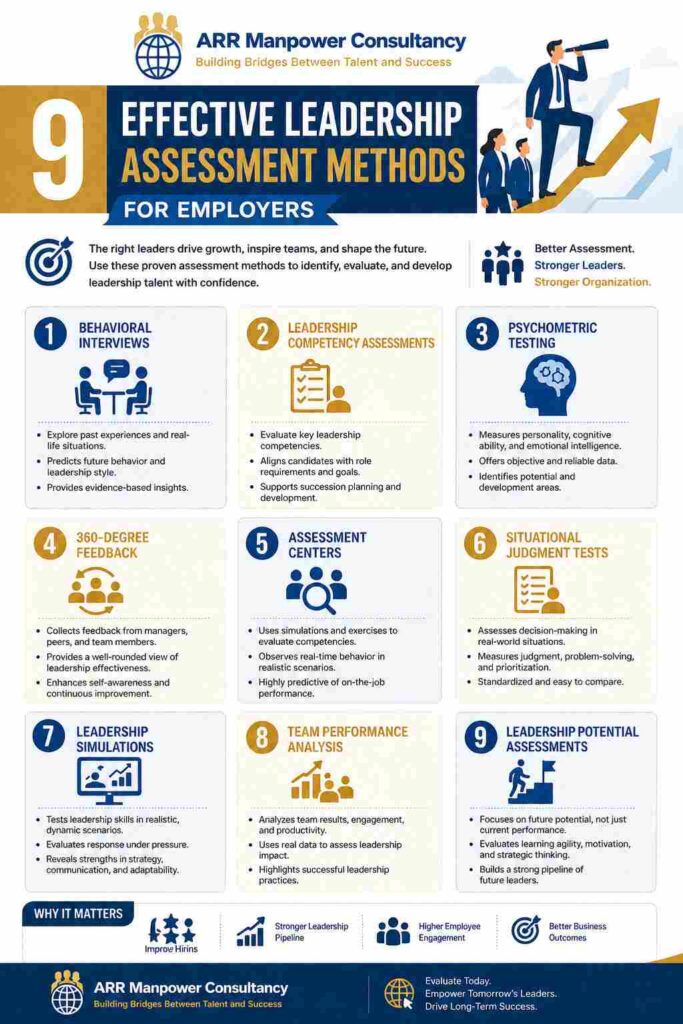
Behavioral interviews, competency assessments, psychometric testing, 360-degree feedback, assessment centers, situational judgment tests, leadership simulations, performance analysis, and leadership potential evaluations each provide valuable insights into an individual’s ability to lead successfully.
By combining these methods and aligning them with business objectives, employers can make better hiring and promotion decisions, strengthen succession planning efforts, and build a pipeline of capable leaders prepared to guide the organization toward future success.
A structured approach to leadership assessment not only improves talent decisions but also contributes to stronger teams, higher employee engagement, and long-term organizational growth.