Introduction
Organizations today operate in a highly competitive business environment where finding and retaining qualified employees has become a strategic priority. As companies expand, they often encounter challenges in sourcing skilled professionals, managing workforce demands, and maintaining operational efficiency. Two commonly used workforce management approaches are recruitment and staffing. Although these terms are often used interchangeably, they represent distinct processes with different objectives, timelines, and outcomes.
Understanding the differences between recruitment and staffing is essential for business leaders, HR professionals, and hiring managers who want to build a productive workforce. Recruitment focuses primarily on identifying and hiring permanent employees for long-term organizational needs, while staffing involves supplying workers for both short-term and long-term assignments based on business requirements.
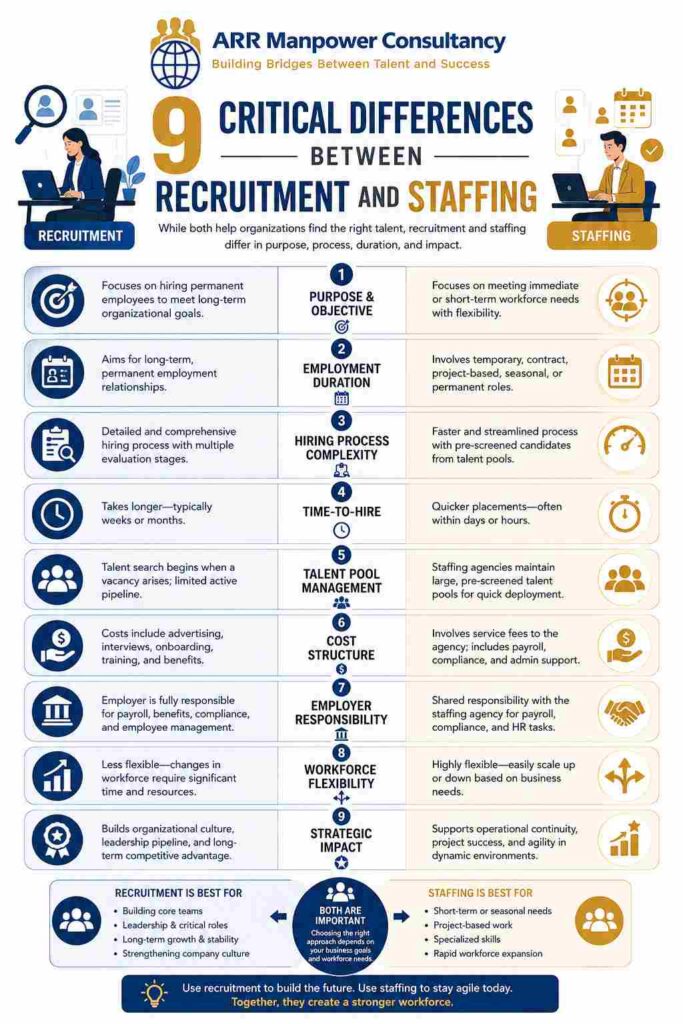
This article explores nine critical differences between recruitment and staffing, helping organizations determine which approach best suits their workforce planning strategy.
https://arrmanpowerconsultancy.com
What Is Recruitment?
Recruitment is the process of attracting, evaluating, selecting, and hiring candidates for permanent positions within an organization. It is a strategic HR function designed to fill long-term vacancies with individuals who align with company goals, culture, and growth plans.
Recruitment typically involves:
- Identifying hiring requirements
- Creating job descriptions
- Advertising vacancies
- Screening applications
- Conducting interviews
- Assessing candidate suitability
- Extending job offers
- Facilitating onboarding
The primary objective is to secure talent that contributes to organizational success over an extended period.
What Is Staffing?
Staffing is a broader workforce management process that involves supplying qualified workers to organizations for temporary, contract, project-based, seasonal, or permanent roles. Staffing agencies often maintain a pool of pre-screened candidates who can be deployed quickly when businesses require additional manpower.
Staffing solutions are commonly used for:
- Seasonal demand fluctuations
- Temporary replacements
- Project-specific assignments
- Contract positions
- Rapid workforce expansion
- Specialized skill requirements
The focus is on providing workforce flexibility while ensuring operational continuity.
1. Purpose and Objective
The most significant difference between recruitment and staffing lies in their core purpose.
Recruitment aims to find permanent employees who will become integral members of an organization. Companies invest considerable time and resources in selecting candidates who fit both the role and company culture.
Staffing, on the other hand, focuses on meeting immediate workforce needs. Businesses often use staffing services when they need workers quickly or for specific projects without committing to permanent employment.
Recruitment Objective:
- Long-term talent acquisition
- Organizational growth
- Leadership development
- Employee retention
Staffing Objective:
- Workforce flexibility
- Immediate manpower support
- Project completion
- Seasonal workforce management
2. Employment Duration
Employment duration is another key distinction.
Recruitment generally involves hiring individuals for permanent positions. Employees are expected to remain with the company for years, contributing to long-term business objectives.
Staffing may involve temporary, contract, seasonal, or project-based assignments. Workers may stay with an organization for a few weeks, several months, or until a project concludes.
For example, a manufacturing company hiring a plant manager is engaging in recruitment. However, hiring additional warehouse workers during peak demand periods reflects a staffing strategy.
3. Hiring Process Complexity
Recruitment typically follows a detailed and comprehensive hiring process.
Organizations often conduct multiple interview rounds, background verification, technical assessments, and cultural fit evaluations before making a hiring decision. Since permanent hires significantly impact organizational success, companies invest more time in candidate evaluation.
Staffing processes are generally faster and more streamlined. Staffing agencies maintain databases of qualified candidates who have already been screened and assessed. This allows businesses to fill vacancies rapidly.
Recruitment Process:
- Job analysis
- Candidate sourcing
- Resume screening
- Multiple interviews
- Assessments
- Reference checks
- Offer negotiation
Staffing Process:
- Requirement analysis
- Candidate matching
- Quick screening
- Deployment
- Assignment management
4. Time-to-Hire
Time-to-hire varies considerably between recruitment and staffing.
Recruitment often requires several weeks or even months to complete. Organizations prioritize selecting the best candidate rather than filling the position quickly.
Staffing services emphasize speed and efficiency. Since agencies maintain talent pools, workers can often be placed within days or even hours.
This distinction becomes particularly important during urgent workforce shortages or sudden increases in workload.
Recruitment Timeline:
- Longer hiring cycle
- Extensive evaluations
- Strategic decision-making
Staffing Timeline:
- Faster placement
- Immediate workforce availability
- Reduced hiring delays
5. Talent Pool Management
Recruitment teams typically search for candidates when a vacancy arises. While companies may maintain talent databases, sourcing efforts often begin after identifying a hiring need.
Staffing firms continuously build and maintain extensive candidate networks. Their success depends on having ready-to-deploy professionals across multiple industries and skill levels.
As a result, staffing agencies can often respond more quickly to workforce requests than internal recruitment teams.
Benefits of Staffing Talent Pools:
- Faster candidate availability
- Reduced sourcing time
- Access to specialized skills
- Improved workforce scalability
6. Cost Structure
The financial implications of recruitment and staffing differ significantly.
Recruitment costs may include:
- Job advertising expenses
- Recruitment software
- Interview costs
- Background verification
- Onboarding expenses
- Training investments
Although recruitment may require substantial upfront spending, permanent employees often generate long-term value for the organization.
Staffing costs are usually structured through service fees paid to staffing agencies. These fees may cover sourcing, screening, payroll administration, compliance management, and employee benefits.
While staffing can sometimes have higher hourly costs, it eliminates many administrative responsibilities associated with direct hiring.
Organizations must evaluate workforce requirements carefully to determine which option offers the best return on investment.
7. Employer Responsibility
Recruitment results in direct employment relationships between the organization and the employee.
The employer becomes responsible for:
- Payroll management
- Benefits administration
- Performance evaluations
- Career development
- Compliance obligations
- Employee engagement initiatives
In staffing arrangements, many administrative responsibilities remain with the staffing agency. Depending on the contract structure, the agency may handle payroll processing, benefits, tax compliance, and workforce administration.
This reduced administrative burden makes staffing attractive for organizations seeking operational flexibility.
8. Workforce Flexibility
Flexibility is one of the defining advantages of staffing.
Recruitment focuses on building a stable workforce designed for long-term business growth. Once employees are hired permanently, workforce adjustments may require substantial planning and resources.
Staffing enables organizations to scale their workforce up or down based on business needs. This flexibility is particularly valuable in industries with fluctuating demand, such as manufacturing, logistics, retail, healthcare, and construction.
Examples include:
- Retail businesses during holiday seasons
- Logistics companies during peak delivery periods
- Construction firms handling project-based workloads
- Healthcare facilities managing patient surges
By leveraging staffing services, businesses can adapt quickly to changing market conditions.
9. Strategic Workforce Impact
Recruitment plays a crucial role in shaping an organization’s future. Permanent hires influence company culture, innovation, leadership development, and long-term competitiveness.
Strategic recruitment helps organizations:
- Build leadership pipelines
- Strengthen organizational culture
- Improve employee retention
- Enhance productivity
- Support sustainable growth
Staffing contributes strategically in a different way. It helps organizations maintain operational continuity while managing workforce fluctuations efficiently.
Strategic staffing benefits include:
- Reduced labor shortages
- Increased operational agility
- Improved project execution
- Enhanced workforce scalability
- Better resource allocation
Both approaches support business success but address different workforce objectives.
When Should Businesses Choose Recruitment?
Recruitment is often the preferred option when organizations need employees who will contribute over the long term.
Businesses should prioritize recruitment when:
- Filling leadership positions
- Building core teams
- Developing organizational culture
- Supporting long-term expansion
- Investing in employee development
Recruitment works best when workforce stability and retention are primary goals.
When Should Businesses Choose Staffing?
Staffing is ideal when flexibility and speed are critical.
Organizations frequently use staffing solutions for:
- Temporary workforce shortages
- Seasonal hiring requirements
- Project-based assignments
- Specialized skill needs
- Rapid business growth
- Employee leave coverage
Staffing allows companies to respond quickly without the commitments associated with permanent hiring.
Can Recruitment and Staffing Work Together?
Absolutely. Many successful organizations combine recruitment and staffing strategies to create a balanced workforce model.
For example:
- Permanent employees manage core business functions.
- Contract workers support short-term projects.
- Temporary staff handle seasonal demand.
- Specialized consultants provide niche expertise.
This hybrid approach allows organizations to maintain stability while retaining the flexibility needed to adapt to changing business conditions.
Companies that integrate recruitment and staffing effectively often experience improved workforce efficiency, reduced hiring risks, and greater operational resilience.
Conclusion
Understanding the differences between recruitment and staffing is essential for making informed workforce decisions. While recruitment focuses on attracting and hiring permanent employees for long-term organizational growth, staffing emphasizes workforce flexibility and rapid deployment of talent to meet immediate business needs.
The nine critical differences discussed in this article—purpose, employment duration, hiring complexity, time-to-hire, talent pool management, cost structure, employer responsibility, workforce flexibility, and strategic impact—highlight how each approach serves unique organizational objectives.
Rather than viewing recruitment and staffing as competing solutions, businesses should consider them complementary workforce strategies. Recruitment helps build a strong foundation of permanent talent, while staffing provides the agility required to navigate changing market demands.
Organizations that leverage both approaches strategically can create a highly adaptable workforce, improve productivity, reduce hiring challenges, and position themselves for sustainable growth in an increasingly competitive business environment.
By understanding these distinctions, organizations can optimize talent acquisition efforts, improve workforce planning, reduce hiring costs, and create a balanced employment strategy that supports both immediate needs and long-term success.