Introduction
In today’s highly competitive business environment, workforce productivity plays a crucial role in determining organizational success. Companies across industries are continuously seeking innovative ways to optimize employee performance, reduce operational inefficiencies, and achieve sustainable growth. One of the most impactful approaches is implementing effective staffing solutions that align talent with business objectives.
A well-planned staffing strategy helps organizations attract qualified professionals, improve employee engagement, reduce turnover, and ensure the right people are placed in the right roles. Whether a business is experiencing rapid expansion, seasonal demand fluctuations, or skill shortages, strategic workforce planning can significantly enhance operational efficiency.
This article explores twelve practical staffing solutions that can help organizations improve productivity, strengthen workforce performance, and achieve long-term success.
https://arrmanpowerconsultancy.com
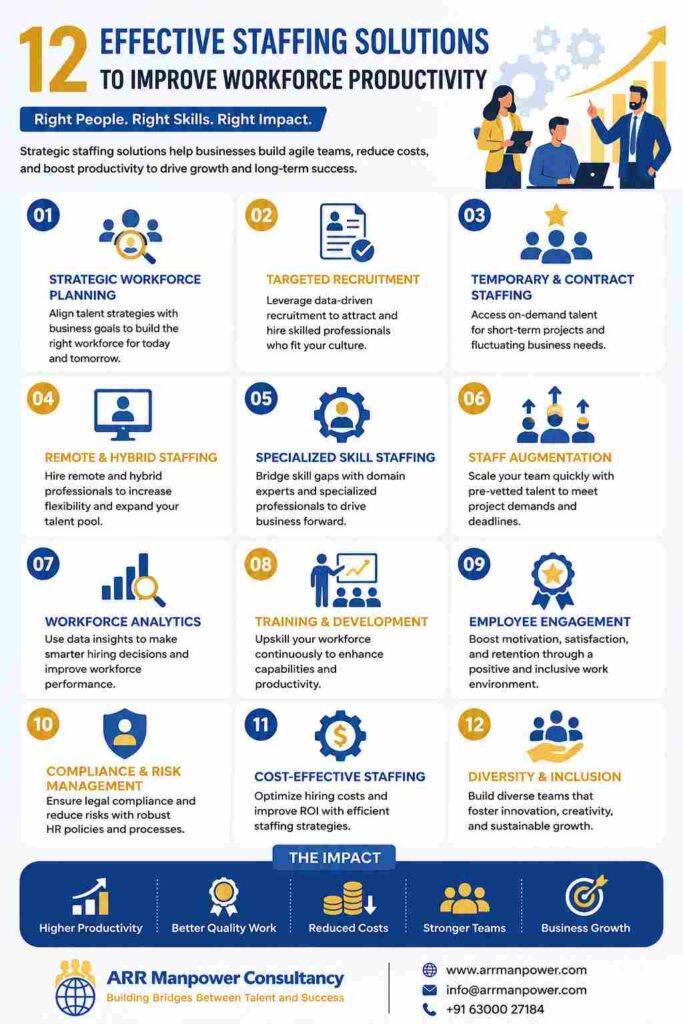
1. Strategic Workforce Planning
Strategic workforce planning involves analyzing current and future staffing requirements to ensure the organization has the necessary talent to meet its objectives.
Rather than reacting to hiring needs as they arise, businesses can forecast workforce demands based on growth projections, market trends, and operational goals. This proactive approach minimizes staffing gaps and prevents productivity losses caused by understaffing or overstaffing.
Benefits include:
- Better resource allocation
- Reduced hiring delays
- Improved workforce readiness
- Enhanced organizational agility
When companies plan ahead, employees experience less workload imbalance, leading to improved performance and job satisfaction.
2. Temporary and Contract Staffing
Temporary and contract professionals provide businesses with flexibility during peak seasons, special projects, or unexpected workforce shortages.
Hiring temporary employees enables organizations to:
- Meet short-term demands quickly
- Control labor costs
- Maintain operational continuity
- Access specialized skills when needed
For example, manufacturing companies often increase temporary hiring during production surges, while IT firms may engage contract specialists for project-based assignments.
This flexible workforce model helps maintain productivity without committing to long-term employment costs.
3. Permanent Recruitment Services
Building a strong workforce requires hiring individuals who possess both technical expertise and cultural compatibility.
Permanent recruitment focuses on identifying candidates who can contribute to long-term organizational goals. Professional recruiters use advanced sourcing methods, screening processes, and assessment tools to identify qualified talent efficiently.
Advantages include:
- Reduced hiring risks
- Improved employee retention
- Stronger workplace culture
- Enhanced team stability
Organizations that invest in quality permanent hiring often experience higher productivity due to reduced turnover and stronger employee commitment.
4. Skills-Based Hiring
Traditional recruitment methods often prioritize educational qualifications and work experience. However, many organizations are now shifting toward skills-based hiring.
This approach focuses on evaluating a candidate’s practical abilities, competencies, and job-specific skills rather than relying solely on degrees or certifications.
Benefits include:
- Access to a larger talent pool
- Better job-role alignment
- Faster onboarding
- Improved employee performance
By prioritizing demonstrated capabilities, businesses can identify individuals who are better equipped to contribute effectively from day one.
5. Workforce Outsourcing
Outsourcing specific functions allows organizations to focus on their core competencies while leveraging external expertise.
Commonly outsourced functions include:
- Payroll administration
- Customer support
- IT services
- Human resources
- Data processing
Outsourcing helps businesses streamline operations and improve productivity by reducing administrative burdens.
Key advantages include:
- Lower operational costs
- Increased efficiency
- Access to specialized expertise
- Improved scalability
When managed effectively, outsourcing enables internal teams to concentrate on strategic priorities that drive business growth.
6. Employee Training and Development
Even the most talented workforce requires ongoing development to remain productive and competitive.
Continuous training programs help employees:
- Enhance technical skills
- Adapt to new technologies
- Improve problem-solving abilities
- Increase confidence and motivation
Organizations that invest in learning initiatives often experience higher employee engagement and better performance outcomes.
Effective training methods include:
- Online learning platforms
- Workshops and seminars
- Mentorship programs
- Leadership development courses
A skilled workforce is better prepared to handle evolving business challenges and contribute to organizational success.
7. Flexible Staffing Models
Modern workplaces increasingly recognize the value of flexibility in workforce management.
Flexible staffing models may include:
- Part-time employees
- Remote workers
- Freelancers
- Hybrid work arrangements
These models allow organizations to adjust workforce capacity based on business needs while supporting employee work-life balance.
Benefits include:
- Improved employee satisfaction
- Reduced absenteeism
- Greater workforce adaptability
- Enhanced productivity
Flexibility also enables businesses to attract talent from broader geographic regions, expanding recruitment opportunities.
8. Technology-Driven Recruitment
Recruitment technology has transformed how organizations identify, evaluate, and hire candidates.
Modern tools such as:
- Applicant Tracking Systems (ATS)
- Artificial Intelligence screening
- Video interviewing platforms
- Recruitment analytics software
help streamline hiring processes and reduce time-to-fill positions.
Technology-driven recruitment provides:
- Faster candidate sourcing
- Improved hiring accuracy
- Better applicant experiences
- Enhanced decision-making
By automating repetitive tasks, recruiters can focus on strategic talent acquisition activities that contribute to workforce effectiveness.
9. Employee Retention Programs
Hiring talent is only one part of workforce management. Retaining skilled employees is equally important for maintaining productivity.
High turnover can result in:
- Increased recruitment costs
- Lost organizational knowledge
- Lower team morale
- Reduced operational efficiency
Effective retention strategies include:
- Competitive compensation packages
- Career advancement opportunities
- Employee recognition programs
- Positive workplace culture
Organizations that prioritize employee satisfaction often achieve greater workforce stability and stronger productivity outcomes.
10. Diversity and Inclusion Initiatives
A diverse workforce brings different perspectives, experiences, and ideas that contribute to innovation and better decision-making.
Inclusive hiring practices help organizations:
- Access wider talent pools
- Improve creativity
- Strengthen problem-solving capabilities
- Enhance workplace collaboration
Research consistently shows that diverse teams often outperform homogeneous groups in terms of innovation and business performance.
To promote diversity and inclusion, organizations can:
- Eliminate hiring biases
- Expand sourcing channels
- Implement inclusive policies
- Provide diversity training
A culture that values diverse perspectives encourages employee engagement and drives organizational growth.
11. Performance Management Systems
Productivity improves when employees clearly understand expectations and receive regular feedback.
Effective performance management systems help organizations:
- Set measurable goals
- Track employee progress
- Identify development needs
- Reward high performance
Regular performance reviews create opportunities for meaningful discussions between managers and employees.
Best practices include:
- Establishing clear objectives
- Conducting frequent check-ins
- Using data-driven evaluations
- Recognizing achievements
When employees receive constructive feedback and support, they are more likely to remain motivated and productive.
12. Partnership with Professional Staffing Agencies
Collaborating with experienced staffing agencies provides organizations with access to recruitment expertise, industry knowledge, and extensive candidate networks.
Professional staffing partners can assist with:
- Temporary staffing
- Permanent recruitment
- Executive search
- Workforce planning
- Talent acquisition consulting
Benefits include:
- Faster hiring processes
- Reduced recruitment costs
- Access to qualified candidates
- Improved workforce quality
Staffing specialists understand market trends and talent availability, enabling businesses to make informed hiring decisions.
By leveraging external expertise, organizations can focus on strategic objectives while ensuring workforce needs are effectively addressed.
How Effective Staffing Solutions Impact Productivity
Implementing the right workforce strategies creates a direct impact on organizational performance.
Key productivity improvements include:
Reduced Skill Gaps
When employees possess the right skills for their roles, tasks are completed more efficiently and accurately.
Better Resource Utilization
Proper workforce planning ensures that employees are deployed where they can create the greatest value.
Increased Employee Engagement
Employees who feel supported, trained, and valued are more likely to remain motivated and committed.
Faster Project Completion
Access to qualified talent helps organizations meet deadlines and maintain operational efficiency.
Improved Business Agility
Flexible workforce strategies allow businesses to respond quickly to changing market conditions.
Together, these benefits contribute to stronger organizational performance and long-term competitiveness.
Common Challenges in Workforce Management
While staffing initiatives offer numerous benefits, organizations may encounter several challenges:
Talent Shortages
Many industries face difficulties finding qualified professionals with specialized skills.
High Employee Turnover
Frequent workforce changes can disrupt operations and increase recruitment expenses.
Evolving Skill Requirements
Technological advancements require continuous workforce development and upskilling.
Recruitment Delays
Lengthy hiring processes may result in productivity losses and missed opportunities.
Workforce Planning Complexity
Accurately forecasting future staffing needs can be challenging in dynamic business environments.
Addressing these challenges requires a combination of strategic planning, technology adoption, and expert recruitment support.
Best Practices for Successful Staffing Strategies
To maximize workforce productivity, organizations should follow several best practices:
- Align hiring plans with business goals.
- Utilize workforce analytics for informed decision-making.
- Invest in employee training and development.
- Build strong employer branding.
- Promote workplace diversity and inclusion.
- Implement flexible staffing models.
- Partner with reputable recruitment specialists.
- Continuously monitor workforce performance.
- Focus on employee engagement and retention.
- Embrace recruitment technology and automation.
These practices help create a workforce that is adaptable, skilled, and capable of driving organizational success.
Conclusion
Workforce productivity is a critical factor in achieving business growth and maintaining a competitive advantage. Organizations that adopt effective staffing solutions are better positioned to attract top talent, optimize workforce performance, and respond to changing market demands.
From strategic workforce planning and skills-based hiring to employee development and professional recruitment partnerships, each staffing approach contributes to creating a stronger and more productive workforce. Businesses that invest in these strategies can reduce operational inefficiencies, improve employee satisfaction, and enhance overall performance.
As workforce expectations continue to evolve, organizations must remain proactive in refining their staffing practices. By implementing the right combination of recruitment, retention, and workforce management strategies, companies can build resilient teams that support long-term success and sustainable growth.