Introduction
In today’s competitive business environment, acquiring new customers is no longer the primary determinant of success. Instead, long-term growth increasingly depends on the ability to retain existing customers and maximize their lifetime value. This shift has made Annual Recurring Revenue (ARR) retention one of the most critical performance indicators for modern organizations.
ARR retention measures how effectively a company maintains and grows revenue from its existing customer base over time. High retention indicates strong customer satisfaction, stable income, and sustainable growth. On the other hand, poor retention can quickly erode revenue, increase acquisition costs, and weaken overall business performance.
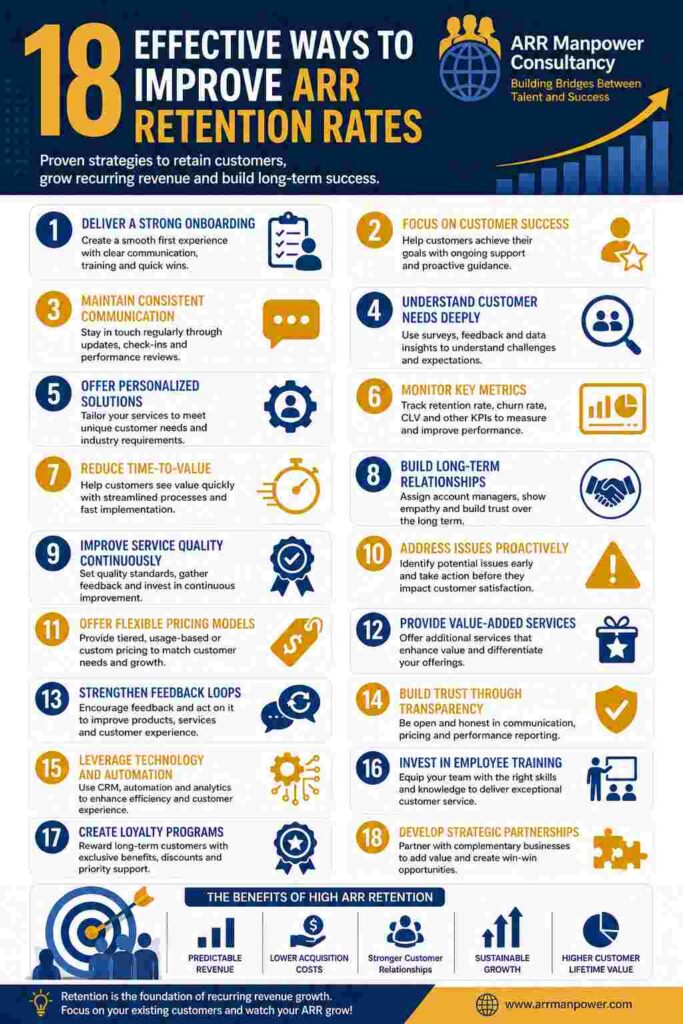
This article explores 18 effective ways to improve ARR retention rates, focusing on practical strategies that businesses—especially in service-based and manpower consultancy sectors—can implement to build long-term success.
https://arrmanpowerconsultancy.com/
1. Deliver a Strong Onboarding Experience
The customer journey begins with onboarding. A smooth and structured onboarding process sets the tone for the entire relationship.
Key Actions:
- Provide clear guidance and expectations
- Offer training sessions or demos
- Assign onboarding specialists
A strong start ensures customers quickly realize value, reducing early-stage churn.
2. Focus on Customer Success
Customer success goes beyond support—it involves actively helping clients achieve their goals.
Strategies:
- Regular check-ins
- Goal tracking
- Personalized recommendations
When customers succeed, they are more likely to stay and expand their engagement.
3. Maintain Consistent Communication
Lack of communication often leads to disengagement.
Best Practices:
- Monthly performance updates
- Quarterly business reviews
- Proactive outreach
Consistent interaction builds trust and strengthens relationships.
4. Understand Customer Needs Deeply
Retention improves when businesses truly understand their customers.
Methods:
- Conduct surveys
- Analyze usage data
- Gather feedback regularly
This insight allows you to tailor services and improve satisfaction.
5. Offer Personalized Solutions
Generic services rarely meet diverse client needs.
Personalization Examples:
- Customized hiring strategies
- Tailored service packages
- Industry-specific solutions
Personalization enhances perceived value and loyalty.
6. Monitor Key Metrics
Data-driven decisions are essential for improving retention.
Important Metrics:
- Customer retention rate
- Churn rate
- Customer lifetime value
Tracking these metrics helps identify issues early and optimize performance.
7. Reduce Time-to-Value
Customers expect quick results. The faster they see value, the more likely they are to stay.
How to Achieve This:
- Streamline processes
- Provide ready-to-use solutions
- Offer quick wins early
Early success reinforces confidence in your services.
8. Build Long-Term Relationships
Retention is rooted in relationships, not transactions.
Relationship-Building Tactics:
- Assign dedicated account managers
- Celebrate client milestones
- Offer loyalty incentives
Strong relationships lead to long-term partnerships.
9. Improve Service Quality Continuously
Consistent quality is essential for retaining customers.
Improvement Strategies:
- Regular performance reviews
- Training and skill development
- Quality assurance processes
High-quality service builds trust and reduces churn.
10. Address Issues Proactively
Waiting for customers to report problems can be risky.
Proactive Approach:
- Monitor performance indicators
- Identify potential issues early
- Resolve problems before escalation
Proactive support demonstrates commitment and reliability.
11. Offer Flexible Pricing Models
Rigid pricing structures can drive customers away.
Flexible Options:
- Tiered pricing
- Custom packages
- Usage-based pricing
Flexibility ensures that customers find value at every stage.
12. Provide Value-Added Services
Additional services can enhance customer satisfaction and retention.
Examples:
- HR consulting
- Compliance support
- Workforce analytics
Value-added offerings increase engagement and dependency.
13. Strengthen Client Feedback Loops
Feedback is essential for continuous improvement.
Feedback Channels:
- Surveys
- Interviews
- Review platforms
Acting on feedback shows customers that their opinions matter.
14. Build Trust Through Transparency
Transparency fosters trust and long-term loyalty.
Practices:
- Clear pricing
- Honest communication
- Transparent reporting
Trust is a key driver of retention.
15. Leverage Technology and Automation
Technology can enhance efficiency and customer experience.
Tools to Use:
- CRM systems
- Automation platforms
- Analytics tools
Automation ensures consistency and scalability.
16. Invest in Employee Training
Your team plays a critical role in customer retention.
Training Focus Areas:
- Communication skills
- Industry knowledge
- Problem-solving abilities
A skilled team delivers better service and improves retention.
17. Create Loyalty Programs
Rewarding long-term customers encourages continued engagement.
Loyalty Ideas:
- Discounts for renewals
- Exclusive services
- Priority support
Incentives strengthen customer commitment.
18. Develop Strategic Partnerships
Partnerships can enhance service offerings and value.
Examples:
- Collaborations with HR tech providers
- Training institutes
- Industry organizations
Partnerships expand capabilities and improve customer satisfaction.
Challenges in Improving Retention
While the benefits are clear, improving retention comes with challenges:
1. Changing Customer Expectations
Customers demand more value and flexibility.
2. Increased Competition
Competitors constantly offer alternative solutions.
3. Operational Complexity
Managing multiple clients and services can be challenging.
4. Data Management
Collecting and analyzing data effectively requires investment.
Overcoming these challenges requires strategic planning and adaptability.
Future Trends in Retention Strategies
As businesses evolve, retention strategies are also changing.
1. AI-Driven Insights
Predictive analytics for identifying churn risks.
2. Hyper-Personalization
Customized experiences based on customer behavior.
3. Remote Engagement
Virtual communication and service delivery.
4. Customer Experience Focus
Enhanced user experience as a retention driver.
Staying ahead of these trends ensures long-term success.
Best Practices for Sustained Retention
To maintain strong retention rates, businesses should:
- Continuously monitor performance metrics
- Invest in customer success initiatives
- Adapt to changing market conditions
- Focus on delivering consistent value
- Build strong customer relationships
Consistency and innovation are key to long-term retention.
Conclusion
Improving ARR retention rates is not a one-time initiative—it is an ongoing commitment to delivering consistent value, building strong customer relationships, and adapting to changing customer needs. While acquiring new customers is essential for business growth, retaining existing customers often provides a greater return on investment and creates a more stable foundation for long-term success.
The 18 strategies discussed in this article demonstrate that retention is influenced by multiple factors, including customer onboarding, product experience, support quality, communication, personalization, and proactive engagement. Businesses that focus on these areas are better positioned to reduce churn, increase customer satisfaction, and maximize recurring revenue. Even small improvements in retention can have a significant impact on annual revenue growth, profitability, and overall business sustainability.
One of the most important principles to remember is that customers stay when they continue to see measurable value. Organizations should regularly evaluate whether their products or services are helping customers achieve their goals. Gathering customer feedback, monitoring usage patterns, and identifying potential issues before they become problems can help businesses create a more customer-centric experience. Companies that actively listen to their customers are often able to strengthen loyalty and uncover opportunities for product improvement.
Customer success teams also play a critical role in retention efforts. By maintaining regular communication and providing timely assistance, businesses can build trust and demonstrate their commitment to customer outcomes. When customers feel supported and understood, they are more likely to renew contracts, expand their usage, and recommend the company to others. Retention is ultimately driven by relationships, and strong relationships are built through consistent engagement and genuine customer care.
Technology and data analytics can further enhance retention strategies. Businesses that track key performance indicators such as churn rate, customer lifetime value, product adoption, and customer health scores gain valuable insights into customer behavior. These insights enable organizations to make informed decisions, identify at-risk accounts, and implement targeted retention campaigns. Data-driven retention efforts are often more effective because they focus resources where they can generate the greatest impact.
Additionally, companies should view retention as a responsibility shared across the entire organization. Sales, marketing, product development, customer support, and leadership teams all contribute to the customer experience. When departments collaborate and align around customer success objectives, they create a seamless journey that encourages long-term loyalty. A company-wide retention culture helps ensure that every customer interaction reinforces value and strengthens trust.
As competition continues to increase across industries, businesses that prioritize retention will gain a significant advantage. Loyal customers not only generate recurring revenue but also serve as brand advocates who contribute to organic growth through referrals and positive reviews. This combination of stable revenue and customer advocacy creates a powerful engine for sustainable business expansion.
By implementing these 18 effective retention strategies and continuously refining your approach, your organization can improve ARR retention rates, reduce revenue loss, and build stronger customer relationships. The most successful companies understand that retention is not simply about preventing cancellations—it is about creating experiences that make customers want to stay, grow, and succeed alongside your business for years to come.
Furthermore, organizations that consistently invest in customer education, innovation, and relationship-building are more likely to maintain competitive advantages, increase customer lifetime value, and achieve predictable recurring revenue growth.
Improving ARR retention rates is not a one-time effort but an ongoing process that requires commitment, strategy, and execution. The 18 effective ways outlined in this article provide a comprehensive framework for businesses aiming to strengthen customer relationships and achieve sustainable growth.
By focusing on customer success, leveraging data, and continuously enhancing service quality, organizations can build a stable and predictable revenue base. In an increasingly competitive market, retention is not just a metric—it is a strategic advantage.
Businesses that prioritize retention will not only improve their financial performance but also establish lasting partnerships that drive long-term success.