Introduction
Hiring the right people is one of the most important responsibilities for any organization. Employees influence productivity, workplace culture, customer satisfaction, innovation, and overall business growth. While companies invest significant time and resources into recruitment, poor hiring choices continue to be a common challenge across industries. A single wrong hire can create ripple effects that extend far beyond the position itself.
Poor recruitment decisions occur when organizations select candidates who lack the required skills, experience, cultural fit, or long-term commitment needed for success. These mistakes often result from rushed hiring processes, inadequate screening, unclear job descriptions, or ineffective interviewing techniques. Although a bad hire may initially seem like a minor setback, its consequences can have a lasting impact on business performance.
Understanding the risks associated with poor recruitment practices can help organizations improve their hiring strategies and make better talent decisions. Below are six shocking consequences that demonstrate why effective recruitment is critical for long-term success.
https://arrmanpowerconsultancy.com
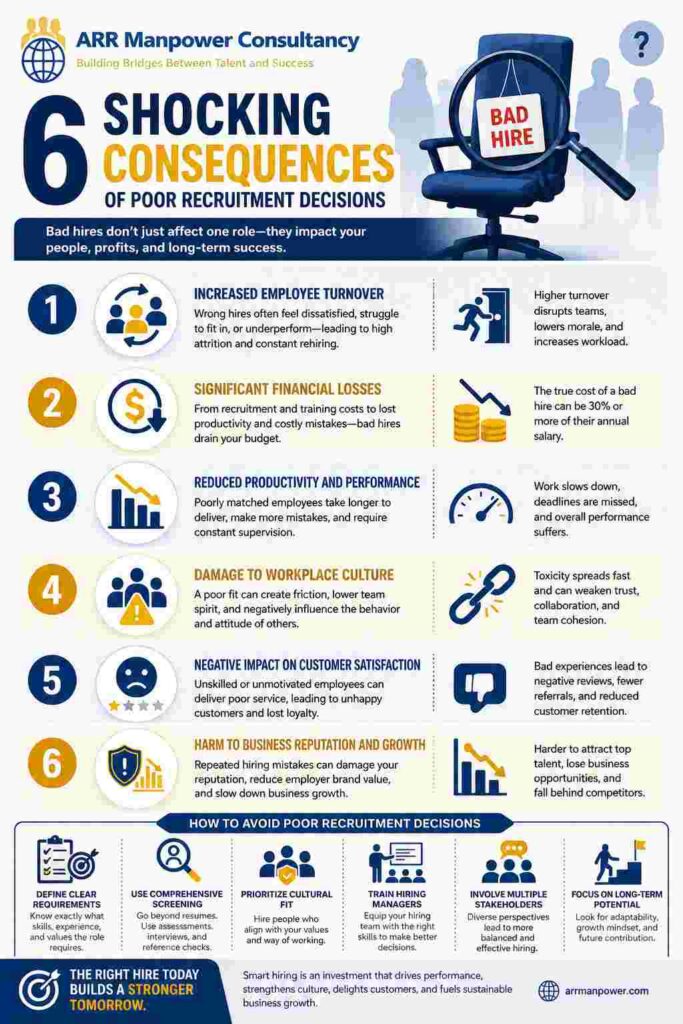
1. Increased Employee Turnover
One of the most immediate consequences of poor recruitment decisions is high employee turnover. When organizations hire individuals who are not suited for a role, those employees often struggle to meet expectations, feel dissatisfied, or fail to integrate with the team. As a result, they may leave voluntarily or be terminated within a short period.
Frequent employee departures create instability within the workforce. Managers must spend additional time recruiting, interviewing, onboarding, and training replacements instead of focusing on strategic priorities. Existing employees may also become frustrated by constant staffing changes, which can negatively affect morale.
High turnover rates can be particularly damaging in specialized industries where finding qualified professionals requires considerable effort. Replacing employees repeatedly increases workload pressures and delays project completion.
Organizations that experience ongoing turnover often develop a reputation for instability, making it more difficult to attract top talent in the future. Candidates may question why positions remain vacant or why employees frequently leave, leading them to explore opportunities elsewhere.
Reducing turnover begins with identifying candidates whose qualifications, values, and career goals align with organizational needs. A structured hiring process helps companies make informed decisions and improve retention rates over time.
2. Significant Financial Losses
Many business leaders underestimate the true cost of a bad hire. Poor recruitment decisions can lead to substantial financial losses that affect profitability and operational efficiency.
Recruitment expenses typically include advertising vacancies, sourcing candidates, conducting interviews, performing assessments, and onboarding new employees. When a hire does not work out, these investments are lost, and the organization must repeat the process.
In addition to direct hiring costs, businesses often incur indirect expenses such as:
- Training and development costs
- Reduced productivity during transition periods
- Overtime payments for existing employees
- Severance expenses
- Administrative and managerial time
A poorly selected employee may also make costly mistakes that impact projects, customers, or business operations. Errors in judgment, missed deadlines, compliance violations, or customer service issues can generate expenses that far exceed the original recruitment budget.
For senior positions, the financial consequences can be even greater. Leaders influence strategic decisions, resource allocation, and organizational direction. Hiring the wrong executive may result in poor business decisions that affect company performance for years.
Investing in thorough recruitment practices may seem time-consuming initially, but it often saves organizations significant amounts of money in the long run.
3. Reduced Productivity and Performance
Productivity is closely linked to workforce quality. When organizations hire individuals who lack the necessary skills or experience, overall performance often suffers.
Employees who are not adequately qualified may require excessive supervision and support. Managers spend valuable time correcting mistakes, providing additional training, and addressing performance issues. This reduces their ability to focus on leadership responsibilities and business objectives.
Team productivity can also decline when colleagues must compensate for underperforming employees. High-performing team members may take on additional responsibilities to ensure work gets completed correctly and on schedule. Over time, this imbalance can lead to frustration and burnout.
Poor recruitment decisions often create workflow disruptions. Projects may take longer to complete, quality standards may decline, and customer expectations may not be met. In competitive markets, reduced productivity can significantly impact an organization’s ability to maintain its position and achieve growth targets.
The effects are particularly noticeable when key roles remain ineffective for extended periods. Departments that rely on collaboration may experience communication breakdowns and operational inefficiencies.
By selecting candidates with the appropriate skills, experience, and motivation, organizations can build high-performing teams that contribute positively to productivity and business success.
4. Damage to Workplace Culture
Workplace culture plays a crucial role in employee engagement, collaboration, and organizational success. Poor recruitment decisions can disrupt team dynamics and create cultural challenges that affect the entire workforce.
Every organization has unique values, expectations, and ways of working. When new hires do not align with these cultural elements, conflicts may arise. Employees who struggle to adapt to organizational norms can create tension among colleagues and managers.
Negative behaviors such as poor communication, lack of accountability, resistance to teamwork, or unprofessional conduct can quickly influence workplace morale. Even highly skilled employees may become disengaged if they feel their work environment is being negatively affected.
Culture-related hiring mistakes often have a broader impact than skill-related issues. Technical deficiencies can sometimes be addressed through training, but behavioral and cultural mismatches are often more difficult to resolve.
Strong workplace cultures are built on trust, collaboration, and shared goals. Introducing individuals who undermine these principles can weaken team cohesion and reduce overall employee satisfaction.
Organizations that prioritize cultural alignment during recruitment are more likely to create positive work environments where employees feel valued, motivated, and committed to long-term success.
5. Negative Impact on Customer Satisfaction
Customers are directly affected by the quality of employees representing an organization. Poor recruitment decisions can lead to service failures, communication problems, and inconsistent customer experiences.
Employees who lack the necessary skills or training may struggle to address customer needs effectively. They may provide inaccurate information, respond slowly to inquiries, or fail to resolve issues appropriately. These shortcomings can result in customer frustration and dissatisfaction.
In customer-facing roles, every interaction contributes to brand perception. A single negative experience can influence whether a customer chooses to continue doing business with an organization. In today’s digital environment, dissatisfied customers can easily share their experiences through online reviews and social media platforms.
Poor customer experiences can have long-term consequences, including:
- Reduced customer loyalty
- Lower retention rates
- Negative reviews and ratings
- Loss of referrals
- Damage to brand reputation
The impact becomes even more significant in service-oriented industries where customer relationships are essential for success. Businesses that consistently deliver poor experiences may struggle to compete against organizations with stronger customer service teams.
Recruiting employees who possess both technical competence and strong interpersonal skills helps ensure positive customer interactions and strengthens overall business performance.
6. Harm to Business Reputation and Growth
A company’s reputation is one of its most valuable assets. Poor recruitment decisions can damage both internal and external perceptions of an organization.
Internally, employees may lose confidence in leadership if they observe repeated hiring mistakes. Team members often notice when new hires lack qualifications or fail to contribute effectively. This can reduce trust in management’s decision-making abilities.
Externally, customers, clients, partners, and job seekers may develop negative impressions of the organization. Consistent staffing problems can create concerns about professionalism, stability, and service quality.
Employer branding is especially important in today’s competitive job market. Talented candidates frequently research organizations before applying for positions. High turnover rates, negative employee reviews, and reports of poor workplace experiences can discourage qualified professionals from pursuing opportunities.
Business growth may also suffer when organizations lack the right talent to support expansion. Employees drive innovation, operational excellence, and customer satisfaction. Without a strong workforce, companies may struggle to achieve strategic goals and maintain competitive advantages.
Poor hiring decisions can delay growth initiatives, reduce market responsiveness, and limit organizational effectiveness. Over time, these challenges can hinder profitability and long-term sustainability.
Companies that prioritize effective recruitment are better positioned to build strong teams, maintain positive reputations, and achieve sustainable growth.
How Organizations Can Avoid Poor Recruitment Decisions
Preventing recruitment mistakes requires a strategic and structured approach. Organizations can improve hiring outcomes by implementing best practices throughout the recruitment process.
Define Clear Job Requirements
Accurate job descriptions help attract suitable candidates and establish clear expectations. Organizations should identify essential skills, qualifications, responsibilities, and performance objectives before beginning the recruitment process.
Use Comprehensive Screening Methods
Resume reviews alone are rarely sufficient for evaluating candidates. Combining interviews, assessments, reference checks, and skills testing provides a more complete understanding of a candidate’s suitability.
Prioritize Cultural Compatibility
Technical skills are important, but cultural alignment should also be considered. Candidates who share organizational values are often more likely to succeed and remain engaged over the long term.
Train Hiring Managers
Interviewing and candidate evaluation require specialized skills. Providing hiring managers with recruitment training can improve consistency and reduce bias in decision-making.
Involve Multiple Stakeholders
Gathering input from team members and department leaders can provide valuable perspectives and improve hiring accuracy.
Focus on Long-Term Potential
Organizations should look beyond immediate requirements and consider a candidate’s ability to grow, adapt, and contribute to future business objectives.
Conclusion
Poor recruitment decisions can have far-reaching consequences that extend well beyond a single vacant position. Increased turnover, financial losses, reduced productivity, cultural disruption, customer dissatisfaction, and reputational damage are just some of the challenges organizations may face when hiring mistakes occur.
Effective recruitment is not simply about filling vacancies quickly. It involves identifying individuals who possess the right combination of skills, experience, values, and potential to contribute to organizational success. By implementing structured hiring processes and making informed talent decisions, businesses can reduce risks, strengthen their workforce, and create a foundation for sustainable growth.
Organizations that invest in quality recruitment practices are better equipped to build high-performing teams, maintain strong customer relationships, and achieve long-term business success in an increasingly competitive marketplace.
https://www.shrm.org/home?int_content=front-door
https://trailhead.salesforce.com/
https://www.linkedin.com/pulse/essential-skills-employers-look-todays-job-market-consultancy-h7sqf