Introduction
Every organization depends on its people to achieve success. Whether it is a startup building its first team or a multinational corporation expanding operations, hiring the right employees remains one of the most important business functions. Yet many companies continue to underestimate the impact of poor hiring decisions. A single wrong hire can create financial losses, reduce productivity, damage workplace culture, and affect customer satisfaction.
Recruitment is not simply about filling vacant positions. It is about identifying individuals whose skills, attitude, and values align with organizational goals. When this process fails, the consequences often extend far beyond the initial recruitment cost.
Many employers focus only on the immediate expenses of hiring, such as advertising job openings or conducting interviews. However, the hidden costs associated with a poor hiring decision can be significantly greater. Understanding these consequences can help businesses improve their recruitment strategies and avoid costly mistakes.
Here are five shocking facts about poor hiring decisions and why organizations should take recruitment more seriously than ever before.
https://arrmanpowerconsultancy.com
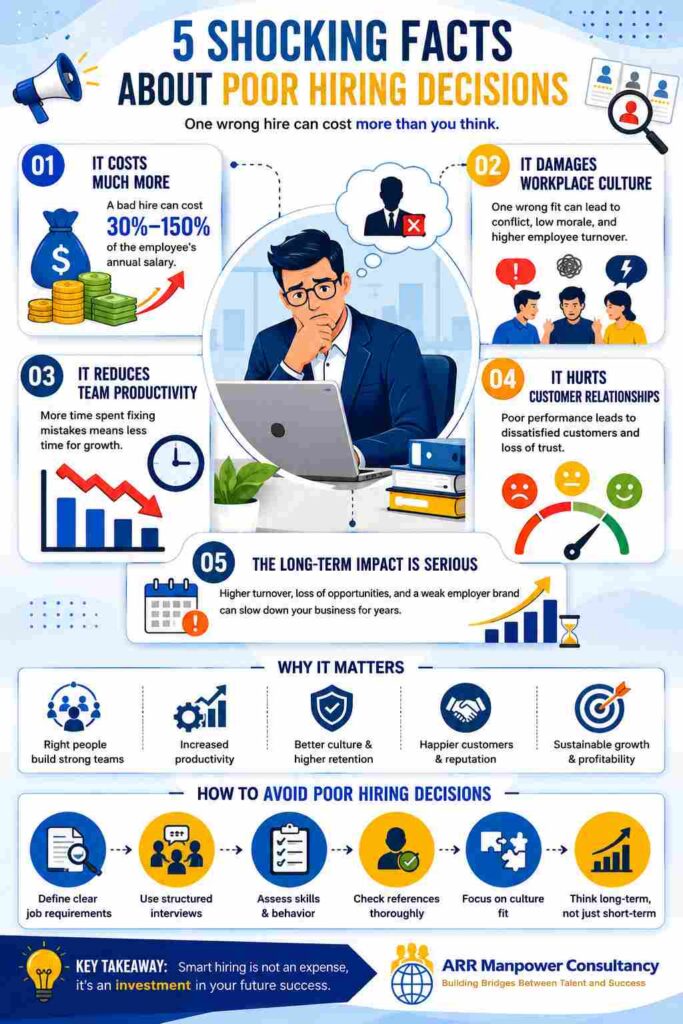
1. A Bad Hire Can Cost Much More Than the Employee’s Annual Salary
One of the most surprising facts about poor hiring decisions is the actual financial impact. Many employers assume that replacing an employee only involves recruitment expenses. In reality, the cost is often much higher.
When an unsuitable candidate joins an organization, businesses invest time and resources in onboarding, training, supervision, and performance management. If the employee fails to meet expectations, managers spend additional hours addressing issues, providing feedback, and attempting corrective measures.
The financial burden includes:
- Recruitment and advertising costs
- Interview and assessment expenses
- Onboarding and training investments
- Reduced productivity during the adjustment period
- Severance or termination costs
- Additional recruitment efforts for replacement
Furthermore, the impact extends to team productivity. Colleagues may need to compensate for underperformance, leading to increased workloads and reduced efficiency.
For small and medium-sized businesses, a single hiring mistake can significantly affect profitability. In some cases, the cumulative cost may exceed several times the employee’s annual compensation.
This reality highlights the importance of implementing structured hiring processes that prioritize quality over speed.
2. Poor Hiring Decisions Can Damage Workplace Culture
Many organizations focus heavily on technical qualifications while overlooking cultural compatibility. However, culture plays a critical role in long-term employee success.
An individual who lacks alignment with company values can disrupt team dynamics and create tension among colleagues. Even highly skilled professionals may struggle if their communication style, work ethic, or attitude conflicts with the organization’s culture.
The effects often include:
- Increased workplace conflicts
- Lower employee morale
- Reduced collaboration
- Higher stress levels among team members
- Decreased engagement
Culture-related hiring mistakes can spread negativity throughout an organization. Employees who previously enjoyed their work environment may become frustrated when forced to deal with ongoing interpersonal challenges.
Over time, this dissatisfaction can contribute to higher turnover rates. Talented employees may choose to leave rather than remain in an unhealthy workplace environment.
Organizations that prioritize cultural fit alongside technical competence often experience stronger teamwork, better communication, and improved retention outcomes.
3. One Wrong Hire Can Reduce Overall Team Productivity
A common misconception is that the impact of a poor hiring decision is limited to the individual employee. In reality, the entire team may suffer.
Teams function most effectively when members contribute consistently and support shared objectives. When one employee underperforms, other team members frequently absorb additional responsibilities.
This creates several challenges:
Increased Workload
Colleagues may need to correct mistakes, complete unfinished tasks, or provide ongoing assistance. This additional burden can reduce their own productivity.
Delayed Projects
Missed deadlines and incomplete assignments can affect project timelines. Teams may struggle to maintain momentum when one member fails to meet expectations.
Reduced Motivation
Employees often become discouraged when they perceive unequal contributions within the team. High performers may feel their efforts are not being recognized fairly.
Managerial Distractions
Managers spend valuable time addressing performance concerns rather than focusing on strategic initiatives and business growth.
The cumulative effect can be substantial. What begins as a single hiring error may evolve into broader organizational inefficiencies that affect multiple departments.
Businesses that invest in careful candidate evaluation are more likely to build teams capable of maintaining consistent performance and achieving organizational goals.
4. Poor Recruitment Choices Can Harm Customer Relationships
Customers may never see internal hiring processes, but they often experience the consequences of poor recruitment decisions directly.
Employees frequently serve as the face of an organization. Their interactions shape customer perceptions and influence purchasing decisions. When an unsuitable individual occupies a customer-facing role, service quality can decline significantly.
Potential consequences include:
- Poor communication with clients
- Delayed responses to inquiries
- Increased customer complaints
- Inconsistent service delivery
- Damage to brand reputation
In competitive markets, customer loyalty is difficult to earn and easy to lose. A single negative experience may encourage customers to seek alternatives from competitors.
The digital age has amplified this risk. Dissatisfied customers can quickly share their experiences through online reviews and social media platforms. Negative feedback may influence potential customers long after the original incident occurs.
Businesses that prioritize hiring individuals with strong communication skills, professionalism, and customer-focused attitudes often build stronger client relationships and protect their brand reputation.
Ultimately, recruitment decisions affect not only internal operations but also external perceptions of the organization.
5. The Long-Term Impact Is Often Hidden Until It Becomes Serious
Perhaps the most shocking fact about poor hiring decisions is that many consequences remain invisible during the early stages.
Organizations often focus on immediate performance indicators while overlooking subtle warning signs. Problems may gradually accumulate over months before becoming obvious.
Common hidden consequences include:
Higher Employee Turnover
Poor hiring decisions can contribute to employee dissatisfaction and increased resignations. Existing staff may leave due to workplace conflicts, management challenges, or increased workloads.
Reduced Innovation
Teams perform best when employees contribute diverse perspectives and creative ideas. An unsuitable hire may limit collaboration and discourage innovation.
Lost Business Opportunities
Managers who spend excessive time addressing performance issues have less capacity to pursue growth opportunities, strategic planning, and business development initiatives.
Increased Recruitment Cycles
Replacing unsuitable employees creates a continuous cycle of recruitment, onboarding, and training. This process consumes resources that could otherwise support organizational growth.
Employer Brand Damage
Organizations known for high turnover or poor workplace experiences may struggle to attract top talent. Recruitment challenges can become more severe over time.
Because these effects develop gradually, many leaders fail to connect them directly to hiring decisions. By the time the full impact becomes apparent, significant damage may already have occurred.
Recognizing the long-term implications of recruitment mistakes enables organizations to adopt a more proactive approach to talent acquisition.
Why Poor Hiring Decisions Happen
Understanding the causes behind hiring mistakes is essential for prevention. Several factors commonly contribute to ineffective recruitment outcomes.
Rushing the Hiring Process
Many organizations face pressure to fill vacancies quickly. Urgency can lead to shortcuts in candidate evaluation and decision-making.
Inadequate Job Descriptions
Unclear expectations attract unsuitable applicants and create confusion during the selection process.
Overreliance on Resumes
A resume provides valuable information, but it does not reveal everything about a candidate’s abilities, personality, or cultural compatibility.
Lack of Structured Interviews
Inconsistent interview methods make it difficult to compare candidates objectively.
Insufficient Reference Checks
Failing to verify employment history and professional performance increases hiring risks.
Ignoring Soft Skills
Technical expertise is important, but communication, adaptability, teamwork, and problem-solving abilities often determine long-term success.
Organizations that address these common challenges are more likely to make informed hiring decisions.
How Companies Can Avoid Costly Hiring Mistakes
Preventing poor recruitment outcomes requires a strategic approach. Several best practices can improve hiring accuracy and reduce risk.
Define Clear Requirements
Develop detailed job descriptions outlining responsibilities, qualifications, and performance expectations.
Implement Structured Interviews
Use standardized questions and evaluation criteria to assess candidates consistently.
Assess Cultural Compatibility
Evaluate whether candidates align with organizational values and workplace expectations.
Verify References Thoroughly
Contact previous employers and professional references to confirm qualifications and performance history.
Use Skills Assessments
Practical evaluations can provide valuable insights into a candidate’s capabilities.
Involve Multiple Stakeholders
Including managers, team members, and HR professionals in the selection process can improve decision quality.
Focus on Long-Term Potential
Consider growth potential, adaptability, and learning ability in addition to current qualifications.
Organizations that adopt these strategies often experience stronger hiring outcomes and improved employee retention.
Conclusion
Poor hiring decisions can have far-reaching consequences that extend well beyond recruitment expenses. From financial losses and reduced productivity to damaged workplace culture and weakened customer relationships, the impact can affect nearly every aspect of an organization.
The five shocking facts discussed in this article demonstrate why recruitment should be viewed as a strategic business function rather than an administrative task. A single hiring mistake can influence team performance, employee engagement, customer satisfaction, and long-term organizational success.
Businesses that invest in effective recruitment processes are better positioned to attract qualified candidates, build high-performing teams, and achieve sustainable growth. By prioritizing careful evaluation, cultural alignment, and long-term potential, organizations can reduce hiring risks and create a stronger foundation for future success.
In today’s competitive business environment, making informed hiring decisions is not merely beneficial—it is essential. The cost of getting recruitment wrong is simply too high to ignore.