Introduction
The logistics industry serves as the backbone of global trade and commerce. From warehousing and transportation to inventory management and last-mile delivery, logistics companies play a crucial role in ensuring products reach customers efficiently. However, one of the biggest challenges facing the sector today is finding and retaining qualified employees.
As supply chains become more complex and customer expectations continue to rise, businesses require skilled professionals who can manage operations effectively. Unfortunately, labor shortages, high turnover rates, and increasing competition for talent make hiring a difficult task. This is why implementing effective recruitment solutions is essential for logistics organizations seeking sustainable growth.
This article explores eleven proven recruitment solutions that help logistics companies attract, hire, and retain high-quality talent while improving operational efficiency.
https://arrmanpowerconsultancy.com
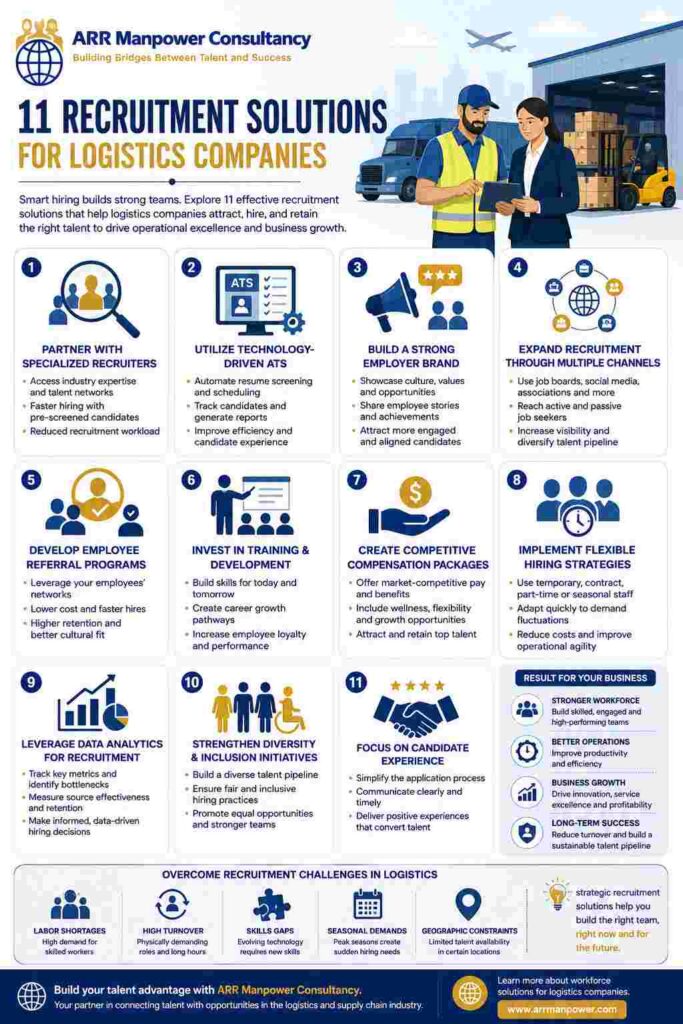
1. Partner with Specialized Recruitment Agencies
One of the most effective ways to address hiring challenges is by partnering with recruitment agencies that specialize in logistics and supply chain staffing.
Specialized recruiters understand industry-specific requirements, job roles, certifications, and market trends. They maintain extensive talent networks that allow them to identify qualified candidates quickly.
Benefits include:
- Faster hiring processes
- Access to pre-screened candidates
- Reduced recruitment workload
- Industry-specific expertise
- Improved hiring accuracy
Whether a company needs warehouse supervisors, fleet managers, supply chain analysts, or transportation coordinators, specialized agencies can significantly shorten the hiring timeline.
2. Utilize Technology-Driven Applicant Tracking Systems
Modern hiring requires technology that streamlines recruitment activities. Applicant Tracking Systems (ATS) help logistics companies manage candidate applications efficiently.
An ATS can:
- Automate resume screening
- Track candidate progress
- Schedule interviews
- Store applicant information
- Generate recruitment reports
Automation reduces administrative tasks and allows HR teams to focus on evaluating talent rather than handling paperwork. It also improves candidate experience by ensuring timely communication throughout the hiring process.
Organizations that adopt digital recruitment tools often experience faster hiring cycles and better workforce planning.
3. Build a Strong Employer Brand
Today’s job seekers carefully evaluate employers before applying. A strong employer brand can help logistics companies stand out in a competitive labor market.
Employer branding involves showcasing:
- Company culture
- Employee success stories
- Career growth opportunities
- Workplace safety initiatives
- Training and development programs
Companies can strengthen their brand through social media, career pages, employee testimonials, and industry events.
When candidates perceive an organization as a desirable workplace, they are more likely to apply and accept job offers. Strong employer branding also contributes to improved employee retention.
4. Expand Recruitment Through Multiple Channels
Relying on a single hiring source limits access to talent. Logistics companies should diversify their recruitment channels to reach a broader candidate pool.
Effective sourcing channels include:
- Online job boards
- Professional networking platforms
- Industry associations
- Employee referrals
- Career fairs
- Educational institutions
- Social media platforms
A multi-channel strategy increases visibility and improves the likelihood of finding qualified candidates for various roles.
Combining traditional and digital recruitment methods ensures organizations can connect with both active and passive job seekers.
5. Develop Employee Referral Programs
Employee referral programs remain one of the most reliable hiring methods across industries.
Current employees often understand company culture and job requirements better than external recruiters. Their recommendations can lead to high-quality hires who fit organizational needs.
Advantages include:
- Lower recruitment costs
- Faster hiring timelines
- Better cultural fit
- Higher retention rates
- Improved employee engagement
Offering incentives such as bonuses, recognition, or rewards can encourage employees to participate actively in referral initiatives.
Many logistics companies report that referred candidates tend to perform better and remain with the organization longer.
6. Invest in Workforce Training and Development
Sometimes the ideal candidate may not possess every required skill. Rather than searching endlessly for perfect applicants, logistics companies can hire individuals with strong potential and provide targeted training.
Training programs can focus on:
- Warehouse operations
- Transportation management
- Inventory control
- Safety compliance
- Technology utilization
- Leadership development
Upskilling initiatives expand the available talent pool and create internal career pathways.
Employees who receive training opportunities often demonstrate greater loyalty and commitment to their employers, resulting in reduced turnover and improved productivity.
7. Create Competitive Compensation Packages
Compensation plays a major role in attracting and retaining talent. Logistics organizations must regularly evaluate market rates to ensure their salary offerings remain competitive.
A comprehensive compensation package may include:
- Competitive wages
- Performance bonuses
- Health benefits
- Retirement plans
- Paid time off
- Flexible schedules
- Wellness programs
Beyond salary, employees increasingly value work-life balance and professional development opportunities.
Conducting regular compensation benchmarking helps companies remain attractive employers within their local and regional labor markets.
8. Implement Flexible Hiring Strategies
The logistics sector often experiences seasonal fluctuations and changing workforce demands. Flexible hiring strategies allow organizations to adapt quickly.
Options include:
- Temporary staffing
- Contract workers
- Part-time employees
- Seasonal hiring
- Project-based recruitment
Flexible workforce models help businesses manage peak periods without committing to long-term labor costs.
Additionally, these arrangements can serve as effective trial periods for evaluating candidates before extending permanent employment offers.
Organizations that embrace flexibility often maintain greater operational resilience during periods of market uncertainty.
9. Leverage Data Analytics for Recruitment
Data-driven recruitment enables logistics companies to make informed hiring decisions.
Recruitment analytics can provide insights into:
- Time-to-hire metrics
- Cost-per-hire
- Candidate sources
- Employee retention rates
- Recruitment effectiveness
- Workforce forecasting
Analyzing recruitment data helps organizations identify bottlenecks and optimize hiring strategies.
For example, if referral hires consistently outperform candidates from other sources, HR teams can allocate additional resources toward referral programs.
Data-driven decision-making improves hiring efficiency and supports long-term workforce planning.
10. Strengthen Diversity and Inclusion Initiatives
A diverse workforce brings valuable perspectives, innovation, and problem-solving capabilities to logistics operations.
Companies can improve workforce diversity by:
- Expanding sourcing efforts
- Eliminating hiring bias
- Providing inclusive training
- Developing equitable hiring processes
- Promoting equal advancement opportunities
Inclusive workplaces often experience higher employee satisfaction and stronger organizational performance.
Diversity initiatives also enhance employer reputation and broaden access to talented candidates from different backgrounds.
As workforce demographics continue to evolve, diversity and inclusion remain important components of successful recruitment strategies.
11. Focus on Candidate Experience
Candidate experience significantly influences hiring outcomes. Job seekers often form lasting impressions based on their interactions during the recruitment process.
Positive candidate experiences involve:
- Clear job descriptions
- Simple application procedures
- Timely communication
- Professional interviews
- Transparent expectations
- Constructive feedback
Lengthy application processes and poor communication can cause qualified candidates to accept opportunities elsewhere.
Logistics companies that prioritize candidate experience often achieve higher offer acceptance rates and stronger employer reputations.
Every interaction should reinforce professionalism, respect, and organizational values.
Common Recruitment Challenges in Logistics
While implementing recruitment solutions can improve hiring outcomes, understanding common industry challenges is equally important.
Labor Shortages
Many regions face ongoing shortages of qualified drivers, warehouse workers, and supply chain professionals. Competition for talent continues to intensify.
High Employee Turnover
Logistics roles often involve physically demanding work and non-traditional schedules, contributing to higher turnover rates.
Skills Gaps
Technological advancements require employees to possess new technical skills that may not be readily available in the labor market.
Seasonal Demand Fluctuations
Peak shipping seasons create sudden workforce demands that require rapid staffing solutions.
Geographic Constraints
Some logistics facilities operate in locations with limited access to skilled labor, making recruitment more challenging.
Addressing these challenges requires a combination of strategic planning, technology adoption, and proactive talent management.
Future Trends in Logistics Recruitment
The recruitment landscape continues to evolve. Logistics companies should prepare for emerging trends that will shape workforce acquisition in the coming years.
Artificial Intelligence in Hiring
AI-powered recruitment tools can automate candidate screening, scheduling, and assessment processes.
Remote Workforce Management
Certain logistics functions, including planning and administrative roles, increasingly support remote work arrangements.
Skills-Based Hiring
Organizations are shifting from traditional qualification requirements toward skills-focused hiring practices.
Workforce Automation
As automation expands, recruitment efforts will increasingly focus on technical and supervisory roles.
Continuous Learning Culture
Employers will prioritize candidates who demonstrate adaptability and commitment to ongoing professional development.
Companies that stay ahead of these trends will be better positioned to attract and retain top talent.
Conclusion
Recruitment remains one of the most critical challenges facing logistics companies today. Growing customer expectations, labor shortages, technological transformation, and increasing competition for skilled workers require organizations to adopt innovative hiring strategies.
By implementing solutions such as partnering with specialized recruiters, leveraging technology, strengthening employer branding, expanding sourcing channels, encouraging employee referrals, investing in training, offering competitive compensation, utilizing flexible staffing models, embracing analytics, promoting diversity, and improving candidate experience, logistics businesses can build stronger and more resilient workforces.
Successful recruitment is not simply about filling vacancies. It is about creating a long-term talent strategy that supports business growth, operational excellence, and customer satisfaction. Organizations that invest in effective hiring practices today will be better equipped to navigate future challenges and achieve sustainable success in the evolving logistics landscape.
Furthermore, organizations that continuously refine their hiring strategies and adapt to changing workforce trends will gain a significant competitive advantage. A proactive approach to talent acquisition not only strengthens operational performance but also enhances employee satisfaction and retention. By prioritizing workforce excellence, logistics companies can build agile teams capable of meeting evolving industry demands and supporting long-term business success.