Introduction
Hiring is one of the most important decisions any business can make. Every employee contributes to the company’s productivity, culture, customer experience, and long-term success. While a great hire can drive innovation and profitability, the wrong hiring decision can create costly setbacks that affect business performance for years.
Many organizations focus heavily on attracting candidates but often overlook common mistakes made during the recruitment process. These mistakes can lead to poor employee performance, high turnover rates, reduced morale, and significant financial losses. According to various industry studies, replacing a bad hire can cost several times the employee’s annual salary when recruitment expenses, training costs, and productivity losses are considered.
Whether you’re a startup, a growing business, or an established enterprise, avoiding hiring pitfalls is essential for sustainable growth. Understanding the most common hiring errors can help organizations build stronger teams and create a more efficient recruitment strategy.
In this article, we’ll explore eight dangerous hiring mistakes that can negatively impact business growth and discuss practical ways to avoid them.
https://arrmanpowerconsultancy.com
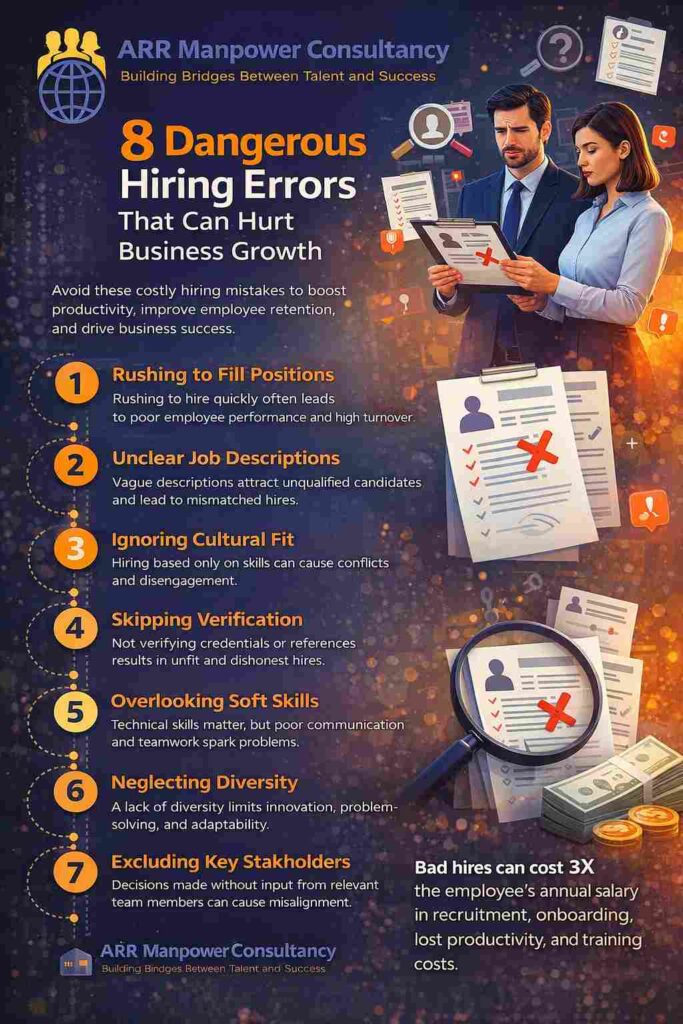
1. Hiring Too Quickly to Fill Vacancies
One of the most common recruitment mistakes is rushing to fill open positions. When a role remains vacant for an extended period, managers often feel pressure to hire the first seemingly qualified candidate available.
While filling positions quickly may seem beneficial, making decisions without proper evaluation can result in hiring someone who lacks the necessary skills, experience, or cultural fit. A rushed hiring process often leads to poor performance, dissatisfaction, and eventual turnover.
Consequences of Fast Hiring
- Increased risk of poor employee performance
- Higher turnover rates
- Additional recruitment expenses
- Disruption of team productivity
- Lower workplace morale
How to Avoid It
Create a structured recruitment process that includes clear job requirements, multiple interview stages, skill assessments, and thorough candidate evaluations. Taking extra time to make the right decision often saves significant resources in the long run.
2. Writing Unclear Job Descriptions
A poorly written job description can attract the wrong candidates and discourage qualified professionals from applying. When responsibilities, expectations, and required qualifications are not clearly defined, recruiters may receive applications from individuals who are not suitable for the role.
Unclear job postings can also create confusion after hiring, leading to unmet expectations and reduced employee satisfaction.
Common Problems in Job Descriptions
- Vague responsibilities
- Excessive qualification requirements
- Missing information about company culture
- Unrealistic expectations
- Lack of performance objectives
How to Avoid It
Develop detailed job descriptions that clearly explain:
- Key responsibilities
- Required skills and experience
- Performance expectations
- Career growth opportunities
- Company values and culture
Accurate job descriptions help attract candidates who are genuinely aligned with the role and organizational goals.
3. Ignoring Cultural Fit
Technical skills are important, but cultural compatibility plays a significant role in employee success. A candidate may possess excellent qualifications yet struggle to adapt to the organization’s work environment, communication style, or values.
When cultural fit is overlooked, businesses often experience conflicts, lower engagement, and increased turnover.
Signs of Poor Cultural Alignment
- Difficulty collaborating with teams
- Resistance to company values
- Communication challenges
- Reduced job satisfaction
- Frequent workplace conflicts
How to Avoid It
During interviews, evaluate both technical abilities and behavioral traits. Ask questions that reveal how candidates approach teamwork, problem-solving, leadership, and workplace challenges.
Organizations should define their culture clearly and ensure hiring managers assess alignment throughout the recruitment process.
4. Failing to Verify Candidate Information
Resumes and interviews provide valuable insights, but they do not always tell the complete story. Some candidates may exaggerate qualifications, responsibilities, or achievements.
Failing to verify employment history, educational credentials, and references can lead to hiring individuals who cannot meet job expectations.
Risks of Skipping Verification
- Reduced productivity
- Compliance concerns
- Damaged reputation
- Increased training costs
- Higher turnover
How to Avoid It
Implement a consistent verification process that includes:
- Reference checks
- Employment verification
- Educational background verification
- Professional certification validation
- Skills assessments when applicable
Conducting due diligence helps organizations make informed hiring decisions and reduce recruitment risks.
5. Overlooking Soft Skills
Many employers focus heavily on technical expertise while neglecting essential soft skills. However, qualities such as communication, adaptability, teamwork, emotional intelligence, and problem-solving often determine long-term success.
An employee with strong technical abilities but poor interpersonal skills can negatively affect collaboration and workplace productivity.
Important Soft Skills to Assess
- Communication
- Leadership
- Adaptability
- Critical thinking
- Time management
- Emotional intelligence
How to Avoid It
Incorporate behavioral interview questions and real-world scenarios into the hiring process. Evaluate how candidates handle challenges, collaborate with others, and respond to feedback.
Balancing technical qualifications with interpersonal abilities leads to stronger team performance and improved workplace relationships.
6. Neglecting Diversity in Hiring
A lack of diversity can limit creativity, innovation, and problem-solving capabilities. Organizations that repeatedly hire similar candidates may unintentionally create homogeneous teams that struggle to adapt to changing market conditions.
Diverse teams bring varied perspectives, experiences, and ideas, which often contribute to better decision-making and business outcomes.
Consequences of Limited Diversity
- Reduced innovation
- Narrow problem-solving approaches
- Lower employee engagement
- Missed market opportunities
- Weaker employer branding
How to Avoid It
Develop inclusive recruitment strategies that focus on skills, potential, and qualifications rather than unconscious biases. Consider expanding sourcing channels to reach a broader talent pool.
Training hiring managers on diversity and inclusion practices can also improve recruitment outcomes and workplace culture.
7. Failing to Involve Key Stakeholders
Hiring decisions made by a single individual can increase the risk of bias and poor judgment. Different stakeholders often provide valuable perspectives that help identify the best candidate for a position.
When managers fail to collaborate with team leaders, department heads, or HR professionals, important concerns may go unnoticed.
Problems Caused by Limited Input
- Inconsistent hiring decisions
- Poor team compatibility
- Increased onboarding challenges
- Reduced employee retention
- Hiring bias
How to Avoid It
Create a collaborative recruitment process involving relevant stakeholders. Panel interviews, structured feedback systems, and candidate evaluation scorecards can improve decision-making accuracy.
Multiple perspectives help organizations make more balanced and effective hiring choices.
8. Ignoring Employee Retention During Hiring
Many companies focus entirely on filling positions without considering long-term retention. Hiring candidates who are unlikely to stay with the organization can result in repeated recruitment cycles and increased operational costs.
Employee retention begins during recruitment. Candidates should understand the role, expectations, career opportunities, and workplace environment before accepting an offer.
Signs of Potential Retention Issues
- Unrealistic job expectations
- Limited career growth opportunities
- Poor cultural alignment
- Compensation concerns
- Lack of engagement during interviews
How to Avoid It
Be transparent throughout the hiring process. Discuss career development opportunities, company culture, performance expectations, and organizational goals.
Candidates who have a realistic understanding of the role are more likely to remain engaged and committed over the long term.
The Financial Impact of Hiring Mistakes
Hiring errors affect far more than recruitment budgets. The financial consequences often extend across multiple areas of the business.
Direct Costs
- Recruitment expenses
- Advertising costs
- Interview time
- Onboarding expenses
- Training investments
Indirect Costs
- Reduced productivity
- Lower team morale
- Customer dissatisfaction
- Project delays
- Lost business opportunities
When organizations repeatedly make poor hiring decisions, these costs accumulate and create significant barriers to growth.
Building a Stronger Hiring Strategy
Avoiding recruitment mistakes requires a proactive and strategic approach. Businesses that consistently hire top talent typically follow well-defined processes and continuously improve their recruitment methods.
Best Practices for Better Hiring
Define Success Clearly
Identify the skills, experience, and behaviors required for success in each role.
Standardize Interviews
Use structured interview questions to ensure fair and consistent evaluations.
Assess Both Skills and Behavior
Evaluate technical expertise alongside communication, teamwork, and adaptability.
Invest in Employer Branding
A strong employer reputation attracts higher-quality candidates and improves recruitment efficiency.
Use Data-Driven Decisions
Track recruitment metrics such as time-to-hire, quality-of-hire, retention rates, and employee performance.
Prioritize Candidate Experience
A positive recruitment experience strengthens your employer brand and increases offer acceptance rates.
The Role of Leadership in Hiring Success
Leadership plays a critical role in recruitment outcomes. Hiring should not be viewed solely as an HR responsibility. Managers and executives must actively participate in workforce planning, talent acquisition, and employee development.
Strong leaders understand that every hiring decision influences organizational culture, customer satisfaction, and future business performance.
When leadership teams prioritize thoughtful recruitment practices, businesses gain a competitive advantage in attracting and retaining top talent.
Conclusion
Hiring is far more than filling vacant positions. It is a strategic business function that directly impacts productivity, profitability, innovation, and long-term growth. Unfortunately, many organizations continue to make avoidable hiring mistakes that lead to costly consequences.
Rushing recruitment decisions, neglecting cultural fit, overlooking soft skills, failing to verify information, and ignoring diversity are just a few of the errors that can weaken organizational performance. These mistakes often result in higher turnover, reduced employee engagement, and increased operational expenses.
By implementing structured hiring processes, involving key stakeholders, assessing both technical and behavioral competencies, and focusing on long-term retention, businesses can significantly improve hiring outcomes.
Successful organizations recognize that every hiring decision shapes the future of the company. Avoiding these eight dangerous hiring errors can help build stronger teams, improve employee retention, and create a foundation for sustainable business.