Introduction
In today’s competitive business environment, organizations must remain agile, cost-efficient, and prepared to respond quickly to market changes. Hiring the right talent at the right time has become one of the most critical factors for business success. However, traditional recruitment methods can be time-consuming, expensive, and inflexible.
This is where contract staffing services have emerged as a practical workforce solution. Businesses across industries are increasingly leveraging temporary and project-based professionals to meet operational demands without the long-term commitments associated with permanent hiring.
Whether a company is managing seasonal workloads, launching new projects, addressing skill shortages, or controlling labor costs, contract staffing offers a strategic advantage. By providing access to qualified professionals on demand, organizations can maintain productivity while adapting to changing business requirements.
This article explores thirteen significant benefits that make contract staffing an essential workforce strategy for modern businesses.
https://arrmanpowerconsultancy.com
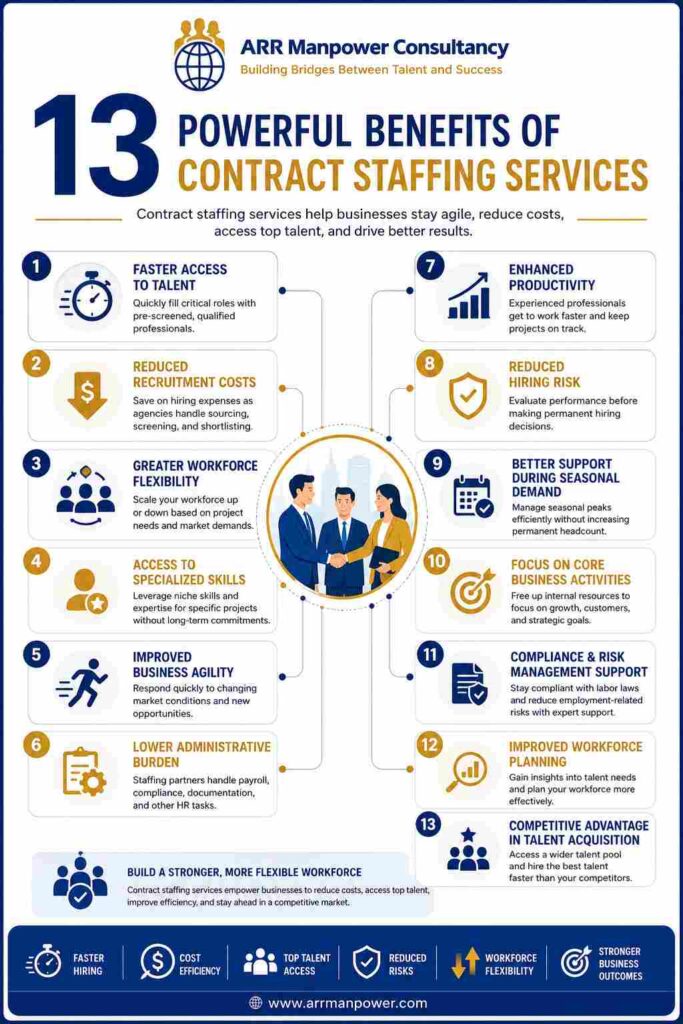
1. Faster Access to Qualified Talent
One of the most significant advantages of contract staffing is the ability to fill positions quickly. Traditional recruitment often involves lengthy job postings, multiple interview rounds, background checks, and onboarding procedures.
Staffing agencies maintain extensive databases of pre-screened candidates who are ready to begin work immediately. This allows organizations to reduce hiring timelines dramatically.
When urgent vacancies arise or critical projects require immediate staffing support, businesses can secure qualified professionals without disrupting operations. Faster hiring helps maintain productivity and prevents delays that could impact customer satisfaction or project deadlines.
2. Reduced Recruitment Costs
Hiring employees involves more expenses than many organizations realize. Costs may include advertising vacancies, conducting interviews, performing assessments, onboarding new hires, and training staff.
Contract staffing significantly reduces these expenses because staffing providers manage much of the recruitment process. Organizations save both time and financial resources while gaining access to suitable candidates.
By minimizing recruitment overhead, businesses can allocate their budgets toward growth initiatives, technology investments, and other strategic objectives rather than extensive hiring campaigns.
3. Greater Workforce Flexibility
Business needs rarely remain constant throughout the year. Demand fluctuations, seasonal peaks, and project-based requirements often create temporary workforce gaps.
Contract staffing allows organizations to scale their workforce up or down according to operational requirements. Companies can bring in additional professionals during busy periods and adjust staffing levels once demand stabilizes.
This flexibility enables businesses to remain responsive without carrying unnecessary labor costs during slower periods.
4. Access to Specialized Skills
Many projects require expertise that may not exist within the current workforce. Hiring permanent employees for short-term skill requirements may not be financially practical.
Contract professionals often possess highly specialized knowledge in areas such as information technology, engineering, healthcare, finance, manufacturing, and digital marketing.
Organizations can quickly access niche expertise without committing to long-term employment contracts. This approach helps businesses complete projects efficiently while maintaining high-quality standards.
5. Improved Business Agility
Modern markets evolve rapidly, and organizations must adapt quickly to remain competitive. New technologies, customer expectations, and industry trends frequently create changing workforce demands.
Contract staffing enables businesses to respond rapidly to evolving situations by acquiring talent precisely when needed.
Whether entering new markets, launching products, or managing unexpected growth, organizations gain the workforce agility required to navigate dynamic business conditions effectively.
6. Lower Administrative Burden
Managing recruitment, payroll, benefits administration, compliance documentation, and employee records can consume significant internal resources.
In many staffing arrangements, agencies handle a substantial portion of these administrative responsibilities. This reduces workload pressures on human resources teams and management personnel.
As a result, internal departments can focus on strategic workforce planning, employee development, and organizational growth rather than routine administrative tasks.
7. Enhanced Productivity
Vacant positions can negatively impact productivity, employee morale, and customer service quality. Existing team members may become overwhelmed when required to absorb additional responsibilities.
Contract professionals help bridge workforce gaps quickly, ensuring projects continue moving forward without interruption.
Because many temporary workers possess extensive experience, they often require minimal training and can contribute effectively from the start. This immediate productivity benefits both short-term operations and long-term business performance.
8. Reduced Hiring Risk
Permanent hiring decisions involve a degree of uncertainty. Even after extensive interviews and evaluations, there is always the possibility that a new employee may not meet expectations.
Contract staffing reduces this risk by allowing organizations to evaluate performance in real work environments before considering long-term employment opportunities.
This arrangement gives employers valuable insight into a candidate’s skills, work ethic, cultural fit, and adaptability. Consequently, businesses can make more informed hiring decisions while minimizing costly recruitment mistakes.
9. Better Support During Seasonal Demand
Many industries experience predictable seasonal fluctuations that require temporary workforce expansion.
Retail businesses may need additional staff during holiday shopping periods. Manufacturing companies often require support during production surges. Logistics providers may face increased demand during peak shipping seasons.
Contract staffing offers an efficient solution for managing these temporary workforce requirements. Organizations can secure qualified personnel for specific periods without increasing permanent headcount.
This approach helps maintain service quality while controlling labor expenses.
10. Increased Focus on Core Business Activities
Recruitment can be a resource-intensive process that diverts attention from strategic priorities.
By partnering with staffing specialists, organizations can delegate candidate sourcing, screening, interviewing, and placement activities to experienced professionals.
This enables business leaders and HR teams to concentrate on core objectives such as customer service, revenue generation, operational efficiency, and business development.
The result is a more focused organization capable of achieving its strategic goals more effectively.
11. Compliance and Risk Management Support
Employment regulations continue to evolve across industries and regions. Organizations must comply with labor laws, workplace regulations, tax requirements, and documentation standards.
Reputable staffing providers possess extensive knowledge of employment compliance requirements and maintain processes designed to reduce legal risks.
Their expertise helps organizations navigate workforce challenges while minimizing exposure to regulatory issues and employment-related liabilities.
This support becomes particularly valuable when hiring across multiple locations or industries with complex compliance requirements.
12. Improved Workforce Planning
Successful organizations rely on effective workforce planning to align talent resources with business objectives.
Contract staffing provides valuable workforce insights by allowing businesses to assess future staffing needs before making permanent commitments.
Managers can evaluate workload trends, project requirements, and talent demands more accurately. This information supports better strategic planning and resource allocation.
Organizations gain the ability to build more resilient workforce strategies while maintaining flexibility for future growth opportunities.
13. Competitive Advantage in Talent Acquisition
Competition for skilled professionals continues to intensify across many industries. Businesses that can secure talent quickly often gain a significant market advantage.
Contract staffing provides access to broader talent networks that may not be reachable through traditional recruitment methods.
Staffing partners actively maintain relationships with qualified professionals, including passive candidates who may not be actively seeking new opportunities.
This expanded talent access enables organizations to secure high-quality professionals faster than competitors relying solely on conventional hiring approaches.
Ultimately, a stronger workforce contributes directly to innovation, customer satisfaction, and business growth.
How Contract Staffing Supports Business Growth
The benefits discussed above extend beyond simple workforce management. Contract staffing supports broader organizational objectives by enabling companies to remain adaptable, efficient, and competitive.
Businesses can respond quickly to market opportunities, control labor costs, access specialized expertise, and maintain operational continuity without the constraints associated with permanent hiring.
As industries continue to evolve, workforce flexibility will remain a critical factor in long-term success. Organizations that embrace adaptable staffing strategies are often better positioned to navigate economic uncertainty and changing customer demands.
Furthermore, contract staffing can complement permanent recruitment efforts, creating a balanced workforce model that combines stability with flexibility.
Choosing the Right Staffing Partner
To maximize the advantages of contract staffing, organizations should carefully evaluate potential staffing providers.
Important considerations include:
- Industry expertise
- Candidate screening processes
- Talent network strength
- Compliance knowledge
- Response time and service quality
- Client support capabilities
- Track record of successful placements
A reliable staffing partner understands business objectives and delivers talent solutions aligned with organizational goals.
Strong partnerships contribute significantly to workforce success and long-term operational efficiency.
Conclusion
The modern business landscape demands workforce solutions that balance flexibility, efficiency, and access to specialized talent. Contract staffing has become an increasingly valuable strategy for organizations seeking to remain competitive while managing workforce challenges effectively.
From faster hiring and reduced recruitment costs to improved productivity and workforce agility, the benefits are substantial. Businesses can scale operations, access expert talent, reduce hiring risks, and respond rapidly to changing market conditions.
By leveraging contract staffing services strategically, organizations can build stronger teams, improve operational performance, and position themselves for sustainable growth. As workforce demands continue to evolve, flexible staffing solutions will remain a vital component of successful business strategies across industries.