Introduction
Hiring the right talent has always been a critical factor in business success. Yet, many companies underestimate the complexity of recruitment. While common hiring issues like lack of applicants or skill gaps are widely discussed, there are several unexpected hiring challenges that often go unnoticed—until they start affecting productivity, team morale, and growth.
In today’s competitive job market, businesses must go beyond traditional recruitment methods and understand these hidden obstacles. More importantly, they need practical solutions to overcome them efficiently.
This article explores seven unexpected hiring challenges and provides simple, actionable fixes to help organizations build stronger, more effective teams.
https://arrmanpowerconsultancy.com/
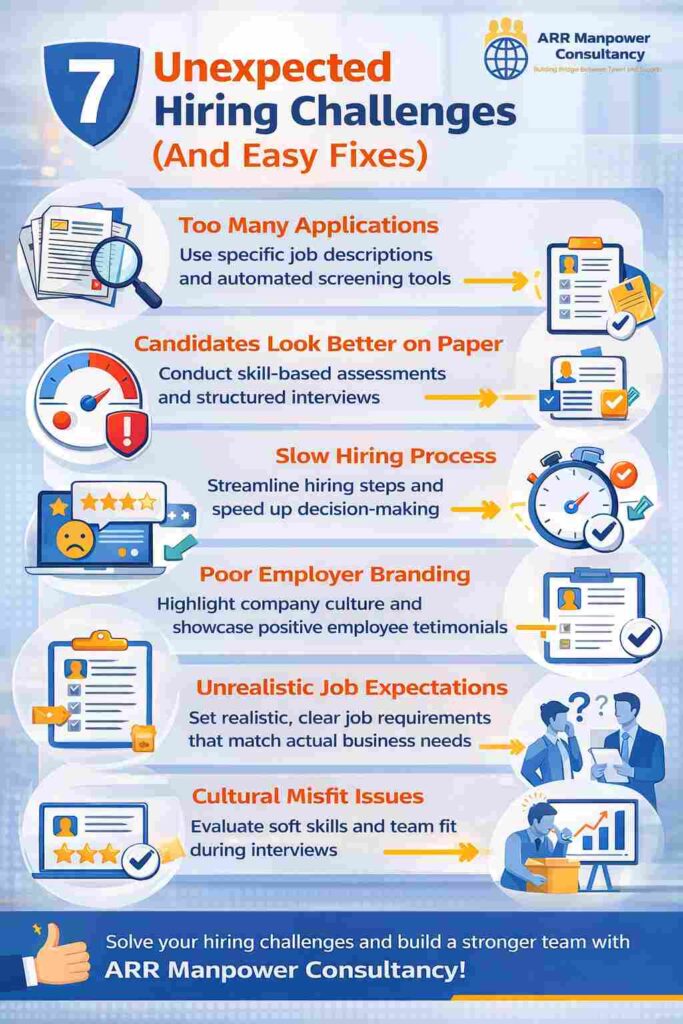
1. The “Too Many Applications” Problem
The Challenge
At first glance, receiving hundreds of applications may seem like a positive sign. However, an overwhelming number of resumes can actually slow down the hiring process. Recruiters often struggle to filter out unqualified candidates, leading to delays and missed opportunities.
Why It Happens
- Easy online application systems
- Lack of targeted job descriptions
- Broad keyword usage in job postings
Easy Fix
- Write clear, specific job descriptions
- Use screening questions to filter candidates
- Implement AI-based applicant tracking systems (ATS)
By refining your hiring process, you can focus only on the most relevant candidates and reduce time-to-hire significantly.
2. Candidates Looking Perfect on Paper but Not in Reality
The Challenge
Some candidates have impressive resumes but fail to perform during interviews or on the job. This mismatch can lead to poor hiring decisions.
Why It Happens
- Over-optimized resumes
- Lack of practical skill evaluation
- Interview bias
Easy Fix
- Conduct skill-based assessments
- Include real-world task simulations
- Use structured interviews
Hiring should not rely solely on resumes. A practical evaluation ensures candidates truly possess the skills they claim.
3. Slow Hiring Process Driving Candidates Away
The Challenge
Top candidates often receive multiple offers. A slow hiring process can cause you to lose them to competitors.
Why It Happens
- Multiple approval layers
- Poor communication between departments
- Inefficient scheduling
Easy Fix
- Streamline interview rounds
- Set clear hiring timelines
- Maintain consistent communication
Speed is a competitive advantage in recruitment. The faster you act, the higher your chances of securing top talent.
4. Poor Employer Branding
The Challenge
Many companies struggle to attract quality candidates because they lack a strong employer brand. Job seekers today research companies before applying.
Why It Happens
- Limited online presence
- Negative employee reviews
- Lack of company culture visibility
Easy Fix
- Showcase company culture on social media
- Encourage employee testimonials
- Maintain a professional career page
A strong employer brand builds trust and attracts candidates who align with your values.
5. Unrealistic Job Expectations
The Challenge
Some job descriptions demand too many skills or unrealistic experience levels. This discourages qualified candidates from applying.
Why It Happens
- Poor understanding of the role
- Attempt to combine multiple roles into one
- Lack of coordination between HR and management
Easy Fix
- Focus on must-have skills only
- Separate roles if necessary
- Align expectations with market standards
Realistic job expectations increase the quality of applications and improve hiring success.
6. Cultural Misfit Issues
The Challenge
Even highly skilled employees may struggle if they don’t fit into the company culture. This can lead to conflicts and high turnover.
Why It Happens
- Ignoring soft skills
- Lack of cultural assessment
- Hiring based only on technical ability
Easy Fix
- Evaluate soft skills and personality traits
- Conduct behavioral interviews
- Involve team members in the hiring process
Hiring for cultural fit ensures long-term employee satisfaction and retention.
7. High Employee Turnover After Hiring
The Challenge
Hiring doesn’t end when a candidate joins. Many companies face early employee turnover, which increases recruitment costs.
Why It Happens
- Poor onboarding
- Mismatch in expectations
- Lack of career growth opportunities
Easy Fix
- Implement a structured onboarding program
- Set clear job expectations from day one
- Provide learning and development opportunities
Retention is just as important as recruitment. A good onboarding experience can make a lasting difference.
How to Build a Smarter Hiring Strategy
Addressing these challenges requires a proactive approach. Here are some key strategies:
1. Use Data-Driven Recruitment
Analyze hiring metrics such as:
- Time-to-hire
- Cost-per-hire
- Candidate drop-off rates
Data helps identify inefficiencies and improve decision-making.
2. Leverage Technology
Modern tools can simplify recruitment:
- Applicant tracking systems
- AI-based screening tools
- Video interview platforms
Technology enhances speed and accuracy in hiring.
3. Partner with Recruitment Experts
Working with a professional manpower consultancy can help:
- Access a wider talent pool
- Reduce hiring time
- Improve candidate quality
Expert support ensures better hiring outcomes.
4. Focus on Candidate Experience
A positive candidate experience improves your reputation and increases offer acceptance rates.
Simple steps include:
- Clear communication
- Timely updates
- Professional interview process
Conclusion
Hiring challenges rarely appear exactly as businesses expect. While organizations often prepare for obvious issues such as talent shortages or high competition, many of the most damaging obstacles emerge quietly during everyday recruitment activities. Communication gaps, unrealistic job expectations, slow decision-making, weak employer branding, and inconsistent candidate experiences can gradually reduce hiring success without employers immediately recognizing the cause.
The good news is that most hiring challenges are not permanent problems. In many cases, they are symptoms of processes that can be improved with relatively simple adjustments. Small changes often produce significant results when applied consistently across the recruitment cycle. Companies that regularly evaluate their hiring practices are better positioned to identify bottlenecks before they become costly issues.
One of the most important lessons for employers is that recruitment is no longer just about filling vacancies. Candidates today evaluate organizations as carefully as organizations evaluate candidates. Every interaction—from the initial job advertisement to the final interview—shapes a candidate’s perception of the company. A confusing application process, delayed responses, or unclear job descriptions can discourage even highly qualified professionals from continuing with the recruitment process.
Organizations that focus on creating a positive candidate experience often gain a competitive advantage in attracting top talent. Clear communication, transparent expectations, and respectful interactions help build trust throughout the hiring journey. Even candidates who are not selected may leave with a favorable impression, strengthening the company’s reputation in the job market.
Another critical factor is adaptability. Workforce expectations continue to evolve, influenced by technological advancements, changing work environments, and shifting employee priorities. Companies that remain flexible and open to updating their hiring strategies are more likely to attract skilled professionals who align with their long-term goals. Recruitment methods that worked successfully a few years ago may not deliver the same results today, making continuous improvement essential.
Data-driven decision-making can also play a valuable role in overcoming unexpected hiring challenges. By tracking metrics such as time-to-hire, application completion rates, interview-to-offer ratios, and candidate feedback, employers can identify patterns that reveal hidden weaknesses in their recruitment process. These insights allow businesses to make targeted improvements rather than relying on assumptions.
Collaboration across departments is equally important. Hiring should not be viewed solely as the responsibility of recruiters or HR teams. Managers, department leaders, and executive stakeholders all contribute to successful talent acquisition. When everyone involved shares clear expectations and communicates effectively, hiring decisions become faster, more accurate, and more aligned with business objectives.
Employers should also remember that the best candidates are often evaluating multiple opportunities simultaneously. Delays that seem minor internally may result in losing qualified applicants to competitors. Streamlining approvals, improving interview scheduling, and maintaining regular communication can significantly increase the likelihood of securing top talent before another organization does.
Technology can support these efforts, but it should never replace the human element of recruitment. Automation tools can simplify administrative tasks, improve efficiency, and reduce workload, allowing hiring teams to focus more on relationship-building and candidate engagement. A balanced approach that combines technology with personalized communication often produces the strongest results.
Ultimately, successful hiring is not about eliminating every challenge. Recruitment will always involve uncertainties, changing market conditions, and evolving workforce expectations. The goal is to build a hiring process that is resilient, responsive, and capable of adapting when obstacles arise. Organizations that embrace continuous improvement, prioritize candidate experience, and remain proactive in addressing recruitment issues are far more likely to attract and retain the talent they need.
By recognizing these unexpected hiring challenges early and implementing practical solutions, businesses can transform recruitment from a recurring frustration into a strategic advantage. Strong hiring practices not only help fill open positions more efficiently but also contribute to long-term organizational growth, stronger workplace culture, and sustained business success. In a competitive talent market, companies that consistently refine their hiring approach will be better prepared to secure the skilled professionals who drive innovation, productivity, and future success.
Hiring is no longer just about filling positions—it’s about finding the right people who can contribute to long-term success. While many companies focus on obvious recruitment challenges, the unexpected issues discussed in this article often have a bigger impact.
By understanding these challenges and applying the easy fixes, businesses can:
- Improve hiring efficiency
- Reduce turnover
- Build stronger teams
In a competitive market, a smart hiring strategy is not optional—it’s essential. Companies that adapt quickly and refine their recruitment approach will always stay ahead.