Introduction
An interview is often the final and most critical stage of the hiring process. While your resume can showcase your qualifications and experience, the interview gives employers an opportunity to assess your communication skills, confidence, personality, and suitability for the role. Whether you are a fresh graduate or an experienced professional, preparing for common interview questions can significantly improve your chances of success.
Many candidates enter interviews feeling nervous because they are unsure about what to expect. Although every organization has its own hiring approach, certain questions appear consistently across industries and job levels. Understanding why employers ask these questions and learning how to answer them effectively can help you make a strong impression.
In this guide, we will explore 12 essential interview questions that frequently arise during hiring discussions. You’ll also learn practical tips to craft compelling responses that highlight your strengths and professionalism.
https://arrmanpowerconsultancy.com
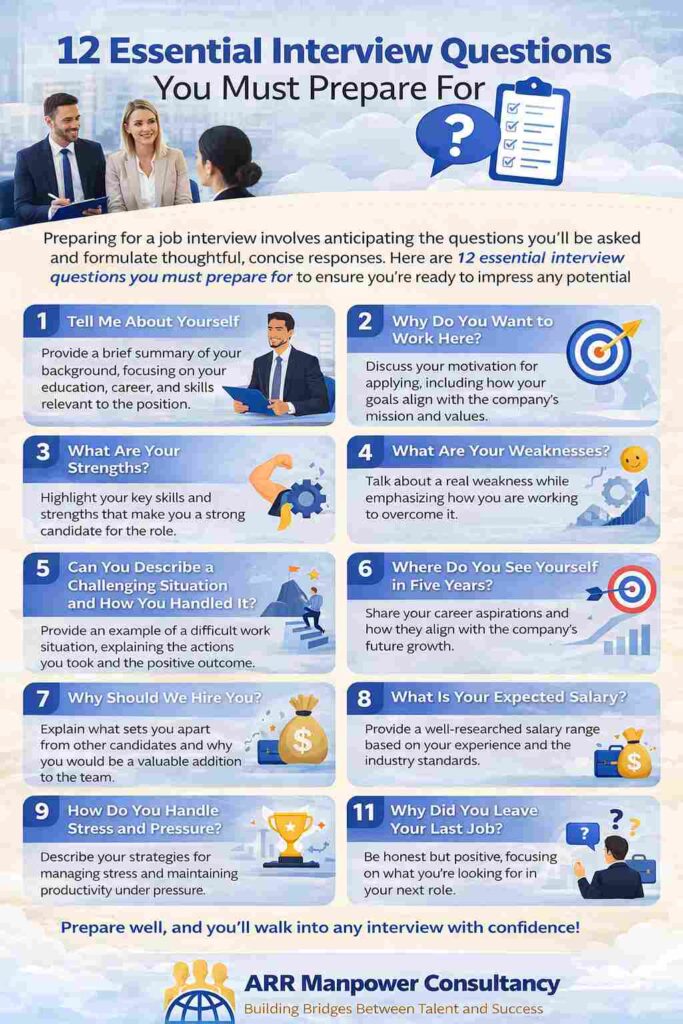
1. Tell Me About Yourself
This is often the opening question in an interview. Employers use it to understand your background and evaluate how well you can summarize your professional journey.
How to Answer
Focus on your professional experience, key achievements, and career goals. Keep your response concise and relevant to the position.
Example
“I have five years of experience in digital marketing, specializing in content strategy and campaign management. In my current role, I have helped increase website traffic by 40% through targeted content initiatives. I am now looking for an opportunity to apply my skills in a growing organization where I can contribute to larger marketing projects.”
Tips
- Keep your answer between one and two minutes.
- Highlight relevant experience.
- Avoid discussing personal details unrelated to the role.
2. Why Do You Want to Work Here?
Hiring managers ask this question to determine whether you have researched the company and genuinely want the position.
How to Answer
Mention specific aspects of the organization that appeal to you, such as its culture, values, products, services, or reputation.
Example
“I admire the company’s commitment to innovation and customer satisfaction. After researching your recent projects, I was impressed by the focus on technology-driven solutions. I believe my skills and experience align well with your mission, and I would be excited to contribute to future growth.”
Tips
- Research the company beforehand.
- Connect your goals with the organization’s objectives.
- Avoid focusing solely on salary or benefits.
3. What Are Your Strengths?
This question allows employers to identify qualities that make you a valuable candidate.
How to Answer
Choose strengths that are relevant to the job and support them with examples.
Example
“One of my greatest strengths is problem-solving. In my previous role, I identified inefficiencies in our reporting process and developed a streamlined system that reduced reporting time by 30%.”
Tips
- Be honest and specific.
- Provide measurable results when possible.
- Select strengths that match the job requirements.
4. What Is Your Greatest Weakness?
Many candidates fear this question, but employers mainly want to see self-awareness and a willingness to improve.
How to Answer
Choose a genuine weakness and explain the steps you are taking to address it.
Example
“I used to struggle with delegating tasks because I wanted to ensure everything was completed perfectly. However, I realized that effective teamwork requires trust, so I have been actively improving my delegation skills by setting clear expectations and providing support when needed.”
Tips
- Avoid mentioning critical weaknesses related to the role.
- Focus on improvement and learning.
- Stay positive and professional.
5. Why Are You Leaving Your Current Job?
Interviewers ask this to understand your motivations and assess whether there may be potential concerns.
How to Answer
Remain positive and focus on career growth rather than criticizing your employer.
Example
“I have gained valuable experience in my current role, but I am seeking new challenges and opportunities for professional development. This position aligns closely with my long-term career goals and offers the chance to expand my skills.”
Tips
- Never speak negatively about previous employers.
- Emphasize growth and opportunity.
- Keep your explanation professional.
6. Describe a Challenging Situation and How You Handled It
This behavioral question helps employers evaluate your problem-solving abilities and resilience.
How to Answer
Use the STAR method:
- Situation
- Task
- Action
- Result
Example
“In a previous project, a key team member unexpectedly left before an important deadline. I coordinated with the remaining team members, reassigned responsibilities, and developed a revised schedule. As a result, we completed the project on time and met all client expectations.”
Tips
- Use real examples.
- Focus on your actions.
- Highlight positive outcomes.
7. Where Do You See Yourself in Five Years?
Employers want to know whether your career aspirations align with the organization’s future.
How to Answer
Demonstrate ambition while showing commitment to professional growth.
Example
“In five years, I hope to have developed advanced expertise in my field and taken on greater responsibilities. I would like to contribute to strategic initiatives and potentially move into a leadership role while continuing to learn and grow within the organization.”
Tips
- Be realistic.
- Align your goals with the role.
- Show enthusiasm for long-term development.
8. Why Should We Hire You?
This question gives you an opportunity to summarize your value proposition.
How to Answer
Highlight your unique combination of skills, experience, and achievements.
Example
“I believe I am an excellent fit because I bring a strong combination of technical expertise, problem-solving skills, and a proven track record of delivering results. My experience managing complex projects and collaborating across teams would allow me to contribute immediately to your organization.”
Tips
- Focus on employer needs.
- Mention relevant accomplishments.
- Be confident without sounding arrogant.
9. Tell Me About a Time You Worked in a Team
Teamwork is essential in most workplaces, making this a common interview topic.
How to Answer
Describe a situation where collaboration contributed to success.
Example
“During a product launch, I worked closely with marketing, sales, and design teams to ensure alignment. Through regular communication and coordination, we successfully launched the product ahead of schedule and exceeded initial sales targets.”
Tips
- Emphasize collaboration.
- Show communication skills.
- Explain your specific contribution.
10. How Do You Handle Pressure and Deadlines?
Employers need employees who can remain productive under challenging circumstances.
How to Answer
Explain your approach to prioritization, organization, and stress management.
Example
“I handle pressure by staying organized and focusing on priorities. When facing tight deadlines, I break tasks into manageable steps, create a timeline, and maintain clear communication with stakeholders. This approach helps me stay productive and deliver quality work.”
Tips
- Provide a real example.
- Show adaptability.
- Highlight planning skills.
11. What Are Your Salary Expectations?
This question helps employers determine whether your expectations align with their budget.
How to Answer
Research industry standards before the interview and provide a reasonable range.
Example
“Based on my experience, skills, and market research, I am seeking a salary in the range of ₹8–10 lakhs annually. However, I am open to discussing the overall compensation package.”
Tips
- Research salary benchmarks.
- Remain flexible.
- Avoid giving unrealistic figures.
12. Do You Have Any Questions for Us?
This question is often asked at the end of an interview. It demonstrates your interest in the role and organization.
Good Questions to Ask
- What does success look like in this position?
- What are the team’s biggest priorities right now?
- How would you describe the company culture?
- What opportunities are available for professional development?
Tips
- Always prepare questions in advance.
- Avoid asking about information easily found online.
- Use the opportunity to learn more about the role.
Additional Interview Preparation Tips
While practicing responses is important, successful interviews require broader preparation.
Research the Company
Learn about the organization’s mission, products, services, leadership, and recent achievements. This knowledge helps you tailor your responses and demonstrate genuine interest.
Review the Job Description
Understand the key responsibilities and required qualifications. Prepare examples that show how your experience aligns with the role.
Practice Your Answers
Conduct mock interviews with friends, mentors, or career coaches. Practicing aloud helps improve confidence and communication skills.
Dress Professionally
Your appearance contributes to first impressions. Choose attire that matches the company’s culture while maintaining professionalism.
Arrive Prepared
Bring multiple copies of your resume, a notebook, and any required documents. For virtual interviews, test your technology beforehand.
Maintain Positive Body Language
Good posture, eye contact, and active listening can strengthen your overall impression and demonstrate confidence.
Conclusion
Interview success rarely happens by chance. It is usually the result of preparation, practice, and confidence. By understanding the purpose behind common interview questions and developing thoughtful responses, you can communicate your qualifications effectively and stand out from other candidates.
The 12 essential interview questions covered in this guide represent some of the most frequently asked topics during hiring conversations. Preparing for them will help you present yourself as a capable, professional, and motivated candidate.
Remember that every interview is also an opportunity for you to evaluate whether the company and role align with your career goals. Approach each conversation with confidence, authenticity, and a willingness to learn. With proper preparation, you can turn interviews into valuable opportunities that bring you closer to your desired career path.
https://www.indeed.com/career-advice/news/job-market-disconnect-employers-workers