Introduction
Organizations across industries are facing a growing challenge: keeping talented employees engaged and committed for the long term. While attracting skilled professionals remains important, retaining them has become even more critical. Businesses are investing heavily in recruitment, onboarding, training, and workplace culture, yet many still struggle with high turnover rates.
The modern workforce has evolved dramatically over the past decade. Employees now expect more than competitive salaries. They seek meaningful work, flexibility, career growth, recognition, and a healthy work-life balance. When these expectations are not met, workers are increasingly willing to explore other opportunities.
High turnover can be costly. Replacing experienced employees requires time, money, and resources. It can also impact productivity, team morale, customer satisfaction, and organizational performance. Understanding why workers leave is the first step toward building a stronger and more stable workforce.
In this article, we explore nine surprising reasons why employee retention is becoming harder and what organizations can do to address these challenges.
https://arrmanpowerconsultancy.com
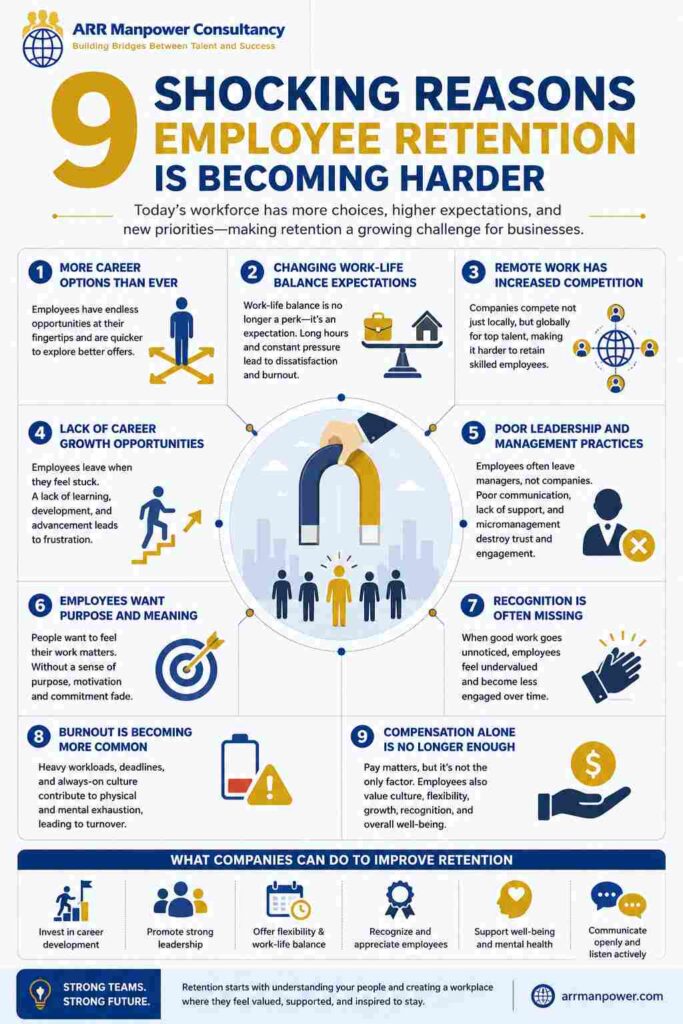
1. Employee Retention Have More Career Options Than Ever Before
The digital age has transformed the job market. Online job portals, professional networking platforms, remote work opportunities, and recruitment technologies have made job searching easier than ever.
Previously, employees often stayed with one employer for years because alternative opportunities were limited. Today, professionals can discover new positions with just a few clicks. Recruiters actively approach skilled candidates, even when they are not looking for a new role.
This increased accessibility creates constant temptation. Employees know they have options, and many are willing to move if another company offers better compensation, benefits, flexibility, or career advancement opportunities.
Organizations that fail to provide growth and satisfaction may quickly lose valuable talent to competitors.
How to Address It
- Offer clear career development pathways.
- Conduct regular salary benchmarking.
- Create opportunities for internal promotions.
- Invest in employee learning and skill development.
2. Work-Life Balance Expectations Have Changed
Modern employees place significant value on personal well-being. Long working hours, excessive workloads, and constant pressure can lead to dissatisfaction and burnout.
The pandemic accelerated this shift. Many workers realized the importance of spending time with family, pursuing hobbies, and maintaining mental health. As a result, work-life balance is now a major factor when evaluating employment opportunities.
Companies that continue to operate with outdated expectations may struggle to keep their workforce engaged.
How to Address It
- Encourage reasonable working hours.
- Offer flexible schedules where possible.
- Promote wellness programs.
- Support mental health initiatives.
Employees who feel respected as individuals are more likely to remain committed to their organizations.
3. Remote Work Has Increased Competition for Talent
Remote work has fundamentally changed hiring practices. Employers are no longer limited to local candidates, and employees are no longer restricted to local jobs.
A software developer in one city can now work for a company located in another state or even another country. This expanded access creates intense competition for skilled professionals.
Organizations that fail to offer flexibility may find themselves losing employees to businesses that embrace hybrid or fully remote work models.
How to Address It
- Evaluate remote and hybrid work possibilities.
- Invest in collaboration technologies.
- Focus on results rather than physical presence.
- Maintain strong communication across distributed teams.
Flexibility has become a key factor influencing workforce decisions.
4. Lack of Career Growth Opportunities
One of the most common reasons employees leave is the absence of professional development opportunities.
Ambitious professionals want to advance their careers. When workers feel stuck in the same position without opportunities for growth, they may begin searching elsewhere.
Career stagnation can affect motivation, engagement, and overall job satisfaction. Employees often view continuous learning and advancement as essential components of long-term success.
How to Address It
- Provide training and development programs.
- Establish mentorship initiatives.
- Create transparent promotion processes.
- Encourage employees to take on new responsibilities.
When organizations invest in employee growth, they create stronger loyalty and engagement.
5. Poor Leadership and Management Practices
People often leave managers rather than companies. Leadership quality has a significant impact on workplace satisfaction.
Employees want managers who communicate clearly, provide guidance, offer support, and recognize achievements. Poor leadership can create frustration, confusion, and disengagement.
Micromanagement, inconsistent communication, favoritism, and lack of empathy are common issues that drive employees away.
Strong leadership fosters trust and creates a positive work environment where employees feel valued.
How to Address It
- Train managers in leadership skills.
- Encourage transparent communication.
- Promote accountability and fairness.
- Collect employee feedback regularly.
Investing in leadership development can significantly improve workforce stability.
6. Employees Want Purpose and Meaning
Today’s workforce increasingly seeks meaningful work. Employees want to understand how their contributions impact customers, communities, and organizational goals.
Many professionals are motivated by more than financial rewards. They want to feel connected to a larger purpose and believe their work makes a difference.
When employees struggle to see the value of their contributions, engagement levels can decline.
Organizations with strong missions and values often experience higher levels of commitment and satisfaction.
How to Address It
- Communicate organizational goals clearly.
- Connect individual roles to broader objectives.
- Celebrate achievements and impact.
- Promote a strong company culture.
Purpose-driven workplaces often attract and retain highly motivated professionals.
7. Recognition Is Often Missing
Employees want their efforts to be acknowledged. Unfortunately, many organizations underestimate the importance of recognition.
When workers consistently deliver strong performance without receiving appreciation, they may feel undervalued. Over time, this can reduce motivation and increase turnover risk.
Recognition does not always require financial rewards. Simple expressions of appreciation can have a significant impact on morale.
A culture of recognition helps employees feel respected and connected to their workplace.
How to Address It
- Recognize achievements regularly.
- Celebrate milestones and successes.
- Implement peer recognition programs.
- Provide constructive and positive feedback.
Employees who feel appreciated are generally more engaged and committed.
8. Burnout Is Becoming More Common
Burnout has emerged as one of the most serious workplace challenges in recent years. Increasing workloads, tight deadlines, staffing shortages, and constant connectivity contribute to employee exhaustion.
Burnout affects both physical and mental well-being. Employees experiencing burnout may become less productive, less engaged, and more likely to seek alternative employment.
Organizations that ignore signs of burnout risk losing valuable talent and damaging workplace culture.
How to Address It
- Monitor workloads carefully.
- Encourage employees to take breaks and vacations.
- Promote realistic performance expectations.
- Provide mental health resources.
Preventing burnout helps create a healthier and more sustainable work environment.
9. Compensation Alone Is No Longer Enough
Competitive salaries remain important, but they are no longer the only factor influencing workforce decisions.
Many organizations assume higher pay will automatically solve retention challenges. While compensation matters, employees also evaluate benefits, flexibility, culture, leadership quality, growth opportunities, and workplace relationships.
A company offering excellent pay but poor culture may still experience high turnover.
Employees increasingly seek comprehensive employment experiences rather than focusing solely on financial rewards.
How to Address It
- Review compensation packages regularly.
- Offer meaningful benefits.
- Strengthen workplace culture.
- Focus on the overall employee experience.
A balanced approach often produces better long-term results than salary increases alone.
The Growing Impact of Retention Challenges
Workforce turnover affects every aspect of business performance. Replacing experienced employees involves recruitment costs, onboarding expenses, training investments, and productivity losses.
Frequent departures can also disrupt team dynamics. Remaining employees may face increased workloads, leading to additional stress and potential burnout. Customer relationships can suffer when experienced staff members leave, particularly in service-oriented industries.
Organizations that prioritize retention often experience several advantages, including:
- Higher productivity
- Stronger employee engagement
- Improved customer satisfaction
- Reduced recruitment costs
- Better organizational knowledge retention
- Enhanced employer reputation
As labor markets become increasingly competitive, retaining skilled professionals is becoming a strategic business priority rather than simply an HR responsibility.
Building a Strong Retention Strategy
Successful organizations recognize that retention requires a proactive approach. Rather than reacting to resignations, they focus on creating environments where employees want to stay.
An effective strategy includes:
- Competitive compensation and benefits
- Career development opportunities
- Strong leadership
- Flexible work arrangements
- Employee recognition programs
- Wellness and mental health support
- Open communication channels
- Inclusive workplace culture
Regular employee surveys and feedback sessions can also help organizations identify potential issues before they lead to turnover.
The most successful employers continuously adapt their practices to meet changing workforce expectations.
Conclusion
Keeping talented employees has become more challenging due to changing workforce priorities, increased career opportunities, remote work expansion, evolving expectations, and growing demands for flexibility and purpose. Organizations that rely on outdated workplace practices may struggle to maintain a stable and engaged workforce.
The good news is that these challenges can be addressed through thoughtful leadership, employee-focused policies, career development initiatives, and a strong workplace culture. Businesses that actively invest in their people are more likely to build loyal, productive, and motivated teams.
Understanding these nine shocking reasons behind rising turnover provides valuable insight into the modern workforce. By addressing these issues proactively, organizations can strengthen employee retention, reduce hiring costs, improve workplace satisfaction, and position themselves for long-term success in an increasingly competitive talent market.