Introduction
Building a startup is exciting, but finding the right people to support growth can be one of the biggest challenges. Unlike established organizations, startups often operate with limited budgets, smaller teams, and high expectations. Every new hire has a significant impact on productivity, company culture, and long-term success.
Many founders focus heavily on product development, funding, and marketing while underestimating the importance of hiring. However, attracting talented professionals can be the difference between rapid growth and business stagnation. A strong workforce helps startups innovate, improve customer satisfaction, and achieve strategic goals faster.
To compete with larger organizations, startups must adopt effective hiring strategies that help identify, attract, and retain top talent. The following recruitment methods can help startups build high-performing teams while managing resources efficiently.
https://arrmanpowerconsultancy.com
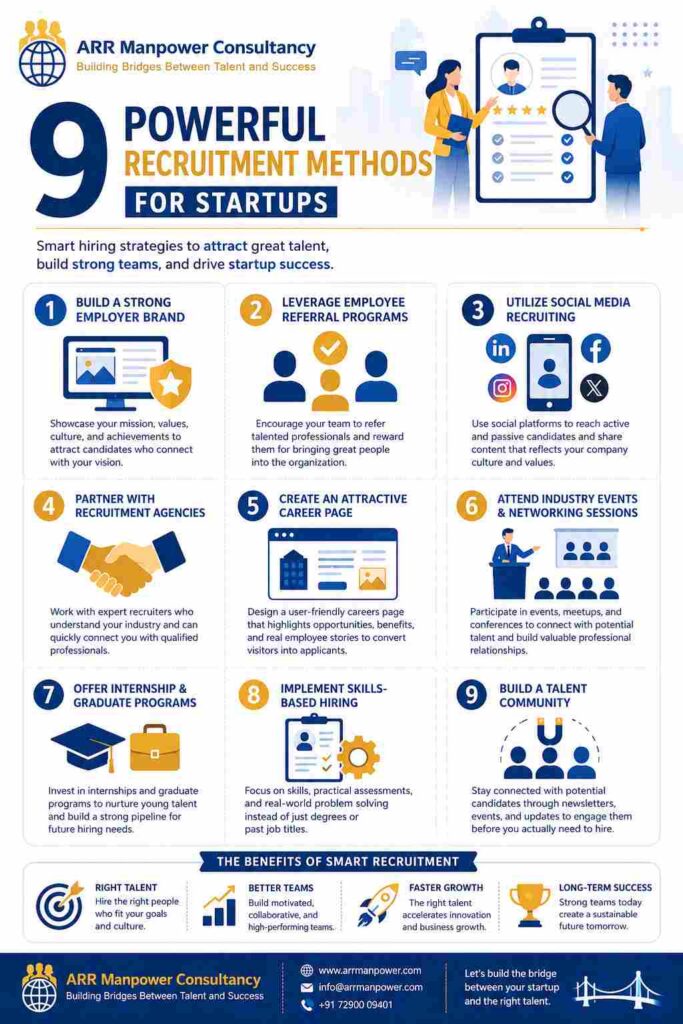
1. Recruitment Methods that Build a Strong Employer Brand
A startup’s reputation plays a major role in attracting quality candidates. Talented professionals often research a company before applying for a position. If they cannot understand the company’s mission, values, or work culture, they may choose opportunities elsewhere.
Creating a compelling employer brand involves showcasing what makes the startup unique. Highlight company achievements, employee success stories, workplace culture, and growth opportunities through your website and social media channels.
Transparency is equally important. Share your vision, challenges, and future plans. Many professionals are attracted to startups because they want meaningful work and the opportunity to make a direct impact.
A strong employer brand helps generate trust, increases application rates, and improves candidate quality.
Benefits
- Attracts highly motivated candidates
- Improves company credibility
- Enhances candidate engagement
- Supports long-term talent acquisition goals
2. Leverage Employee Referral Programs
Employee referrals remain one of the most effective ways to find qualified professionals. Existing team members understand company culture and can recommend individuals who fit organizational requirements.
Referral programs encourage employees to introduce talented people from their professional networks. These candidates often move through the hiring process more quickly because they come with trusted recommendations.
Startups can offer incentives such as bonuses, gift cards, recognition awards, or additional benefits to encourage participation.
Referrals frequently result in higher retention rates because referred candidates already have a realistic understanding of workplace expectations.
Benefits
- Reduces hiring costs
- Speeds up candidate sourcing
- Improves cultural alignment
- Increases retention rates
3. Utilize Social Media Recruiting
Social media platforms have transformed how organizations connect with potential candidates. Startups can use channels such as LinkedIn, Facebook, Instagram, and X to reach active and passive job seekers.
Instead of posting only job advertisements, share valuable content that reflects company culture and achievements. Behind-the-scenes photos, employee testimonials, industry insights, and company milestones help attract professionals who align with your vision.
Engaging with industry communities and participating in relevant discussions can also expand visibility among potential applicants.
Social recruiting allows startups to compete with larger companies without spending large amounts on advertising.
Benefits
- Expands candidate reach
- Enhances brand awareness
- Encourages direct engagement
- Supports cost-effective hiring
4. Partner with Recruitment Agencies
Many startups lack dedicated HR teams capable of managing large-scale hiring initiatives. Working with specialized recruitment agencies can simplify the process and provide access to a wider talent pool.
Professional recruiters understand market trends, candidate expectations, and industry-specific hiring requirements. They can quickly identify qualified professionals while reducing the burden on internal teams.
Agencies are particularly valuable when hiring for technical, executive, or highly specialized positions where sourcing candidates independently may be challenging.
Although agency fees may seem significant, the time savings and improved hiring outcomes often justify the investment.
Benefits
- Access to qualified candidates
- Faster hiring timelines
- Industry expertise
- Reduced workload for founders and managers
5. Create an Attractive Career Page
Your career page serves as a digital gateway for prospective employees. A well-designed careers section can significantly improve candidate interest and application rates.
Rather than listing only job openings, explain the company mission, workplace culture, employee benefits, and growth opportunities. Include photographs, videos, and employee testimonials to create a more engaging experience.
Job descriptions should be clear, concise, and realistic. Candidates appreciate transparency regarding responsibilities, expectations, and career progression.
A user-friendly application process also plays a crucial role. Complicated application systems often lead to candidate drop-offs.
Benefits
- Improves candidate experience
- Increases application completion rates
- Enhances employer credibility
- Supports talent attraction efforts
6. Attend Industry Events and Networking Sessions
Industry conferences, trade shows, startup meetups, and networking events provide valuable opportunities to connect with talented professionals.
Face-to-face interactions help build relationships that may not develop through traditional online applications. Startups can present their vision directly and engage with individuals who possess relevant skills and experience.
Networking events are particularly useful for discovering passive candidates who are not actively searching for new opportunities but may be open to the right offer.
Building professional relationships before vacancies arise can create a valuable talent pipeline for future hiring needs.
Benefits
- Expands professional networks
- Identifies passive talent
- Enhances brand visibility
- Creates future hiring opportunities
7. Offer Internship and Graduate Programs
Internships provide startups with access to emerging talent while allowing candidates to gain practical experience. Graduate programs can help identify future employees with strong potential and fresh perspectives.
Students and recent graduates are often eager to learn, adapt, and contribute. By providing meaningful projects and mentorship opportunities, startups can develop skilled professionals who understand the company culture and objectives.
Successful interns frequently transition into full-time employees, reducing future hiring challenges.
Internship programs also strengthen relationships with educational institutions and enhance employer visibility among students.
Benefits
- Builds a future talent pipeline
- Reduces hiring costs
- Supports workforce development
- Encourages innovation and creativity
8. Implement Skills-Based Hiring
Traditional hiring practices often prioritize academic qualifications and previous job titles. However, startups can benefit significantly from focusing on skills, competencies, and practical abilities.
Skills-based hiring evaluates candidates according to their ability to perform specific tasks rather than relying solely on formal credentials.
Practical assessments, portfolio reviews, case studies, and work simulations provide better insights into candidate capabilities.
This approach widens the talent pool and helps identify individuals who may have unconventional backgrounds but possess exceptional skills.
As industries evolve rapidly, adaptability and problem-solving abilities often matter more than specific degrees.
Benefits
- Expands candidate availability
- Improves hiring accuracy
- Encourages diversity
- Focuses on practical performance
9. Build a Talent Community
Hiring should not begin only when a vacancy appears. Successful startups continuously engage with potential candidates and nurture professional relationships over time.
A talent community consists of individuals who have expressed interest in the company but may not currently be applying for a position. These can include former applicants, event contacts, interns, referrals, and industry professionals.
Regular communication through newsletters, webinars, company updates, and networking opportunities keeps potential candidates connected to the organization.
When hiring needs arise, startups can quickly reach out to an already engaged audience instead of starting from scratch.
Benefits
- Reduces future hiring delays
- Strengthens candidate relationships
- Improves hiring efficiency
- Supports long-term workforce planning
Common Recruitment Mistakes Startups Should Avoid
While implementing hiring strategies, startups should also avoid common mistakes that can negatively impact results.
Rushing the Hiring Process
Fast growth often creates pressure to fill positions quickly. However, hiring the wrong person can be more costly than leaving a position open temporarily.
Writing Vague Job Descriptions
Unclear expectations lead to mismatched applications and wasted time for both employers and candidates.
Ignoring Candidate Experience
Poor communication, delayed responses, and complicated application processes can damage a startup’s reputation.
Overlooking Cultural Fit
Technical expertise is important, but alignment with company values and team dynamics also influences long-term success.
Failing to Plan Ahead
Reactive hiring often results in rushed decisions. Workforce planning helps ensure future staffing needs are addressed proactively.
Measuring Recruitment Success
To continuously improve hiring outcomes, startups should track key performance indicators.
Important metrics include:
- Time-to-fill
- Cost-per-hire
- Quality of hire
- Offer acceptance rate
- Employee retention rate
- Candidate satisfaction
- Source effectiveness
Regular analysis helps identify which methods generate the best results and where improvements are needed.
Conclusion
Hiring exceptional talent is one of the most important responsibilities for any startup. Every team member contributes directly to innovation, productivity, customer satisfaction, and business growth. By adopting proven recruitment methods such as employer branding, employee referrals, social media outreach, agency partnerships, networking, internship programs, skills-based assessments, and talent community development, startups can build stronger teams and improve hiring outcomes.
A strategic approach to talent acquisition not only helps fill current vacancies but also creates a sustainable foundation for future expansion. Startups that invest in effective hiring practices position themselves for long-term success in an increasingly competitive marketplace.
Hiring exceptional talent is one of the most important responsibilities for any startup. Every team member contributes directly to innovation, productivity, customer satisfaction, and business growth. By adopting proven recruitment methods such as employer branding, employee referrals, social media outreach, agency partnerships, networking, internship programs, skills-based assessments, and talent community development, startups can build stronger teams and improve hiring outcomes.
A strategic approach to talent acquisition not only helps fill current vacancies but also creates a sustainable foundation for future expansion. Startups that invest in effective hiring practices position themselves for long-term success in an increasingly competitive marketplace.
Additionally, the modern hiring landscape continues to evolve with changing workforce expectations, remote work opportunities, and advancements in recruitment technology. Startups that remain flexible and open to new talent acquisition techniques can gain a significant competitive advantage. Consistently evaluating hiring performance, refining candidate experiences, and nurturing professional relationships will help organizations attract high-quality talent over time. By treating recruitment as a long-term growth strategy rather than a short-term necessity, startups can create resilient teams capable of driving innovation, overcoming challenges, and supporting sustainable business success for years to come.