Introduction
Annual recurring revenue is one of the strongest indicators of stability and growth in a consultancy business. Firms that rely only on one-time projects often struggle with inconsistent cash flow, unpredictable workloads, and slow expansion. Building a predictable revenue model creates stronger client relationships while improving long-term profitability. Consultancy leaders who want sustainable expansion must focus on strategies that encourage repeat engagement, higher retention, and scalable delivery.
The following strategies explain practical ways consultancy firms can increase recurring revenue without relying on aggressive sales tactics or unrealistic promises. Each approach focuses on improving value, strengthening positioning, and creating systems that support consistent growth.
https://arrmanpowerconsultancy.com/
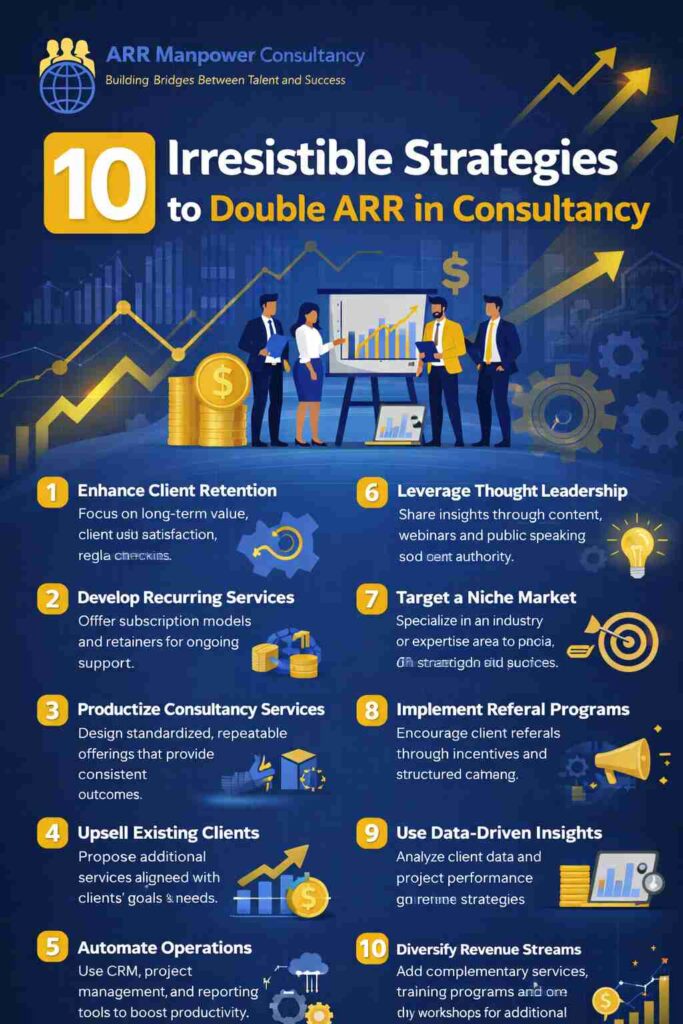
1. Shift From Project-Based Work to Retainer Models
Many consultancy businesses remain trapped in the cycle of selling isolated projects. Although projects may generate large invoices, they often create unpredictable income patterns. Retainer agreements solve this challenge by creating ongoing partnerships that provide continuous support and measurable results.
Instead of offering a single audit or short engagement, consultants can package services into monthly advisory plans. These retainers may include strategic meetings, performance monitoring, reporting, implementation guidance, or continuous optimization.
Clients usually prefer retainers because they gain dependable access to expertise without restarting the procurement process every few months. At the same time, consultancy firms benefit from improved forecasting and stronger client loyalty.
To make retainers successful:
- Define clear deliverables
- Set measurable milestones
- Offer tiered service levels
- Schedule regular communication
- Focus on long-term outcomes
Retainers also reduce the pressure of constantly finding new clients. When recurring agreements increase, leadership teams can spend more time improving delivery quality and scaling operations.
2. Create Specialized Service Niches
Generalist firms often face intense competition and pricing pressure. Specialization helps a consultancy stand out in crowded markets while attracting clients willing to pay premium rates.
A niche can be based on:
- Industry expertise
- Business size
- Technical capability
- Operational challenge
- Geographic market
For example, a consultancy that focuses exclusively on healthcare technology adoption will likely command more authority than a broad business advisory firm with no clear specialization.
Clients prefer experts who understand their unique challenges, regulations, workflows, and growth barriers. A focused positioning strategy also improves marketing efficiency because messaging becomes more relevant and targeted.
Consultancies that dominate a niche often receive more referrals, stronger retention, and larger contracts. Expertise creates trust, and trust accelerates purchasing decisions.
3. Build Productized Consulting Services
Custom engagements consume significant time and resources. Every proposal, scope, and delivery plan requires additional effort. Productized services simplify the sales process while making revenue more predictable.
A productized offering packages consulting expertise into a structured solution with fixed outcomes, pricing, timelines, and deliverables. Instead of creating entirely new engagements for every client, consultants follow repeatable frameworks.
Examples include:
- A fixed onboarding process
- A standardized operational audit
- A recurring executive coaching package
- A monthly analytics review system
- A compliance readiness program
Standardization improves efficiency because teams spend less time reinventing workflows. It also makes pricing easier for prospects to understand.
Consultancy firms that use productized solutions can scale more effectively since delivery becomes repeatable and easier to train across teams.
4. Invest in Client Success and Retention
Acquiring new business is expensive. Losing clients weakens growth momentum and increases operational stress. Strong retention strategies help consultancy firms maximize lifetime value while increasing recurring revenue.
Client success should become part of the company culture rather than an isolated department. Firms that consistently deliver measurable results create stronger loyalty and long-term engagement.
Retention improves when consultants:
- Respond quickly to concerns
- Maintain proactive communication
- Share performance insights regularly
- Identify improvement opportunities
- Educate clients continuously
Regular review meetings are especially valuable. These discussions allow consultants to demonstrate progress while identifying new opportunities for expansion.
Satisfied clients are more likely to renew agreements, purchase additional services, and recommend the consultancy to peers. Word-of-mouth referrals often become one of the most reliable growth channels.
5. Expand Through Upselling and Cross-Selling
Many consultancy businesses focus heavily on acquisition while overlooking existing clients who already trust their expertise. Upselling and cross-selling create efficient growth opportunities without the high cost of generating completely new leads.
Upselling involves increasing the scope or value of current engagements. Cross-selling introduces complementary services that address additional client needs.
For instance:
- A strategy consultancy may introduce implementation support
- A marketing advisory firm may add analytics reporting
- A technology consultant may offer cybersecurity assessments
- A financial advisory firm may provide training workshops
The key is relevance. Additional services should genuinely improve client outcomes rather than feel like unnecessary sales pressure.
Consultants who understand client objectives deeply can identify adjacent challenges and recommend practical solutions. This creates stronger partnerships while increasing recurring revenue streams.
6. Strengthen Thought Leadership
Authority influences buying decisions. Clients are more likely to engage firms that consistently demonstrate expertise and industry knowledge.
Thought leadership builds credibility through educational content, public speaking, research, and strategic insights. Consultancy firms that invest in visibility often experience stronger inbound demand and shorter sales cycles.
Effective thought leadership channels include:
- Industry articles
- Research reports
- Webinars
- Podcasts
- LinkedIn publishing
- Executive roundtables
- Case studies
Educational content should focus on solving real business challenges instead of promoting services aggressively. Valuable insights position the consultancy as a trusted advisor rather than simply another vendor.
Over time, strong authority can reduce dependency on outbound sales efforts. Prospects who already trust the firm’s expertise usually convert faster and remain engaged longer.
7. Develop Strategic Partnerships
Partnerships can accelerate growth without requiring massive increases in advertising budgets. Consultancy firms that collaborate with complementary businesses gain access to new audiences, expertise, and opportunities.
Strategic partnerships may include:
- Technology providers
- Software platforms
- Accounting firms
- Legal advisors
- Marketing agencies
- Industry associations
For example, a digital transformation consultancy could partner with a cloud software company to deliver implementation services for shared clients.
Successful partnerships create mutual value. Each organization should benefit through revenue opportunities, stronger client outcomes, or increased market reach.
Referral agreements can also become highly effective growth engines when supported by trust and clear communication. Long-term alliances often generate consistent recurring opportunities with minimal acquisition costs.
8. Use Data to Improve Decision-Making
Growing recurring revenue requires accurate visibility into performance metrics. Consultancy leaders who rely only on intuition may overlook inefficiencies, weak retention patterns, or missed opportunities.
Data-driven decision-making helps firms optimize pricing, improve delivery, and identify scalable growth channels.
Important metrics include:
- Client retention rate
- Revenue per client
- Proposal conversion rate
- Utilization rate
- Customer acquisition cost
- Service profitability
- Expansion revenue
Tracking these indicators allows leadership teams to identify which services generate the highest profitability and strongest retention.
Analytics can also reveal operational bottlenecks that limit scalability. For example, if delivery timelines consistently exceed expectations, leadership may need to improve workflows, staffing, or automation.
Consultancy firms that use data strategically often make faster and more confident growth decisions.
9. Automate Repetitive Processes
Operational inefficiencies can limit profitability even when demand is strong. Manual administrative tasks consume valuable time that consultants could otherwise spend delivering high-value strategic work.
Automation improves scalability while reducing operational strain. Firms that streamline repetitive activities can serve more clients without dramatically increasing headcount.
Processes suitable for automation include:
- Scheduling meetings
- Invoice generation
- Client onboarding
- Reporting workflows
- Proposal templates
- Email follow-ups
- CRM updates
Automation tools also improve consistency across teams. Standardized systems reduce errors while ensuring clients receive a smoother experience.
Technology should support human expertise rather than replace it. The goal is to free consultants from repetitive administration so they can focus on strategic problem-solving and relationship building.
As operational efficiency improves, consultancy businesses gain stronger margins and greater capacity for growth.
10. Build Scalable Talent Systems
Growth becomes difficult when expertise depends entirely on a few senior consultants. Sustainable expansion requires systems that allow knowledge transfer, efficient onboarding, and consistent delivery quality.
Scalable talent strategies help consultancy firms grow without sacrificing client satisfaction.
Important initiatives include:
- Documented processes
- Internal training programs
- Mentorship structures
- Performance frameworks
- Knowledge management systems
Conclusion
Doubling annual recurring revenue in consultancy is not achieved through quick fixes or temporary sales spikes. It requires a combination of strategic planning, client-focused delivery, and scalable business systems. Consultancy firms that prioritize long-term relationships, recurring service models, operational efficiency, and specialized expertise are better positioned to create predictable and sustainable growth.
Each strategy discussed in this blog contributes to building a stronger foundation for recurring income. From improving client retention and creating productized services to leveraging automation and strengthening thought leadership, successful consultancy growth depends on delivering continuous value rather than one-time solutions.
As markets become more competitive, clients increasingly seek trusted advisors who can provide consistent results and ongoing support. Consultancy businesses that adapt to these expectations while maintaining high service quality can increase profitability, strengthen brand authority, and achieve lasting business stability.
Ultimately, sustainable ARR growth comes from creating systems that support both client success and operational scalability. Firms that invest in these areas today will be better prepared to grow confidently and maintain a competitive advantage in the future.