Introduction
In an increasingly competitive and unpredictable business environment, consistency has become more valuable than rapid but unstable growth. Organizations today are not only focused on increasing revenue but also on ensuring that their revenue streams are reliable, predictable, and scalable over time. This is where Annual Recurring Revenue (ARR) consistency plays a crucial role.
ARR consistency reflects a company’s ability to maintain stable revenue from its existing customers while minimizing fluctuations caused by churn, seasonal demand, or operational inefficiencies. Businesses with consistent ARR are better positioned to forecast growth, attract investors, and allocate resources effectively.
However, achieving consistency is not accidental. It requires a deliberate combination of strategy, operational discipline, customer-centric practices, and data-driven decision-making. This article outlines 14 strategic moves that organizations can implement to improve ARR consistency and build a sustainable revenue foundation.
https://arrmanpowerconsultancy.com/
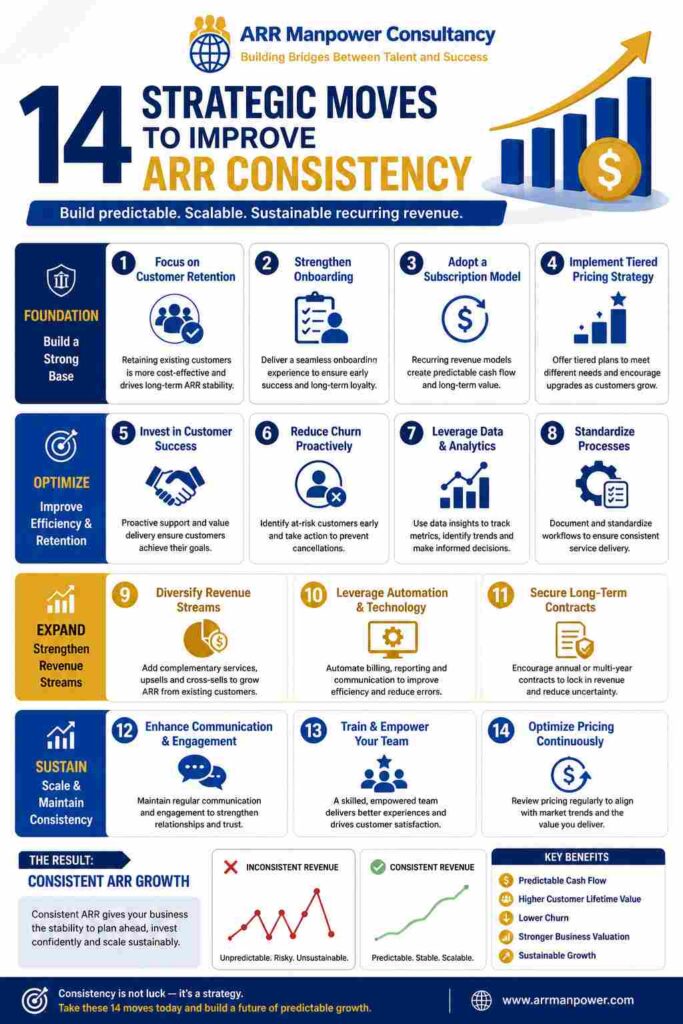
1. Prioritize Customer Retention Over Acquisition
While acquiring new customers is essential for growth, retention is the foundation of consistency. Losing customers not only reduces revenue but also increases the cost of replacing them.
Key Actions:
- Focus on long-term relationships
- Provide ongoing value
- Monitor satisfaction levels
Retained customers contribute to stable revenue streams and predictable growth patterns.
2. Strengthen Onboarding Processes
The onboarding phase significantly impacts customer retention and long-term engagement.
Best Practices:
- Provide clear guidance and training
- Set realistic expectations
- Deliver quick initial results
A strong onboarding experience reduces early churn and establishes trust.
3. Implement Subscription-Based Models
Subscription-based revenue models are inherently more predictable than one-time transactions.
Advantages:
- Recurring income
- Easier forecasting
- Stronger customer relationships
By shifting to subscription models, businesses can create a stable revenue base.
4. Develop Tiered Pricing Structures
Tiered pricing allows businesses to cater to different customer segments while maximizing value extraction.
Strategy:
- Offer multiple pricing levels
- Clearly differentiate features
- Encourage upgrades
This approach not only improves consistency but also supports revenue expansion.
5. Focus on Customer Success Initiatives
Customer success ensures that clients achieve their desired outcomes, which directly impacts retention.
Tactics:
- Assign dedicated account managers
- Conduct regular reviews
- Provide proactive support
Successful customers are more likely to renew and expand their engagement.
6. Reduce Churn Through Proactive Measures
Churn is one of the biggest threats to consistent revenue.
Reduction Strategies:
- Identify at-risk customers early
- Address issues proactively
- Improve service quality
Even small reductions in churn can significantly improve overall stability.
7. Leverage Data Analytics for Decision-Making
Data-driven insights enable businesses to optimize performance and identify trends.
Key Metrics:
- Retention rate
- Churn rate
- Customer lifetime value
Using analytics tools helps organizations make informed decisions and maintain consistency.
8. Standardize Processes and Operations
Inconsistent processes lead to unpredictable outcomes.
Standardization Benefits:
- Improved efficiency
- Reduced errors
- Better scalability
Documented workflows and standardized procedures ensure consistent service delivery.
9. Diversify Revenue Streams
Relying on a single revenue source can create instability.
Diversification Examples:
- Value-added services
- Consulting offerings
- Upselling and cross-selling
Multiple revenue streams reduce risk and enhance overall stability.
10. Invest in Technology and Automation
Technology plays a critical role in maintaining consistency.
Tools to Consider:
- CRM systems
- Billing automation platforms
- Analytics software
Automation reduces manual errors and ensures consistent execution.
11. Build Long-Term Contracts and Agreements
Long-term contracts provide revenue visibility and reduce uncertainty.
Benefits:
- Predictable income
- Stronger client commitment
- Reduced churn
Encouraging clients to commit to longer terms enhances stability.
12. Enhance Communication and Engagement
Regular communication keeps customers engaged and informed.
Engagement Strategies:
- Monthly updates
- Performance reports
- Feedback sessions
Strong communication builds trust and reduces the likelihood of churn.
13. Train and Empower Your Team
Your team plays a crucial role in delivering consistent results.
Focus Areas:
- Skill development
- Customer relationship management
- Problem-solving abilities
A well-trained team ensures high-quality service and consistent outcomes.
14. Continuously Optimize Pricing Strategies
Pricing should evolve with market conditions and customer needs.
Optimization Tips:
- Conduct regular pricing reviews
- Align pricing with value delivered
- Test different pricing models
Effective pricing strategies support both profitability and consistency.
Challenges in Achieving ARR Consistency
While the benefits are clear, maintaining consistent revenue comes with challenges:
1. Market Volatility
Changing economic conditions can impact demand.
2. Customer Expectations
Customers expect continuous value and flexibility.
3. Operational Complexity
Managing multiple clients and services can be challenging.
4. Data Management
Collecting and analyzing data effectively requires investment.
Overcoming these challenges requires adaptability and strategic planning.
Future Trends Impacting ARR Consistency
As businesses evolve, several trends are shaping the future of recurring revenue:
1. AI and Automation
Advanced tools for predictive analytics and process optimization.
2. Personalization
Tailored experiences to meet individual customer needs.
3. Flexible Pricing Models
Dynamic pricing structures based on usage and value.
4. Customer Experience Focus
Enhanced experiences to drive retention and loyalty.
Organizations that adapt to these trends will be better positioned for long-term success.
Best Practices for Sustained Consistency
To maintain stable revenue over the time, businesses should:
- Monitor performance metrics regularly
- Invest in customer success initiatives
- Adapt to changing market conditions
- Focus on delivering consistent value
- Build strong customer relationships
Consistency is achieved through continuous improvement and strategic alignment.
Conclusion
Achieving a consistent Annual Recurring Revenue (ARR) is not the result of a single initiative, marketing campaign, or sales strategy. It is the outcome of multiple business functions working together toward a common objective: creating predictable, sustainable, and scalable growth. The 14 strategic moves discussed throughout this article demonstrate that ARR consistency is built through deliberate planning, continuous optimization, and a deep understanding of customer needs.
The Organizations that maintain stable ARR growth focus on much more than acquiring new customers. They invest in customer retention, strengthen onboarding experiences, improve product value, and develop long-term relationships that encourage renewals and expansion opportunities. While new revenue is important, protecting existing recurring revenue often delivers a greater impact on long-term business stability and profitability.
Consistency also requires a proactive approach to risk management. Companies that regularly monitor key metrics such as churn rate, customer lifetime value, renewal rates, and expansion revenue are better positioned to identify potential problems before they become significant threats. Data-driven decision-making enables leadership teams to make adjustments quickly and maintain momentum even during periods of market uncertainty.
Another important takeaway is the value of alignment across departments. Sales, marketing, customer success, product development, and finance all play critical roles in ARR performance. When these teams share common goals and collaborate effectively, organizations can create a seamless customer journey that drives both satisfaction and recurring revenue growth. Businesses that operate in silos often struggle to maintain consistency because customer experiences become fragmented and opportunities for improvement are overlooked.
Technology and automation further support ARR stability by helping organizations scale efficiently. From customer relationship management systems to predictive analytics and automated customer engagement tools, modern technology provides the visibility and operational efficiency required to manage recurring revenue successfully. However, technology alone is not enough. The most successful companies combine advanced tools with strong processes and a customer-centric culture.
It is also important to recognize that ARR consistency is a long-term commitment rather than a short-term achievement. Markets evolve, customer expectations change, and competitors continually introduce new solutions. Businesses must remain agile and willing to refine their strategies as conditions shift. Regular performance reviews, customer feedback collection, and ongoing experimentation help organizations stay ahead of challenges and uncover new growth opportunities.
The Companies that prioritize value creation over transactional selling are often the ones that achieve the most reliable ARR growth. Customers continue renewing subscriptions and expanding contracts when they consistently experience measurable benefits from a product or service. By focusing on delivering outcomes, solving problems, and supporting customer success, businesses create stronger loyalty and a more dependable revenue foundation.
Ultimately, improving ARR consistency requires discipline, strategic thinking, and continuous execution. Every improvement in retention, customer engagement, pricing optimization, operational efficiency, and revenue forecasting contributes to a stronger recurring revenue model. While growth may not always occur in a perfectly linear fashion, organizations that apply these strategic moves consistently will be better equipped to reduce volatility, improve predictability, and build a resilient business capable of sustained success.
In an increasingly competitive business environment, consistent ARR is more than a financial metric—it is a reflection of customer trust, operational excellence, and long-term market relevance. Organizations that commit to these principles today will be in a stronger position to achieve sustainable growth, attract investment, and create lasting value for both customers and stakeholders in the years ahead.
Improving ARR consistency is essential for building a stable and scalable business. It requires a holistic approach that combines customer-centric strategies, operational efficiency, and data-driven decision-making.
The 14 strategic moves outlined in this article provide a roadmap for organizations seeking to enhance revenue stability and achieve sustainable growth. By prioritizing retention, leveraging technology, and continuously optimizing processes, businesses can create a predictable revenue model that supports long-term success.
In a world where uncertainty is constant, consistency becomes a competitive advantage. Organizations that focus on maintaining stable revenue streams will not only improve financial performance but also build stronger, more resilient businesses.