Introduction
India has emerged as one of the world’s largest talent hubs, offering organizations access to a diverse and highly skilled workforce. From technology and healthcare to manufacturing and finance, businesses across industries are competing to attract qualified professionals who can drive growth and innovation. However, finding the right candidates in a competitive employment market requires more than simply posting job openings and waiting for applications.
Organizations must adopt effective hiring approaches that align with evolving workforce expectations, technological advancements, and industry demands. A structured recruitment process not only helps companies secure top talent but also improves employee retention, productivity, and organizational performance.
This article explores 11 essential recruitment strategies that can help businesses strengthen their hiring efforts and build a high-performing workforce in India.
https://arrmanpowerconsultancy.com
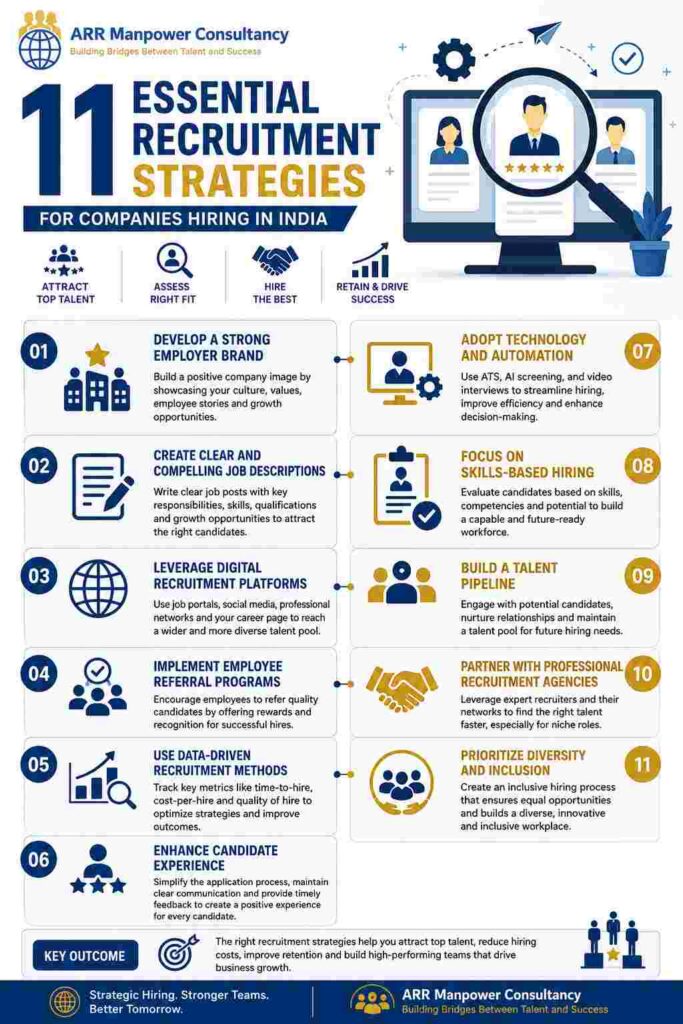
1. Develop a Strong Employer Brand for Companies Hiring
Employer branding plays a significant role in attracting skilled professionals. Job seekers today research potential employers before applying for positions. They often evaluate company culture, employee reviews, career growth opportunities, and workplace values.
Organizations can strengthen their employer brand by:
- Showcasing company culture through social media
- Sharing employee success stories
- Highlighting learning and development initiatives
- Promoting diversity and inclusion efforts
- Maintaining a positive online reputation
A strong employer image creates trust among candidates and encourages highly qualified professionals to consider available opportunities.
2. Create Clear and Compelling Job Descriptions
A well-written job description serves as the foundation of an effective hiring process. Ambiguous or overly complex job postings can discourage qualified applicants from applying.
Effective job descriptions should include:
- Clear job titles
- Key responsibilities
- Required qualifications
- Preferred skills
- Salary range when appropriate
- Growth opportunities
- Company overview
When candidates fully understand the role and expectations, organizations receive applications that better match their requirements, reducing screening time and improving hiring outcomes.
3. Leverage Digital Recruitment Platforms
Digital recruitment platforms have transformed the hiring landscape in India. Companies can now reach a larger pool of candidates across multiple locations and industries.
Popular hiring channels include:
- Professional networking platforms
- Online job portals
- Industry-specific job boards
- Company career pages
- Mobile recruitment applications
Using multiple digital channels increases visibility and helps organizations connect with both active and passive job seekers. Digital platforms also provide valuable analytics that support data-driven hiring decisions.
4. Implement Employee Referral Programs
Employee referrals remain one of the most reliable sources of quality hires. Existing employees often understand organizational culture and can recommend candidates who are likely to fit well within the company.
Benefits of referral programs include:
- Faster hiring cycles
- Lower recruitment costs
- Higher employee retention
- Improved candidate quality
- Better cultural alignment
Organizations can encourage participation by offering incentives, recognition programs, or referral bonuses for successful hires.
A well-structured referral strategy creates a continuous pipeline of qualified talent while strengthening employee engagement.
5. Use Data-Driven Recruitment Methods
Modern hiring decisions should be supported by data rather than intuition alone. Recruitment analytics provide insights into the effectiveness of hiring strategies and identify opportunities for improvement.
Important recruitment metrics include:
- Time-to-hire
- Cost-per-hire
- Source of hire
- Offer acceptance rate
- Quality of hire
- Employee retention rate
By monitoring these indicators, companies can optimize recruitment efforts, allocate resources effectively, and improve overall hiring performance.
Data-driven decision-making also helps organizations identify trends in candidate behavior and workforce demand.
6. Enhance Candidate Experience
Candidate experience significantly influences an organization’s ability to attract and retain talent. A lengthy or confusing hiring process can result in losing top candidates to competitors.
Ways to improve candidate experience include:
- Simplifying application procedures
- Maintaining clear communication
- Providing timely interview feedback
- Offering transparent timelines
- Creating a respectful interview environment
Positive experiences leave lasting impressions even among candidates who are not selected. They may recommend the company to others or apply for future opportunities.
A strong candidate experience contributes to a positive employer reputation and supports long-term talent acquisition goals.
7. Adopt Technology and Automation
Recruitment technology has become an essential component of modern hiring practices. Automation helps reduce administrative workload while improving efficiency and consistency.
Useful technologies include:
Applicant Tracking Systems (ATS)
These systems help manage applications, screen resumes, schedule interviews, and track candidate progress throughout the hiring process.
AI-Powered Screening Tools
Artificial intelligence can assist recruiters by identifying candidates whose qualifications closely match job requirements.
Video Interview Platforms
Virtual interviews enable organizations to connect with candidates from different regions, reducing travel expenses and accelerating hiring decisions.
Technology allows recruitment teams to focus more on strategic activities and candidate engagement rather than repetitive administrative tasks.
8. Focus on Skills-Based Hiring
Traditional hiring practices often place significant emphasis on educational qualifications and prior experience. However, many organizations are shifting toward skills-based hiring to identify capable candidates regardless of their backgrounds.
Skills-based hiring evaluates:
- Technical competencies
- Problem-solving abilities
- Communication skills
- Leadership potential
- Adaptability
- Industry knowledge
This approach expands the available talent pool and helps organizations discover high-potential individuals who may otherwise be overlooked.
Skills assessments, practical assignments, and competency-based interviews can support more accurate hiring decisions.
9. Build a Talent Pipeline
Successful organizations do not wait until vacancies arise before searching for talent. Instead, they maintain a proactive approach by building a continuous talent pipeline.
Strategies for developing talent pipelines include:
- Networking with industry professionals
- Attending career fairs
- Engaging with educational institutions
- Maintaining candidate databases
- Creating internship programs
- Developing relationships with passive candidates
A strong pipeline reduces hiring delays and enables organizations to respond quickly when new positions become available.
Proactive talent acquisition also provides a competitive advantage in industries experiencing skill shortages.
10. Partner with Professional Recruitment Agencies
Working with specialized recruitment agencies can significantly improve hiring outcomes, especially for difficult-to-fill positions.
Recruitment agencies offer:
- Access to extensive candidate networks
- Industry-specific expertise
- Faster sourcing capabilities
- Market intelligence
- Screening and assessment support
For organizations hiring at scale or seeking niche talent, recruitment partners can streamline the entire process and reduce internal workload.
Experienced recruiters understand local employment trends and can identify candidates who align with specific organizational requirements.
11. Prioritize Diversity and Inclusion
Diversity and inclusion have become critical components of successful workforce strategies. Diverse teams bring varied perspectives, improve creativity, and support better decision-making.
Organizations can promote inclusive hiring by:
- Eliminating bias from job descriptions
- Using structured interview processes
- Expanding sourcing channels
- Providing diversity training
- Ensuring equal opportunity practices
Inclusive workplaces attract a broader range of talent and strengthen employer reputation.
A commitment to diversity also supports innovation and enhances organizational resilience in an increasingly global business environment.
Challenges Companies Face While Hiring in India
Despite access to a large workforce, companies often encounter several hiring challenges, including:
Talent Shortages in Specialized Fields
Industries such as information technology, cybersecurity, healthcare, and advanced manufacturing frequently experience shortages of highly skilled professionals.
High Competition for Top Talent
Leading employers often compete for the same pool of experienced candidates, making recruitment more challenging.
Geographic Diversity
India’s vast geographic landscape requires organizations to adapt hiring strategies to regional labor markets and cultural differences.
Changing Candidate Expectations
Modern professionals increasingly prioritize flexibility, career development, work-life balance, and organizational culture when evaluating employment opportunities.
Addressing these challenges requires a strategic and adaptable recruitment approach.
Future Trends in Recruitment
The recruitment landscape continues to evolve rapidly. Several emerging trends are expected to influence hiring practices in the coming years.
Artificial Intelligence Integration
AI will continue to support candidate sourcing, screening, and workforce planning.
Remote and Hybrid Hiring
Organizations are increasingly recruiting talent from multiple locations, expanding access to skilled professionals.
Predictive Analytics
Advanced analytics will help employers anticipate workforce needs and make more informed hiring decisions.
Employer Branding Expansion
Companies will invest further in employer branding initiatives to attract and retain high-quality talent.
Skills-First Recruitment
Skills assessments and competency evaluations will become increasingly important in hiring decisions.
Organizations that embrace these trends will be better positioned to compete for talent in a dynamic employment market.
Conclusion
Building a successful workforce requires more than filling open positions. Companies hiring in India must implement strategic recruitment practices that attract qualified candidates, improve hiring efficiency, and support long-term business objectives.
Developing a strong employer brand, leveraging digital platforms, enhancing candidate experience, embracing technology, focusing on skills-based hiring, and promoting diversity are all essential elements of an effective hiring strategy. Additionally, maintaining talent pipelines and collaborating with professional recruitment experts can help organizations address evolving workforce challenges.
By adopting these 11 essential recruitment strategies, businesses can strengthen their talent acquisition efforts, secure top professionals, and create a competitive advantage in India’s rapidly changing employment landscape.
Building a successful workforce requires more than filling open positions. Companies hiring in India must implement strategic recruitment practices that attract qualified candidates, improve hiring efficiency, and support long-term business objectives.
Developing a strong employer brand, leveraging digital platforms, enhancing candidate experience, embracing technology, focusing on skills-based hiring, and promoting diversity are all essential elements of an effective hiring strategy. Additionally, maintaining talent pipelines and collaborating with professional recruitment experts can help organizations address evolving workforce challenges.
By adopting these 11 essential recruitment strategies, businesses can strengthen their talent acquisition efforts, secure top professionals, and create a competitive advantage in India’s rapidly changing employment landscape.
As the employment market continues to evolve, organizations that remain adaptable and invest in modern hiring practices will be better positioned for sustainable growth. Continuous evaluation of recruitment processes, workforce trends, and candidate expectations can help employers stay ahead of competitors.
Companies that prioritize long-term talent acquisition strategies rather than short-term hiring needs are more likely to build resilient teams, improve employee retention, and achieve consistent business success in an increasingly competitive and dynamic Indian job market.