Introduction
Hiring the right employee is one of the most important decisions an organization can make. A successful hire contributes to productivity, strengthens workplace culture, and supports long-term business growth. On the other hand, a poor hiring decision can result in lost time, increased costs, lower team morale, and reduced efficiency.
As competition for skilled professionals continues to grow, recruiters and hiring managers must go beyond reviewing resumes and conducting basic interviews. Modern recruitment requires a structured approach that identifies the most qualified candidates while minimizing hiring risks. This is where effective candidate screening becomes essential.
Candidate screening is the process of evaluating applicants to determine whether they possess the skills, experience, qualifications, and cultural fit needed for a role. By implementing proven screening methods, employers can streamline recruitment, improve hiring accuracy, and make better workforce decisions.
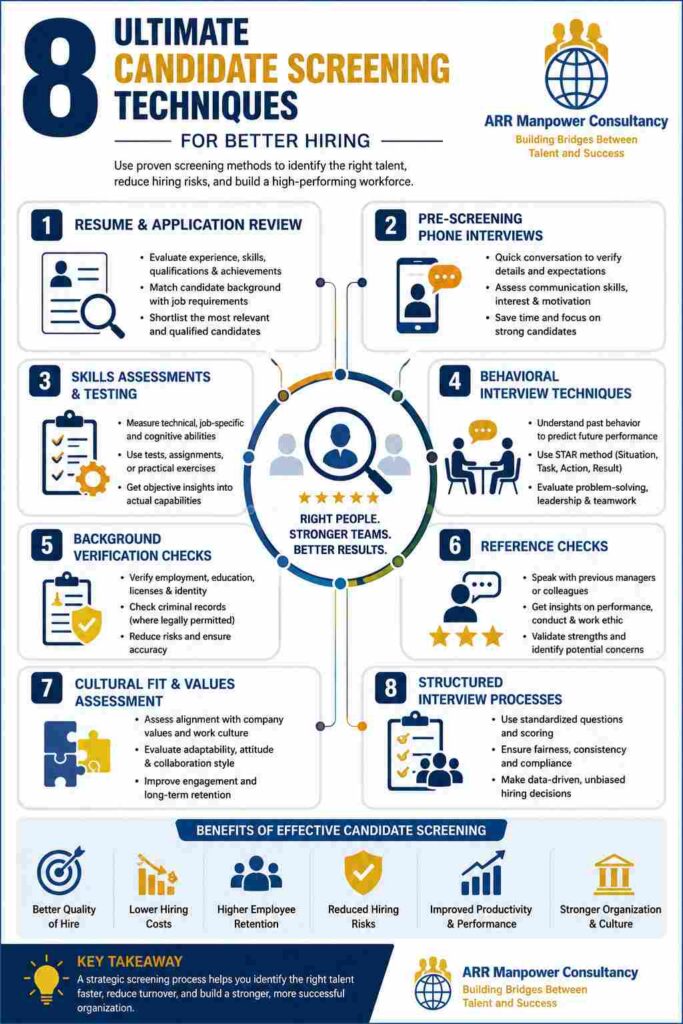
In this article, we explore eight powerful candidate screening techniques that can help organizations identify top talent and build stronger teams.
https://arrmanpowerconsultancy.com
1. Resume and Application Review
The first step in the hiring process is reviewing resumes and job applications. Although it may seem straightforward, a strategic resume review can reveal valuable insights about a candidate’s background and suitability for a position.
During this stage, recruiters should evaluate:
- Relevant work experience
- Educational qualifications
- Technical skills
- Career progression
- Industry expertise
- Achievements and certifications
Instead of focusing solely on job titles, hiring managers should assess how a candidate’s accomplishments align with the position’s requirements. Looking for measurable results and career consistency often provides a clearer picture of potential performance.
Using a standardized evaluation checklist can help maintain fairness and reduce unconscious bias during the review process.
Benefits
- Quickly filters unqualified applicants
- Saves time in recruitment
- Creates a shortlist of suitable candidates
- Supports objective decision-making
2. Pre-Screening Phone Interviews
A pre-screening phone interview is an efficient way to evaluate candidates before scheduling formal interviews. These short conversations typically last between 15 and 30 minutes and help recruiters gather essential information.
Topics commonly covered include:
- Career goals
- Availability
- Salary expectations
- Relevant experience
- Communication skills
- Interest in the role
Phone interviews allow recruiters to verify information presented on resumes while assessing professionalism and enthusiasm.
Strong communication skills are often critical for many positions. A brief phone conversation can reveal whether a candidate can clearly express ideas, listen effectively, and engage professionally.
Benefits
- Reduces interview scheduling burden
- Identifies strong candidates early
- Clarifies candidate expectations
- Improves recruitment efficiency
3. Skills Assessments and Testing
Resumes and interviews may not always accurately reflect a candidate’s abilities. Skills assessments provide direct evidence of competence and help employers make informed hiring decisions.
Depending on the role, assessments may include:
- Technical tests
- Coding challenges
- Writing assignments
- Numerical reasoning tests
- Problem-solving exercises
- Industry-specific evaluations
For example, a software developer might complete a coding assessment, while a content writer could be asked to create a sample article. These evaluations help recruiters measure actual performance rather than relying solely on self-reported skills.
Well-designed assessments should reflect real job responsibilities to ensure accurate evaluation.
Benefits
- Measures practical abilities
- Reduces hiring uncertainty
- Improves quality of hire
- Provides objective evaluation criteria
4. Behavioral Interview Techniques
Behavioral interviews are based on the principle that past behavior often predicts future performance. Rather than asking hypothetical questions, recruiters encourage candidates to share real examples from previous experiences.
Common behavioral questions include:
- Describe a time you handled a difficult customer.
- Tell us about a challenging project you completed.
- Explain a situation where you resolved workplace conflict.
- Share an example of meeting a tight deadline.
Many recruiters use the STAR method:
- Situation
- Task
- Action
- Result
This framework helps candidates provide structured responses while allowing interviewers to evaluate critical competencies such as leadership, teamwork, communication, and problem-solving.
Behavioral interviews often reveal valuable insights that may not appear on resumes or assessments.
Benefits
- Evaluates real-world experience
- Identifies soft skills
- Improves interview consistency
- Predicts workplace performance
5. Background Verification Checks
Background checks play an important role in reducing hiring risks and ensuring workplace safety. Verifying information provided by candidates helps employers confirm accuracy and identify potential concerns.
Common verification areas include:
- Employment history
- Educational credentials
- Professional licenses
- Criminal records (where legally permitted)
- Identity verification
- Reference validation
Organizations should follow all applicable laws and regulations when conducting background checks.
A thorough verification process protects businesses from fraudulent claims and helps maintain trust throughout the hiring process.
Benefits
- Confirms candidate information
- Reduces hiring risks
- Protects organizational reputation
- Supports compliance requirements
6. Reference Checks
Reference checks remain one of the most effective ways to gather additional insights about a candidate’s work history and professional behavior.
Speaking directly with former supervisors, managers, or colleagues can provide valuable information regarding:
- Work ethic
- Reliability
- Team collaboration
- Leadership abilities
- Performance consistency
- Professional conduct
To obtain meaningful feedback, recruiters should ask open-ended questions rather than simple yes-or-no inquiries.
Examples include:
- What were the candidate’s greatest strengths?
- How did they handle pressure?
- Would you hire this individual again?
- What areas could be improved?
Reference conversations often reveal details that are not visible through interviews or assessments.
Benefits
- Provides independent validation
- Offers performance insights
- Identifies strengths and weaknesses
- Supports informed hiring decisions
7. Cultural Fit and Values Assessment
Technical expertise alone does not guarantee success within an organization. Employees who align with company values and workplace culture often adapt more quickly and contribute more effectively.
Cultural fit assessments help determine whether a candidate’s working style, attitudes, and professional values align with organizational expectations.
Areas commonly evaluated include:
- Collaboration preferences
- Leadership style
- Communication approach
- Adaptability
- Work ethic
- Organizational values
Recruiters should focus on alignment rather than similarity. Diverse perspectives strengthen teams, while shared values support organizational cohesion.
Questions might explore how candidates approach teamwork, respond to change, or contribute to workplace culture.
Benefits
- Improves employee engagement
- Supports retention efforts
- Enhances team collaboration
- Strengthens workplace culture
8. Structured Interview Processes
A structured interview follows a standardized format in which all candidates are asked the same core questions and evaluated using consistent criteria.
Unlike unstructured interviews, structured interviews reduce bias and improve fairness throughout the hiring process.
A structured process typically includes:
- Predefined interview questions
- Standardized scoring systems
- Competency-based evaluation
- Consistent interview panels
- Documented feedback
This approach allows recruiters to compare candidates objectively and make evidence-based decisions.
Structured interviews are particularly effective when multiple hiring managers participate in the selection process, as they create consistency and accountability.
Benefits
- Reduces subjective decision-making
- Enhances fairness
- Improves hiring accuracy
- Supports compliance and documentation
Best Practices for Effective Candidate Screening
Implementing screening techniques is only part of the solution. Organizations should also follow best practices to maximize recruitment success.
Define Clear Job Requirements
Before screening begins, employers should establish clear expectations regarding qualifications, experience, and responsibilities. Well-defined criteria improve evaluation accuracy.
Use Multiple Screening Methods
Relying on a single evaluation technique can lead to incomplete assessments. Combining interviews, testing, reference checks, and background verification creates a more comprehensive picture of each applicant.
Maintain Consistency
All candidates should be evaluated using the same standards and procedures. Consistency promotes fairness and strengthens hiring decisions.
Leverage Recruitment Technology
Applicant Tracking Systems (ATS) and recruitment software can automate administrative tasks, improve efficiency, and help manage candidate pipelines.
Focus on Candidate Experience
A positive recruitment experience strengthens employer branding and encourages high-quality professionals to remain engaged throughout the hiring process.
Common Candidate Screening Mistakes to Avoid
Even experienced recruiters can encounter challenges during hiring. Avoiding common mistakes can improve outcomes significantly.
Rushing the Screening Process
Quick hiring decisions may save time initially but often increase the risk of poor recruitment outcomes.
Overlooking Soft Skills
Technical expertise is important, but communication, adaptability, and teamwork are equally valuable.
Ignoring Verification Steps
Skipping reference checks or background verification may expose organizations to unnecessary risks.
Allowing Bias to Influence Decisions
Structured evaluations help reduce unconscious bias and promote objective candidate assessment.
Focusing Only on Experience
Years of experience do not always indicate future success. Skills, attitude, and learning ability should also be considered.
The Future of Candidate Screening
Recruitment continues to evolve as organizations adopt new technologies and data-driven hiring strategies.
Emerging trends include:
- Artificial intelligence screening tools
- Predictive hiring analytics
- Video interview assessments
- Automated skills testing
- Enhanced candidate experience platforms
While technology can improve efficiency, human judgment remains essential. The most successful organizations combine advanced tools with thoughtful evaluation practices to identify exceptional talent.
Conclusion
Finding the right employee requires more than reviewing resumes and conducting interviews. A comprehensive screening strategy helps organizations identify qualified candidates, reduce hiring risks, and improve long-term workforce performance.
By implementing these eight ultimate candidate screening techniques—resume review, phone interviews, skills assessments, behavioral interviews, background verification, reference checks, cultural fit evaluation, and structured interviews—employers can make smarter hiring decisions and build stronger teams.
As the talent market becomes increasingly competitive, organizations that invest in effective screening processes will be better positioned to attract, evaluate, and retain top-performing professionals. A structured and strategic approach to candidate evaluation ultimately leads to better hiring outcomes, stronger organizational performance, and sustainable business growth.