Introduction
Recruitment has always been a critical function for businesses seeking the right talent. However, traditional hiring processes often involve extensive manual work, lengthy screening procedures, and challenges in identifying the best candidates quickly. Today, artificial intelligence (AI) is revolutionizing the hiring landscape by enabling organizations to streamline operations, improve decision-making, and enhance candidate experiences.
From sourcing talent to onboarding new employees, AI-powered tools are helping recruiters work smarter and more efficiently. As competition for skilled professionals continues to increase, companies are leveraging advanced technologies to stay ahead in attracting and retaining top talent.
This article explores 15 proven ways AI is transforming recruitment and why organizations are increasingly integrating intelligent solutions into their hiring strategies.
https://arrmanpowerconsultancy.com
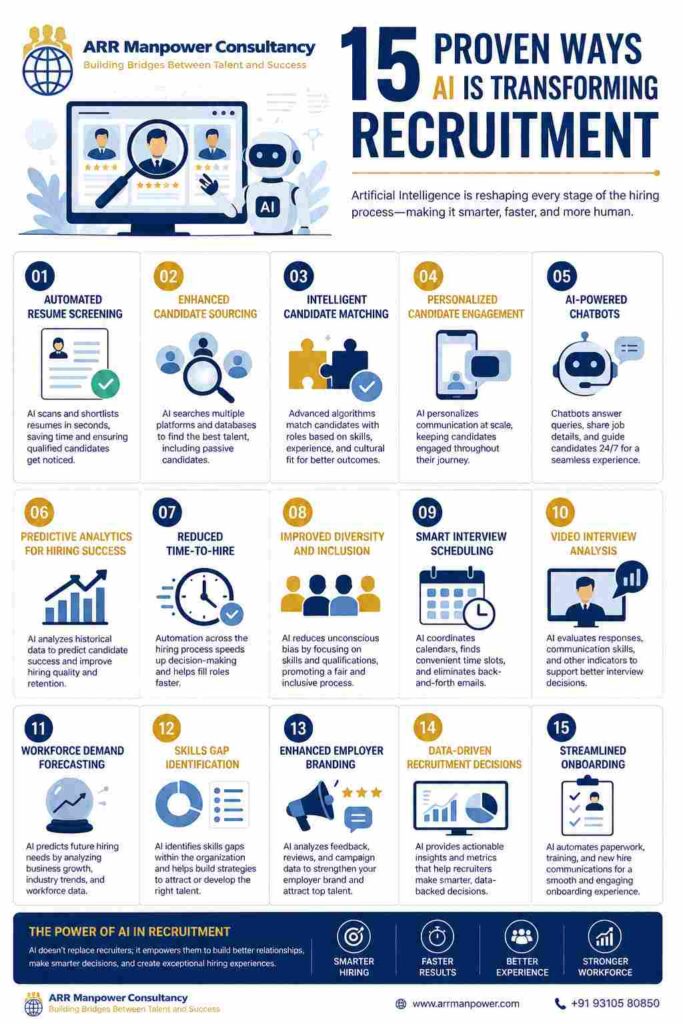
1. Artificial Intelligence Automated Resume Screening
One of the most significant applications of AI in recruitment is resume screening. Recruiters often receive hundreds or even thousands of applications for a single position. Reviewing every resume manually can be time-consuming and prone to human error.
AI-powered screening systems can quickly analyze resumes, identify relevant skills, qualifications, and experience, and rank candidates based on predefined criteria. This automation significantly reduces administrative workload and enables recruiters to focus on high-potential applicants.
Benefits include:
- Faster application processing
- Reduced manual effort
- Improved consistency in candidate evaluation
- Shorter hiring cycles
Organizations can fill positions more efficiently while ensuring qualified candidates receive prompt attention.
2. Enhanced Candidate Sourcing
Finding qualified candidates has traditionally required extensive searching across job boards, professional networks, and databases. AI simplifies this process by scanning multiple sources simultaneously.
Advanced algorithms analyze candidate profiles, employment history, skills, certifications, and online activity to identify suitable matches for open positions. Recruiters can access a broader talent pool without spending countless hours sourcing candidates manually.
Key advantages include:
- Expanded talent discovery
- Access to passive candidates
- Improved quality of candidate matches
- Increased recruiter productivity
As a result, companies can connect with highly qualified professionals who might otherwise remain undiscovered.
3. Intelligent Candidate Matching
AI-driven matching systems go beyond keyword comparisons. These tools evaluate multiple factors such as experience, technical competencies, career progression, industry expertise, and cultural fit indicators.
By analyzing large volumes of data, AI can predict which candidates are most likely to succeed in a specific role. This improves hiring accuracy and helps organizations make more informed decisions.
Benefits include:
- Better alignment between candidates and roles
- Reduced hiring mistakes
- Improved workforce performance
- Higher employee retention rates
Intelligent matching creates stronger connections between employer requirements and candidate capabilities.
4. Personalized Candidate Engagement
Modern job seekers expect timely and personalized communication throughout the hiring process. AI helps organizations deliver customized interactions at scale.
AI systems can tailor messages based on candidate preferences, application status, skills, and interests. Personalized communication keeps applicants informed and engaged throughout their journey.
Advantages include:
- Improved candidate satisfaction
- Increased response rates
- Stronger employer branding
- Enhanced recruitment experiences
Organizations that maintain meaningful engagement often attract higher-quality applicants and reduce candidate drop-off rates.
5. AI-Powered Chatbots for Recruitment
Recruitment chatbots have become increasingly popular for handling routine candidate interactions. These virtual assistants can answer frequently asked questions, provide job information, schedule interviews, and guide applicants through the hiring process.
Available 24/7, chatbots ensure candidates receive immediate assistance regardless of time zones or business hours.
Key benefits include:
- Continuous support
- Faster responses
- Reduced recruiter workload
- Improved applicant experiences
Recruiters can dedicate more time to strategic hiring activities while chatbots manage repetitive inquiries.
6. Predictive Analytics for Hiring Success
Predictive analytics enables organizations to use historical hiring data to forecast future outcomes. AI examines previous recruitment patterns, employee performance records, and retention metrics to identify characteristics associated with successful hires.
This data-driven approach helps recruiters make more accurate hiring decisions.
Benefits include:
- Better workforce planning
- Improved hiring quality
- Reduced turnover
- Stronger business outcomes
Predictive insights allow companies to identify candidates with the greatest potential for long-term success.
7. Reduced Time-to-Hire
Lengthy hiring processes can result in losing top candidates to competitors. AI accelerates multiple stages of recruitment, from sourcing and screening to scheduling and communication.
Automation eliminates many repetitive administrative tasks, enabling recruiters to move candidates through the hiring funnel more efficiently.
Advantages include:
- Faster hiring decisions
- Reduced vacancy periods
- Improved candidate experience
- Increased organizational agility
A shorter hiring timeline helps businesses secure talent before competitors do.
8. Improved Diversity and Inclusion Efforts
Organizations increasingly prioritize diversity and inclusion initiatives. AI can support these efforts by focusing on objective qualifications rather than demographic characteristics.
When properly designed and monitored, AI systems can help reduce unconscious bias during screening and candidate evaluation.
Benefits include:
- Broader talent representation
- Fairer hiring practices
- More inclusive recruitment processes
- Enhanced workplace diversity
Diverse teams often contribute to greater innovation, creativity, and organizational performance.
9. Smart Interview Scheduling
Coordinating interviews between recruiters, hiring managers, and candidates can be challenging. AI-powered scheduling tools automate this process by identifying available time slots and managing calendar coordination.
Candidates can select convenient interview times without extensive email exchanges.
Advantages include:
- Simplified scheduling
- Reduced administrative work
- Faster interview arrangements
- Better candidate convenience
Automation ensures a smoother experience for everyone involved in the hiring process.
10. Video Interview Analysis
AI is increasingly being used to analyze video interviews and provide additional insights to recruiters. These tools can evaluate speech patterns, communication skills, responses to questions, and other job-related indicators.
While human judgment remains essential, AI-generated insights can support more comprehensive evaluations.
Benefits include:
- Structured assessments
- Consistent candidate evaluation
- Improved decision support
- Enhanced interview efficiency
Organizations gain deeper insights while maintaining standardized evaluation processes.
11. Workforce Demand Forecasting
Recruitment is no longer limited to filling immediate vacancies. AI helps organizations anticipate future talent requirements by analyzing business growth, workforce trends, turnover rates, and industry developments.
Forecasting tools enable proactive hiring strategies rather than reactive recruitment efforts.
Advantages include:
- Better workforce planning
- Reduced talent shortages
- Improved resource allocation
- Stronger long-term hiring strategies
Organizations can prepare for future staffing needs with greater confidence.
12. Skills Gap Identification
AI can analyze existing workforce capabilities and compare them against future business requirements. This allows organizations to identify skills shortages before they become critical challenges.
Recruiters can then focus on attracting candidates with the necessary competencies or supporting employee development initiatives.
Benefits include:
- Strategic talent acquisition
- Better workforce readiness
- Enhanced competitiveness
- Stronger organizational growth
Addressing skills gaps proactively strengthens overall business performance.
13. Enhanced Employer Branding
Employer reputation plays a major role in attracting top talent. AI helps organizations improve branding efforts by analyzing candidate feedback, online reviews, social media engagement, and recruitment campaign performance.
Insights generated by AI enable employers to refine their messaging and improve candidate perceptions.
Advantages include:
- Stronger employer reputation
- Increased application rates
- Better candidate engagement
- Improved recruitment marketing effectiveness
A positive employer brand attracts qualified professionals and strengthens talent pipelines.
14. Data-Driven Recruitment Decisions
Traditional hiring decisions often rely heavily on intuition and subjective assessments. AI introduces a more analytical approach by providing measurable insights throughout the recruitment process.
Recruiters can evaluate key metrics such as source effectiveness, candidate conversion rates, interview performance, and hiring outcomes.
Benefits include:
- Increased decision accuracy
- Greater transparency
- Improved recruitment performance
- Better return on hiring investments
Data-driven hiring enables organizations to continuously optimize their recruitment strategies.
15. Streamlined Onboarding Processes
The impact of AI extends beyond hiring into employee onboarding. Intelligent systems can automate document collection, training assignments, policy acknowledgments, and new-hire communications.
This creates a smoother transition for employees while reducing administrative burdens on HR teams.
Advantages include:
- Faster onboarding
- Improved employee experiences
- Increased compliance
- Higher productivity from day one
Effective onboarding helps new employees integrate successfully and contribute more quickly to organizational goals.
Challenges of AI Adoption in Recruitment
While AI offers substantial advantages, organizations must address certain challenges when implementing these technologies.
Important considerations include:
Data Quality
AI systems depend on accurate and comprehensive data. Poor-quality data can lead to ineffective recommendations and flawed hiring decisions.
Bias Management
Although AI can help reduce bias, poorly designed algorithms may unintentionally reinforce existing biases present in historical data. Regular audits and monitoring are essential.
Human Oversight
Recruitment involves nuanced decision-making that requires human judgment. AI should support recruiters rather than replace them entirely.
Candidate Privacy
Organizations must ensure compliance with data protection regulations and maintain transparency regarding how candidate information is collected and used.
Addressing these concerns helps maximize the benefits of intelligent recruitment technologies.
The Future of AI in Recruitment
The future of recruitment will likely involve even greater integration of AI-powered solutions. Emerging technologies are expected to provide deeper workforce insights, more sophisticated candidate assessments, and increasingly personalized hiring experiences.
As machine learning models continue to evolve, recruiters will gain access to more accurate predictive capabilities and advanced automation tools. Organizations that embrace innovation responsibly will be better positioned to attract top talent in a highly competitive labor market.
Rather than replacing human recruiters, AI is enhancing their ability to make informed decisions, build meaningful relationships, and focus on strategic talent acquisition activities. The combination of human expertise and intelligent technology is shaping a new era of recruitment excellence.
Conclusion
AI is fundamentally transforming recruitment by improving efficiency, enhancing candidate experiences, and enabling more data-driven hiring decisions. From automated resume screening and intelligent candidate matching to predictive analytics and streamlined onboarding, these technologies are reshaping every stage of the hiring process.
The 15 proven methods discussed in this article demonstrate how organizations can leverage AI to overcome traditional recruitment challenges and achieve better hiring outcomes. While careful implementation and human oversight remain essential, the benefits of adopting intelligent recruitment solutions are becoming increasingly clear.
As businesses continue to compete for skilled professionals, AI-driven recruitment strategies will play a critical role in helping organizations identify, attract, and retain exceptional talent. Companies that successfully integrate these technologies into their hiring processes will be well-positioned to build stronger workforces and drive long-term success.