Introduction
Modern organizations are operating in a rapidly changing business environment where talent comes from different backgrounds, cultures, generations, and experiences. As companies compete for innovation, productivity, and growth, the composition of their workforce has become a significant factor in determining long-term success.
Many leaders claim to support workplace diversity, but the real impact becomes clearer when examining the numbers. Research consistently shows that organizations with inclusive teams often outperform competitors, attract stronger talent, and build deeper connections with customers. At the same time, many industries continue to face challenges related to representation, equal opportunity, and advancement.
The following statistics reveal surprising truths about workforce inclusion and explain why organizations can no longer afford to treat it as a secondary business objective.
https://arrmanpowerconsultancy.com
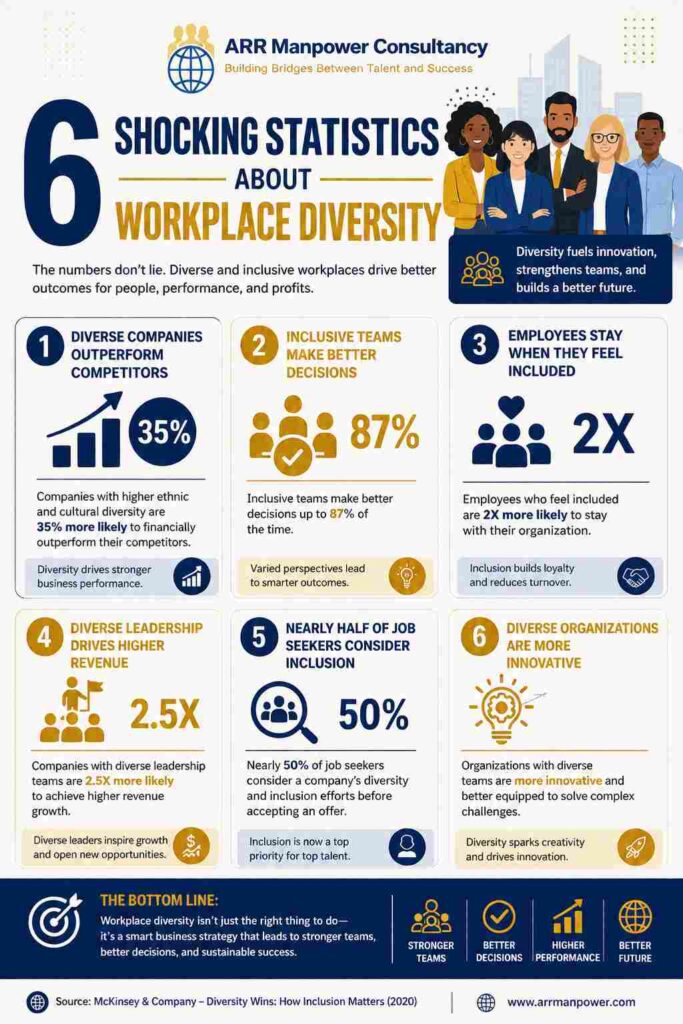
1. Diverse Companies Are 35% More Likely to Outperform Their Competitors
One of the most eye-opening findings comes from studies showing that organizations with higher levels of ethnic and cultural representation are significantly more likely to achieve above-average financial performance.
This statistic challenges the outdated belief that diversity initiatives are merely social programs. Instead, the data suggests that varied perspectives contribute directly to stronger business outcomes. Teams composed of individuals with different experiences often approach challenges from multiple angles, leading to better problem-solving and more creative solutions.
When employees bring unique viewpoints to discussions, organizations are less likely to fall victim to groupthink. Decision-makers gain access to broader insights, allowing them to identify opportunities and risks that might otherwise go unnoticed.
Companies operating in global markets particularly benefit from diverse teams because they can better understand the needs and expectations of customers from different regions and cultures.
The financial advantage demonstrated by this statistic shows that inclusion is not simply a human resources issue—it is a strategic business asset.
2. Inclusive Teams Make Better Decisions Up to 87% of the Time
Decision-making quality has a direct impact on profitability, efficiency, and customer satisfaction. Research indicates that inclusive teams can make better decisions significantly more often than homogeneous groups.
The reason is relatively straightforward. When people with varied educational backgrounds, life experiences, and professional expertise collaborate, they contribute different perspectives to the discussion. This diversity of thought encourages deeper analysis and reduces the likelihood of overlooking critical information.
In many organizations, poor decisions occur when team members hesitate to challenge assumptions. Inclusive environments encourage constructive debate, allowing ideas to be tested before implementation.
Leaders who create a culture where every employee feels comfortable sharing opinions often benefit from improved decision accuracy and stronger organizational performance.
The statistic highlights an important reality: successful decision-making depends not only on expertise but also on the variety of viewpoints present during the process.
3. Employees Are More Likely to Stay When They Feel Included
Retention remains one of the biggest challenges facing employers worldwide. Replacing experienced staff can be expensive and disruptive, particularly in competitive industries.
Studies have shown that employees who feel respected, valued, and included are significantly more likely to remain with their employer. Conversely, individuals who experience exclusion or discrimination are more likely to seek opportunities elsewhere.
This finding is especially important as organizations face increasing competition for skilled professionals. Compensation matters, but workplace culture often plays an equally important role in determining whether employees stay or leave.
An inclusive environment creates a sense of belonging. Employees who believe their contributions matter tend to demonstrate greater commitment, engagement, and loyalty.
Organizations that invest in equitable hiring practices, mentorship programs, leadership development opportunities, and inclusive policies often experience lower turnover rates and stronger employee satisfaction.
The financial implications are substantial. Reduced turnover decreases recruitment costs, shortens onboarding cycles, and preserves valuable institutional knowledge.
4. Companies With Diverse Leadership Teams Generate Higher Revenue
Representation at the leadership level remains a challenge in many sectors. Despite progress in recent years, executive positions in numerous organizations still lack balanced representation.
Research suggests that companies with more diverse leadership teams are more likely to achieve higher revenue growth than organizations with less representative executive groups.
Leadership diversity matters because strategic decisions influence every aspect of business operations. Executives with different perspectives often identify new market opportunities, challenge conventional assumptions, and encourage innovation throughout the organization.
A leadership team that reflects a broad range of experiences may also better understand the needs of customers, employees, and stakeholders.
Furthermore, visible representation in senior roles sends a powerful message to employees. It demonstrates that advancement opportunities are accessible based on talent and performance rather than limited by background.
When individuals see leaders who share aspects of their identity or experience, they may feel more motivated to pursue professional growth within the organization.
This statistic reinforces the importance of building leadership pipelines that support equal opportunity at every stage of career development.
5. Nearly Half of Job Seekers Consider Inclusion Before Accepting an Offer
The hiring landscape has changed dramatically. Today’s candidates evaluate employers on more than salary, benefits, and job responsibilities.
A growing percentage of job seekers actively research company culture before accepting employment offers. Many candidates specifically assess whether an organization demonstrates a genuine commitment to inclusion and equal opportunity.
This trend is particularly noticeable among younger professionals entering the workforce. They often seek employers whose values align with their own expectations regarding fairness, respect, and representation.
Organizations that fail to communicate their commitment to inclusion may struggle to attract top talent. Conversely, companies that publicly demonstrate support for equitable practices frequently gain a competitive advantage in recruitment.
Candidates increasingly examine factors such as leadership representation, employee resource groups, community involvement, and diversity-related initiatives when evaluating potential employers.
As transparency becomes more important, organizations must ensure that their stated values align with actual workplace experiences. Employees can quickly identify situations where corporate messaging does not reflect reality.
This statistic demonstrates that inclusion has become a critical component of employer branding and talent acquisition strategies.
6. Diverse Organizations Are More Innovative
Innovation is essential for long-term business success. Whether developing new products, improving customer experiences, or identifying emerging opportunities, organizations rely on creative thinking to remain competitive.
Research consistently shows that diverse organizations tend to be more innovative than their less diverse counterparts. Teams with varied perspectives often generate a wider range of ideas, leading to stronger creativity and improved problem-solving.
Innovation rarely emerges from identical viewpoints. Breakthrough ideas often result from combining different experiences, skills, and ways of thinking.
Individuals from different backgrounds may identify unmet customer needs, challenge established assumptions, or introduce alternative approaches to solving complex problems.
This advantage becomes particularly valuable in industries experiencing rapid technological change. Companies capable of adapting quickly are more likely to remain relevant and competitive.
The connection between innovation and inclusion demonstrates why workforce composition should be viewed as a strategic priority rather than a compliance requirement.
Why These Statistics Matter
The six statistics discussed above reveal a common theme: organizations benefit when they create environments where people from different backgrounds can contribute fully.
The advantages extend far beyond public image. Financial performance, decision quality, employee retention, recruitment success, leadership effectiveness, and innovation all appear to improve when inclusion becomes part of organizational culture.
However, achieving meaningful progress requires more than hiring individuals from different demographic groups. True inclusion involves ensuring that every employee has access to opportunities, resources, support, and a voice in decision-making.
Organizations must regularly evaluate their policies, practices, and workplace culture to identify barriers that may prevent employees from reaching their full potential.
Leadership commitment is also essential. Change is most effective when executives actively support initiatives designed to promote fairness, representation, and belonging.
Steps Organizations Can Take
Companies seeking to strengthen workplace diversity and inclusion can begin with several practical actions:
Expand Recruitment Efforts
Organizations should broaden talent sourcing strategies to reach candidates from varied backgrounds. This approach helps create larger and more diverse applicant pools.
Review Promotion Processes
Career advancement opportunities should be transparent and based on objective criteria. Regular audits can help identify potential barriers affecting employee progression.
Provide Inclusive Leadership Training
Managers play a critical role in shaping workplace culture. Training can help leaders recognize unconscious bias and improve communication across teams.
Encourage Employee Resource Groups
Employee-led communities can provide support, networking opportunities, and valuable feedback to leadership teams.
Measure Progress
Organizations should establish clear goals and regularly track metrics related to hiring, retention, promotion, and employee engagement.
Consistent measurement helps ensure accountability and supports continuous improvement.
Conclusion
The evidence is clear: workplace diversity is not simply a trend or a compliance requirement. It is a powerful driver of business success. The statistics highlighted in this article demonstrate how inclusive organizations can achieve stronger financial performance, better decision-making, higher employee retention, greater innovation, and improved recruitment outcomes.
As industries continue to evolve, businesses that embrace varied perspectives will likely be better positioned to adapt, compete, and grow. Creating an environment where all employees feel respected and valued is not only the right thing to do—it is also a smart business strategy.
Organizations that invest in inclusion today are building the foundation for sustainable success tomorrow.
https://www.skillshare.com/en/
https://www.linkedin.com/pulse/from-vacancy-productivity-recruitment-journey-consultancy-wzmkf