Introduction
The talent landscape is evolving faster than ever. Organizations across industries are facing increased competition for skilled professionals, changing employee expectations, technological advancements, and a growing emphasis on workplace flexibility. As businesses prepare for 2026, attracting and retaining top talent requires more than posting job openings and waiting for applications.
Modern recruitment demands a proactive, data-driven, and candidate-centric approach. Companies that invest in innovative hiring practices gain a significant competitive advantage by securing high-performing employees who contribute to long-term business growth.
This guide explores 14 effective talent acquisition strategies that organizations can implement in 2026 to strengthen their workforce, reduce hiring challenges, and build a sustainable pipeline of qualified candidates.
https://arrmanpowerconsultancy.com
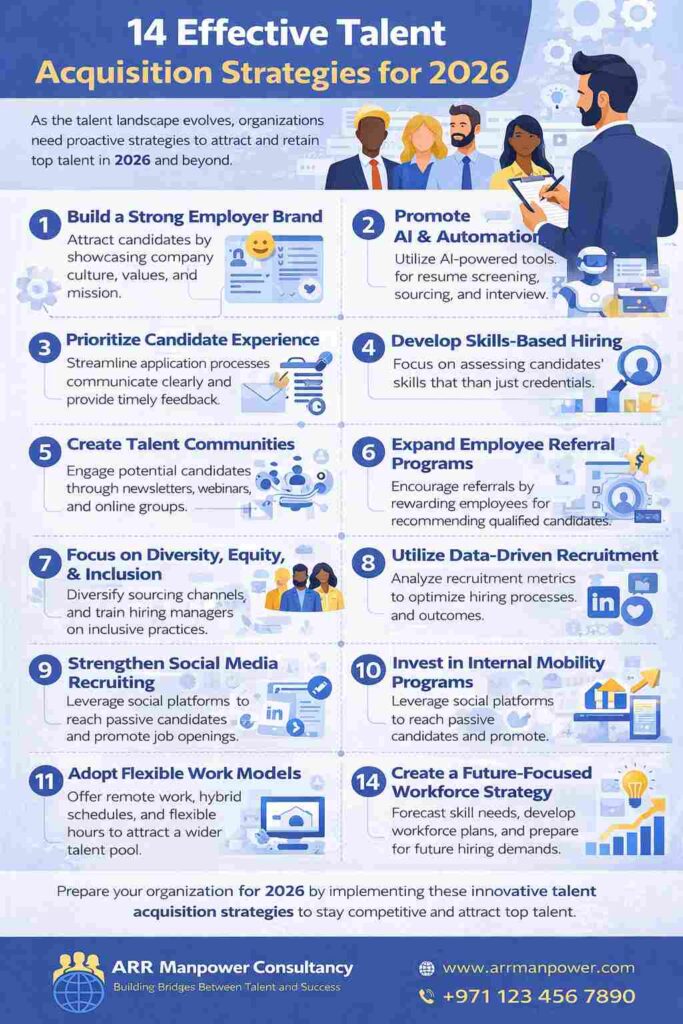
1. Build a Strong Employer Brand with Talent Acquisition Strategies
Employer branding remains one of the most influential factors in attracting quality candidates. Job seekers increasingly research organizations before applying, evaluating company culture, values, leadership, and employee experiences.
A compelling employer brand should clearly communicate:
- Company mission and vision
- Workplace culture
- Employee growth opportunities
- Diversity and inclusion initiatives
- Benefits and perks
Organizations can strengthen their brand through career pages, social media content, employee testimonials, and transparent communication.
When candidates perceive a company positively, they are more likely to apply and remain engaged throughout the hiring process.
2. Prioritize Candidate Experience
The hiring process significantly influences whether candidates accept offers or recommend an organization to others.
Improving candidate experience involves:
- Simplifying application processes
- Providing timely updates
- Conducting respectful interviews
- Offering clear communication
- Delivering constructive feedback when possible
A smooth and professional experience reflects positively on the organization and increases offer acceptance rates.
Companies that prioritize candidate satisfaction often develop stronger talent pipelines and improve their reputation within the job market.
3. Leverage Artificial Intelligence and Automation
AI-powered recruitment technologies continue to transform hiring practices.
Organizations can utilize automation for:
- Resume screening
- Candidate sourcing
- Interview scheduling
- Skill assessments
- Recruitment analytics
These technologies reduce administrative burdens and allow recruiters to focus on relationship-building and strategic decision-making.
When implemented responsibly, AI can improve efficiency, reduce time-to-hire, and help identify qualified candidates more effectively.
4. Develop a Skills-Based Hiring Approach
Traditional hiring often emphasizes degrees and previous job titles. However, many employers are shifting toward skills-based recruitment models.
Skills-based hiring focuses on:
- Technical competencies
- Problem-solving abilities
- Communication skills
- Leadership potential
- Adaptability
This approach expands the talent pool and allows organizations to discover capable candidates who may not possess conventional credentials.
By evaluating actual abilities rather than relying solely on educational qualifications, businesses can improve hiring outcomes and workplace performance.
5. Create Talent Communities
Recruitment should not begin only when positions become available.
Talent communities help organizations build relationships with potential candidates long before vacancies arise.
Methods include:
- Career newsletters
- Professional networking events
- Industry webinars
- Online communities
- Talent relationship management systems
Maintaining regular communication keeps prospective candidates engaged and familiar with the organization.
When hiring needs emerge, recruiters already have access to a pool of interested professionals.
6. Expand Employee Referral Programs
Employee referrals remain one of the most effective recruitment channels.
Current employees often understand company culture and can recommend individuals who are likely to succeed within the organization.
Successful referral programs typically offer:
- Clear guidelines
- Referral incentives
- Recognition programs
- Transparent tracking processes
Referred candidates often demonstrate higher retention rates and faster onboarding success compared to applicants from other sources.
A strong referral program can significantly reduce recruitment costs while improving hiring quality.
7. Focus on Diversity, Equity, and Inclusion
Workplace diversity is no longer optional; it is a business necessity.
Organizations that embrace diverse perspectives often benefit from:
- Enhanced innovation
- Better decision-making
- Improved employee engagement
- Stronger organizational performance
To support inclusive hiring, employers should:
- Review job descriptions for bias
- Diversify sourcing channels
- Implement structured interviews
- Train hiring managers on inclusive practices
Creating equitable opportunities helps attract a broader range of talented professionals and strengthens organizational culture.
8. Utilize Data-Driven Recruitment
Data analytics provides valuable insights into hiring performance and workforce planning.
Recruitment metrics may include:
- Time-to-fill
- Cost-per-hire
- Source effectiveness
- Offer acceptance rate
- Candidate conversion rate
- Employee retention
By analyzing recruitment data, organizations can identify bottlenecks, optimize hiring processes, and make informed decisions.
Data-driven strategies help recruiters allocate resources more effectively and improve overall hiring outcomes.
9. Strengthen Social Media Recruiting
Social media platforms continue to play a critical role in talent acquisition.
Professional networks and social channels allow organizations to:
- Showcase company culture
- Promote job opportunities
- Engage passive candidates
- Share employee success stories
- Build industry credibility
Consistent social recruiting efforts increase visibility among potential candidates and enhance employer branding initiatives.
Recruiters who actively engage with talent on social platforms often develop stronger candidate relationships and improve sourcing efficiency.
10. Invest in Internal Mobility Programs
Hiring externally is important, but organizations should not overlook existing employees.
Internal mobility programs help identify and develop talent already within the organization.
Benefits include:
- Reduced hiring costs
- Faster onboarding
- Increased employee retention
- Improved engagement
- Enhanced career development
Employees who see opportunities for advancement are more likely to remain loyal and contribute to long-term organizational success.
Promoting internal growth demonstrates a commitment to employee development and workforce sustainability.
11. Adopt Flexible Work Models
Workplace flexibility remains a major priority for modern professionals.
Organizations that offer flexible options can attract a wider range of candidates.
Common arrangements include:
- Remote work
- Hybrid schedules
- Flexible hours
- Compressed workweeks
Flexibility improves work-life balance and expands access to talent beyond geographic limitations.
Employers that adapt to changing workforce preferences often experience stronger recruitment results and higher employee satisfaction.
12. Enhance Recruitment Marketing Efforts
Recruitment marketing combines traditional marketing principles with hiring objectives.
Its purpose is to attract, engage, and nurture potential candidates throughout their journey.
Effective recruitment marketing includes:
- Targeted content campaigns
- Career-focused videos
- Employee testimonials
- Personalized messaging
- Employer branding initiatives
By creating valuable and informative content, organizations can build awareness and generate interest among qualified professionals.
Recruitment marketing supports long-term talent acquisition goals by maintaining visibility in competitive markets.
13. Build Relationships with Educational Institutions
Partnerships with universities, colleges, and training providers can create a steady flow of emerging talent.
These collaborations may include:
- Internship programs
- Campus recruitment events
- Scholarship initiatives
- Industry workshops
- Mentorship opportunities
Early engagement allows organizations to identify promising candidates before they enter the broader job market.
Building relationships with educational institutions strengthens future workforce planning and supports organizational growth.
14. Create a Future-Focused Workforce Strategy
The most successful organizations prepare for future talent needs rather than reacting to immediate vacancies.
Strategic workforce planning involves:
- Forecasting skill requirements
- Identifying talent gaps
- Monitoring industry trends
- Developing succession plans
- Investing in workforce development
As technology and business models evolve, workforce planning becomes increasingly important.
Organizations that align recruitment activities with long-term business objectives are better positioned to adapt to market changes and maintain a competitive advantage.
Key Challenges Talent Acquisition Teams Will Face in 2026
Despite advancements in recruitment technology and hiring practices, organizations will continue facing several challenges:
Skills Shortages
Demand for specialized skills often exceeds available talent supply, particularly in technology, healthcare, engineering, and data-focused roles.
Candidate Expectations
Job seekers increasingly prioritize flexibility, career growth, meaningful work, and organizational values.
Increased Competition
Organizations are competing globally for top professionals, making differentiation more important than ever.
Rapid Technological Change
Recruiters must continuously adapt to new tools, platforms, and recruitment technologies.
Retention Concerns
Attracting talent is only part of the equation; retaining employees remains equally important.
Addressing these challenges requires a proactive and adaptable approach to recruitment and workforce management.
Measuring the Success of Talent Acquisition Efforts
Organizations should regularly evaluate recruitment performance to ensure continuous improvement.
Important indicators include:
- Quality of hire
- Candidate satisfaction scores
- Employee retention rates
- Hiring manager satisfaction
- Recruitment funnel conversion rates
- Time-to-productivity
Tracking these metrics helps identify strengths, uncover improvement opportunities, and support data-informed decision-making.
Continuous measurement enables organizations to refine strategies and achieve better hiring outcomes over time.
Conclusion
By refining these strategies, organizations can build resilient, future-ready workforces that adapt quickly to changing market demands. A proactive approach to talent acquisition improves hiring quality, reduces recruitment costs, strengthens employer branding, and enhances retention. Companies that invest in data-driven, candidate-focused hiring practices today will gain a competitive advantage in attracting, engaging, and retaining talent.
As the workforce landscape continues to evolve, organizations must embrace innovative and adaptable approaches to recruitment. The most successful companies in 2026 will be those that prioritize candidate experience, leverage technology, strengthen employer branding, embrace diversity, and focus on long-term workforce planning.
Implementing these 14 effective talent acquisition strategies can help businesses attract highly qualified professionals, improve hiring efficiency, and build resilient teams capable of driving future growth. By combining human-centered recruitment practices with data-driven decision-making, organizations can position themselves as employers of choice in an increasingly competitive talent market.
The future of hiring belongs to organizations that view talent acquisition as a strategic business function rather than a transactional process. Investing in modern recruitment practices today will create stronger, more agile workforces for tomorrow.