Introduction
The business environment in 2026 is more competitive, technology-driven, and fast-paced than ever before. Organizations across industries are under pressure to hire skilled professionals quickly while maintaining productivity and reducing operational costs. Finding the right employees has become one of the biggest challenges for companies of all sizes.
This is where recruitment agencies play a major role. They help organizations identify suitable talent, streamline hiring processes, and improve workforce quality. From startups to multinational corporations, businesses are increasingly relying on staffing experts to meet changing employment demands.
Modern hiring is no longer limited to posting job advertisements and waiting for applications. Companies now require strategic hiring support, industry-specific knowledge, access to qualified candidates, and efficient onboarding systems. Recruitment firms bridge the gap between employers and job seekers by offering customized hiring solutions.
In this ARR Guide, we will explore why recruitment agencies are becoming essential partners for modern businesses in 2026 and how they contribute to sustainable growth, productivity, and workforce success.
https://arrmanpowerconsultancy.com/
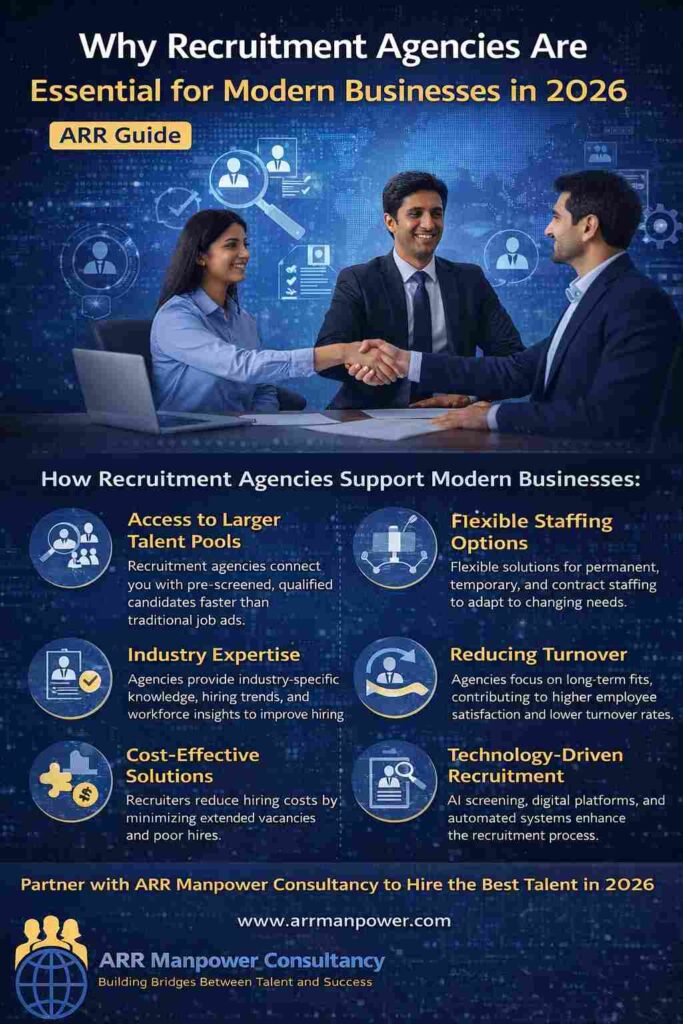
The Changing Hiring Landscape in 2026
The recruitment industry has experienced significant changes over the last few years. Technological advancements, remote work models, evolving employee expectations, and skill shortages have transformed the way organizations hire talent.
Today, businesses must compete for highly skilled professionals in industries such as information technology, healthcare, manufacturing, finance, logistics, and digital marketing. Traditional hiring methods often fail to deliver quick and reliable results.
Several factors are shaping recruitment in 2026:
- Increased demand for specialized skills
- Remote and hybrid working opportunities
- Faster hiring expectations
- Employee retention challenges
- Greater focus on workplace culture
- Rising competition for top talent
- Digital recruitment platforms and AI-based screening
Managing these changes internally can be difficult for companies that lack dedicated recruitment expertise. Recruitment agencies help businesses adapt to these evolving workforce trends efficiently.
Access to a Larger Talent Pool
One of the biggest advantages of working with a recruitment agency is access to a broad network of candidates. Recruitment consultants maintain databases of skilled professionals across multiple industries and job categories.
Many qualified candidates are passive job seekers who are not actively applying on job portals. Staffing agencies connect businesses with these professionals through their industry networks, referrals, and talent pipelines.
Instead of depending only on public job advertisements, companies gain access to:
- Pre-screened candidates
- Experienced professionals
- Industry specialists
- Contract workers
- Temporary staff
- Executive-level talent
- Fresh graduates with relevant skills
This wider reach increases the chances of finding employees who align with company goals and organizational culture.
Faster Hiring Process
Hiring delays can negatively impact productivity, customer service, and business operations. Vacant positions often create additional pressure on existing employees and reduce operational efficiency.
Recruitment agencies simplify the hiring process by handling several time-consuming tasks, including:
- Job posting
- Resume screening
- Candidate sourcing
- Initial interviews
- Skill assessments
- Background verification
- Interview scheduling
Because agencies specialize in hiring, they can identify suitable candidates much faster than internal HR teams managing multiple responsibilities.
In competitive industries where talent availability is limited, speed plays a crucial role. Businesses that delay hiring may lose top candidates to competitors. Recruitment firms help reduce the time-to-hire significantly.
Industry Expertise and Market Knowledge
Modern recruitment agencies possess strong industry-specific expertise. Their consultants understand hiring trends, salary expectations, skill requirements, and workforce availability within different sectors.
For example, hiring for IT roles requires different strategies compared to manufacturing or healthcare recruitment. Specialized staffing consultants understand these differences and provide targeted hiring solutions.
Industry expertise helps businesses in several ways:
Better Candidate Matching
Recruitment professionals evaluate candidates based on technical skills, experience, communication abilities, and cultural fit.
Salary Benchmarking
Agencies provide insights into current market salaries and compensation trends, helping employers remain competitive.
Hiring Strategy Support
Businesses receive guidance on workforce planning, hiring timelines, and role structuring.
Skill Gap Identification
Consultants help organizations identify missing competencies and future workforce requirements.
This professional support improves overall hiring quality and long-term employee performance.
Cost-Effective Recruitment Solutions
Many businesses assume that handling recruitment internally saves money. However, inefficient hiring processes often increase overall costs due to:
- Extended vacancies
- Poor hiring decisions
- Repeated recruitment cycles
- Employee turnover
- Productivity losses
- Advertising expenses
Recruitment agencies reduce these costs by improving hiring accuracy and efficiency.
A wrong hire can affect team morale, productivity, and customer relationships. Replacing employees frequently also increases onboarding and training expenses. Staffing agencies minimize these risks by conducting proper candidate evaluations before recommending applicants.
Additionally, businesses save valuable time that can be redirected toward core operations and growth activities.
Flexibility in Workforce Management
Workforce requirements vary depending on project demands, seasonal operations, and market conditions. Recruitment agencies provide flexible staffing solutions that help businesses adapt quickly.
Common staffing models include:
Permanent Recruitment
Suitable for long-term organizational growth and leadership positions.
Temporary Staffing
Ideal for seasonal workloads, short-term projects, or employee replacements.
Contract Staffing
Useful for specialized assignments requiring technical expertise for a limited duration.
Remote Hiring
Supports businesses hiring professionals from different locations.
Flexible hiring solutions allow organizations to scale operations without long-term employment risks.
Improved Quality of Hiring
Successful businesses understand that hiring quality directly impacts productivity and profitability. Recruitment agencies use structured screening methods to identify candidates who match job requirements effectively.
Professional hiring processes may include:
- Technical assessments
- Communication evaluation
- Behavioral interviews
- Reference checks
- Experience verification
- Skill testing
These screening methods help employers avoid unsuitable hires and improve workforce reliability.
Recruitment consultants also evaluate cultural compatibility, which plays an important role in employee retention and workplace collaboration.
Support for Small and Medium Businesses
Small and medium-sized enterprises often face recruitment challenges due to limited HR resources and smaller hiring budgets. Competing with large corporations for skilled professionals can be difficult.
Recruitment agencies help SMEs by offering:
- Affordable hiring support
- Access to qualified candidates
- Faster recruitment cycles
- Industry hiring guidance
- Scalable staffing solutions
This support enables smaller businesses to focus on growth while maintaining a strong workforce.
In 2026, SMEs increasingly depend on external staffing support to remain competitive in rapidly changing markets.
Technology-Driven Recruitment
Technology has transformed modern recruitment practices. Leading recruitment agencies now use advanced tools and digital platforms to improve hiring accuracy and efficiency.
Popular recruitment technologies include:
- Artificial intelligence-based screening
- Applicant tracking systems
- Video interviews
- Automated candidate matching
- Data-driven hiring analytics
- Digital onboarding platforms
These technologies help streamline recruitment while reducing manual workload.
Businesses partnering with modern staffing agencies benefit from improved hiring speed, better candidate experience, and enhanced recruitment accuracy.
Reducing Employee Turnover
High employee turnover creates instability within organizations and increases recruitment costs. Recruitment agencies focus on finding candidates who are more likely to remain committed to their roles.
By understanding company culture, work environment, and career expectations, consultants identify applicants who align with organizational goals.
Better hiring decisions contribute to:
- Higher employee satisfaction
- Improved workplace stability
- Reduced training costs
- Stronger team performance
- Long-term workforce development
Retention-focused recruitment strategies are becoming increasingly important in 2026 as businesses aim to build stable and productive teams.
Recruitment Agencies and Employer Branding
Employer branding has become an important factor in attracting skilled professionals. Job seekers now evaluate company reputation, workplace culture, career growth opportunities, and employee benefits before applying.
Recruitment agencies help organizations present themselves professionally in the job market.
This includes:
- Writing effective job descriptions
- Promoting workplace culture
- Enhancing candidate communication
- Improving interview experiences
- Managing professional outreach
Positive employer branding increases candidate interest and improves hiring success rates.
Compliance and Risk Management
Employment laws and hiring regulations continue to evolve across industries and regions. Businesses must comply with legal requirements related to contracts, employee rights, payroll practices, and workplace policies.
Recruitment agencies assist organizations in maintaining compliance during the hiring process.
Their support may include:
- Documentation management
- Employment verification
- Background checks
- Labor law guidance
- Contract administration
This reduces legal risks and ensures smoother workforce management.
Global and Remote Hiring Opportunities
Remote work has expanded access to international talent. Businesses are no longer limited to hiring candidates within a single city or country.
Recruitment agencies help companies manage remote hiring efficiently by sourcing professionals from different regions and handling virtual recruitment processes.
Global hiring offers several advantages:
- Access to specialized talent
- Greater workforce diversity
- Cost optimization
- Around-the-clock operations
- Improved business scalability
As remote work continues to grow in 2026, staffing agencies play an essential role in building distributed teams.
Strategic Workforce Planning
Modern businesses require long-term workforce strategies instead of short-term hiring solutions. Recruitment agencies assist organizations with future workforce planning and talent forecasting.
This strategic approach helps businesses:
- Prepare for expansion
- Address future skill shortages
- Plan leadership succession
- Improve workforce productivity
- Build sustainable talent pipelines
Rather than reacting to hiring needs, companies can proactively develop stronger workforce structures.
Why Businesses Trust ARR Manpower Consultancy
ARR Manpower Consultancy understands the challenges modern businesses face in today’s competitive hiring environment. With professional recruitment solutions tailored to different industries, ARR helps companies identify skilled talent efficiently and effectively.
By combining industry expertise, technology-driven recruitment methods, and personalized staffing support, ARR Manpower Consultancy assists businesses in building productive and reliable teams.
Whether companies require permanent employees, temporary staff, contract professionals, or executive-level recruitment, ARR provides customized solutions designed to support long-term business success.
Conclusion
Recruitment in 2026 is more complex than ever before. Businesses must navigate skill shortages, changing workforce expectations, technological advancements, and competitive hiring markets while maintaining productivity and operational efficiency.
Recruitment agencies have become valuable partners because they simplify hiring, improve workforce quality, reduce recruitment costs, and provide access to qualified professionals.
From startups to large enterprises, organizations increasingly rely on staffing experts to meet evolving workforce demands. Professional recruitment support not only saves time but also helps businesses build stable, skilled, and future-ready teams.
As industries continue to evolve, recruitment agencies will remain essential for organizations seeking sustainable growth and long-term success. Companies that invest in strategic hiring partnerships today are better positioned to compete in the modern business world of tomorrow.
http://recruitingexecutivesprioritiesandperspectives2026bysrhm.in