Introduction
The staffing industry has evolved rapidly over the last decade. Agencies are no longer relying only on transactional hiring models. Instead, many firms are moving toward recurring revenue income frameworks that provide predictable growth and stronger client relationships. One of the most discussed metrics in this transition is ARR.
Although ARR has become a common business measurement, many staffing companies still misunderstand how it works, how it should be calculated, and why it matters. These misunderstandings often lead to poor forecasting, unrealistic growth expectations, and flawed strategic decisions.
Understanding the reality behind ARR can help staffing businesses improve financial planning, strengthen long-term partnerships, and build scalable operations. Below are eleven common misconceptions that continue to create confusion across the staffing sector.
https://arrmanpowerconsultancy.com/
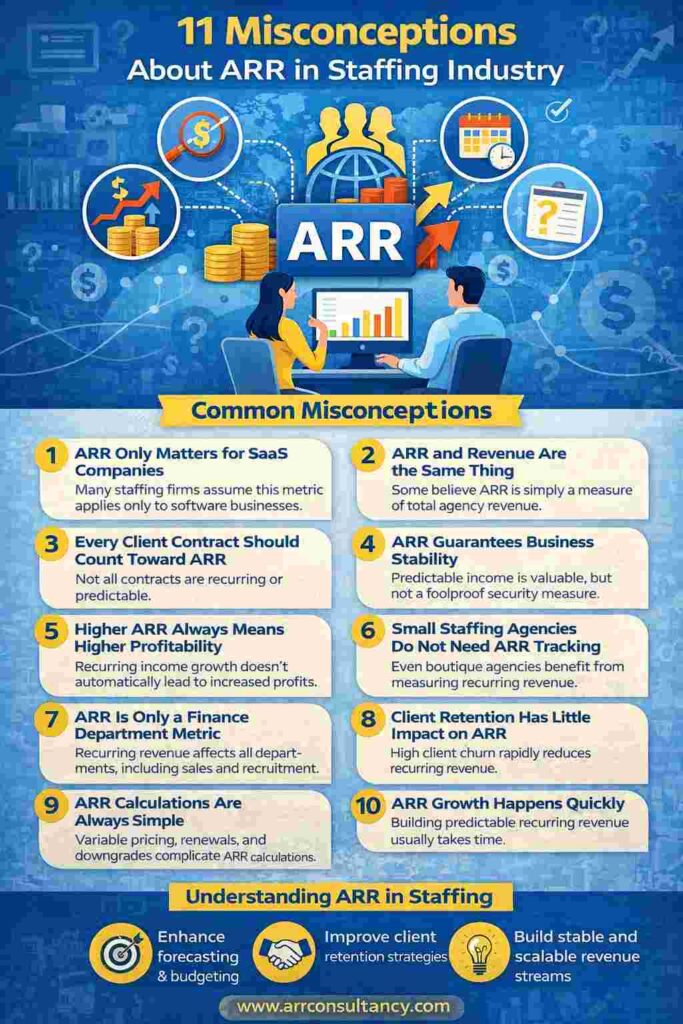
1. ARR Only Matters for SaaS Companies
One of the biggest myths is that ARR belongs exclusively to software businesses. Because the term became popular in subscription-based technology companies, many staffing leaders assume it has little relevance in recruitment.
In reality, staffing firms increasingly operate with recurring revenue structures. Managed services, retained recruitment agreements, recruitment process outsourcing, and workforce management programs all generate ongoing income streams. These models fit naturally into recurring revenue calculations.
For staffing agencies, predictable monthly or yearly income provides better visibility into future earnings. It also improves budgeting, hiring plans, and operational stability. Agencies that ignore recurring revenue measurements often struggle to forecast growth accurately.
The staffing market is becoming more service-oriented, making recurring revenue metrics more valuable than ever before.
2. ARR and Revenue Are the Same Thing
Many professionals use total revenue and ARR interchangeably, but they represent very different concepts.
Revenue reflects all income generated during a given period. ARR focuses only on predictable recurring income expected annually. Temporary placements, one-time consulting assignments, or short-term hiring projects may contribute to revenue without contributing to recurring income calculations.
For example, a staffing agency may generate significant quarterly sales through seasonal hiring projects. However, if those clients do not continue contracts year after year, the business may still have weak recurring income stability.
Confusing these two measurements can create a false sense of security. A company with high sales numbers may still face unpredictable cash flow if recurring client relationships remain limited.
Understanding the distinction helps staffing businesses focus on sustainable growth rather than temporary spikes.
3. Every Client Contract Should Count Toward ARR
Another common misunderstanding is assuming all contracts automatically qualify as recurring income.
Not every agreement creates predictable annual value. One-time hiring engagements, emergency recruitment projects, and seasonal staffing assignments often lack long-term continuity. Including these deals in recurring calculations inflates projections and creates unrealistic expectations.
Only contracts with ongoing, repeatable billing structures should be included. Long-term workforce partnerships, subscription recruitment services, and annual retainers typically qualify because they generate stable income over time.
Staffing agencies must establish clear criteria for which accounts count toward recurring financial measurements. Without consistency, reports become unreliable and difficult to compare across business periods.
Accurate classification leads to better forecasting and stronger decision-making.
4. ARR Guarantees Business Stability
Predictable income is valuable, but it does not automatically guarantee long-term security.
Some staffing leaders assume recurring revenue means their business is protected from market fluctuations. While recurring contracts reduce uncertainty, client retention remains critical. A few large clients leaving can still create major financial disruptions.
Economic downturns, hiring freezes, and organizational restructuring can impact staffing agreements quickly. Even long-standing partnerships may be renegotiated or canceled during uncertain market conditions.
Agencies should avoid becoming overconfident simply because they have recurring contracts in place. Maintaining strong relationships, delivering consistent service quality, and diversifying client portfolios remain essential.
Recurring income creates a stronger foundation, but operational discipline still determines long-term success.
5. Higher ARR Always Means Higher Profitability
Many staffing firms believe growing recurring income automatically improves profits. However, revenue growth does not always translate into healthier margins.
Some agencies spend aggressively to acquire long-term clients. Marketing costs, recruiter salaries, onboarding expenses, and account management investments can significantly reduce profitability. If client acquisition costs remain too high, recurring income growth may still produce limited financial gains.
In some cases, staffing firms sign low-margin contracts simply to increase recurring business numbers. While this may improve headline metrics, it can weaken overall financial performance.
Profitability depends on operational efficiency, pricing strategy, and client retention quality. Recurring revenue should support sustainable margins rather than become a vanity metric.
Balanced growth is more valuable than rapid expansion without financial discipline.
6. Small Staffing Agencies Do Not Need ARR Tracking
Smaller agencies often believe recurring income measurements are only useful for large enterprises. This assumption prevents many growing firms from developing strong financial systems early.
Even boutique staffing companies benefit from understanding predictable income patterns. Tracking recurring business helps identify loyal clients, estimate future cash flow, and plan hiring needs more effectively.
Smaller firms usually face greater financial volatility than larger organizations. Because of this, visibility into stable income streams becomes even more important.
A small staffing agency with several ongoing contracts may have stronger long-term potential than a larger competitor relying heavily on one-time placements.
Monitoring recurring business performance from the beginning helps agencies build scalable operations and attract future investors or partners.
7. ARR Is Only a Finance Department Metric
Another misconception is that recurring income measurements belong exclusively to finance teams.
In reality, this metric affects nearly every department inside a staffing company. Sales teams influence contract renewals and long-term account growth. Recruiters contribute through client satisfaction and delivery quality. Customer success managers help maintain retention and reduce churn.
Leadership teams also rely on recurring revenue data when making strategic decisions related to expansion, hiring, technology investments, and market positioning.
When departments operate without understanding recurring business goals, organizations often experience misalignment. Sales teams may focus only on short-term deals while account managers prioritize retention. This disconnect limits sustainable growth.
Making recurring revenue visibility part of company-wide strategy encourages collaboration and long-term thinking.
8. Client Retention Has Little Impact on ARR
Some staffing firms focus heavily on new client acquisition while underestimating the value of retention.
Losing existing clients directly affects predictable income. Acquiring replacement accounts usually costs far more than maintaining current partnerships. High churn rates can quickly erase recurring revenue gains, even when new business appears strong.
Long-term staffing relationships create multiple advantages beyond financial stability. Existing clients often expand hiring needs over time, provide referrals, and generate stronger trust with recruiters.
Improving communication, response times, candidate quality, and service consistency helps strengthen retention rates. Agencies that prioritize long-term relationships often experience more sustainable recurring growth than firms chasing constant new business opportunities.
Retention should be treated as a strategic priority rather than a secondary operational concern.
9. ARR Calculations Are Always Simple
Many people assume recurring income calculations involve straightforward math. In practice, staffing models can become highly complex.
Contracts may include variable pricing, performance bonuses, temporary scaling clauses, or hybrid billing arrangements. Some clients increase hiring volume seasonally while others reduce workforce needs during specific periods.
Determining which revenue qualifies as recurring often requires careful analysis. Agencies must also decide how to handle contract renewals, expansions, downgrades, and cancellations.
Without standardized reporting processes, different teams may calculate recurring figures differently. This creates confusion and weakens financial accuracy.
Clear definitions and consistent methodologies are essential. Agencies should document exactly how recurring contracts are measured and reviewed to ensure reliable reporting across the organization.
10. Technology Alone Can Improve ARR
Modern staffing platforms provide powerful analytics, automation tools, and reporting capabilities. However, technology by itself does not create recurring business success.
Some agencies invest heavily in software expecting immediate revenue growth. While technology improves efficiency, client relationships remain the true driver of long-term retention.
Recruitment still depends heavily on communication, trust, responsiveness, and service quality. Even the best systems cannot compensate for poor candidate matching or weak account management.
Technology should support strategic goals rather than replace relationship-building efforts. The most successful staffing firms combine operational efficiency with strong human engagement.
Automation can strengthen recurring revenue performance, but sustainable growth still depends on delivering consistent client value.
11. ARR Growth Happens Quickly
Many staffing leaders expect recurring income to grow rapidly once they introduce subscription-style services or long-term contracts.
Building predictable recurring business usually takes time. Clients often require proof of performance before committing to extended partnerships. Staffing agencies may need months or even years to establish trust strong enough for ongoing agreements.
Transitioning from transactional recruitment to recurring service models also requires operational changes. Agencies must improve reporting, communication, account management, and retention strategies.
Some firms become discouraged when recurring growth appears slower than expected. However, stable long-term relationships typically create stronger business foundations than short-term sales spikes.
Patience, consistency, and client satisfaction are essential during this transition process.
Why Understanding ARR Correctly Matters
Recurring revenue metrics offer valuable insights for staffing firms seeking sustainable growth. However, misunderstanding these measurements can lead to unrealistic projections and ineffective strategies.
Correct interpretation helps agencies:
- Forecast revenue more accurately
- Improve budgeting decisions
- Strengthen investor confidence
- Build longer client relationships
- Reduce financial volatility
- Improve operational planning
- Focus on retention and scalability
As the staffing industry becomes increasingly competitive, firms that understand recurring business dynamics will likely gain a stronger market position.
Leaders should treat recurring revenue as more than a financial calculation. It reflects client trust, service consistency, and long-term operational health.
Final Thoughts
The staffing industry is shifting toward more predictable and relationship-driven business models. As this transformation continues, recurring revenue measurements are becoming increasingly important.
Still, many misconceptions prevent staffing firms from using these metrics effectively. Some agencies overestimate their recurring stability, while others ignore the value of tracking predictable income altogether.
Understanding the truth behind these misconceptions helps organizations make smarter decisions and build more resilient businesses. Recurring revenue is not simply a finance trend borrowed from software companies. It is a practical framework that supports long-term planning, client retention, and sustainable growth.
Staffing firms that approach recurring revenue with clarity and discipline will be better positioned to navigate changing market conditions and create lasting success.
http://Investopedia – Annual Recurring Revenue (ARR) Definition