Introduction
The success of any organization depends heavily on the quality of its workforce. While training, leadership, and workplace culture all contribute to business growth, the hiring process remains the foundation of long-term employee success. Recruiting the right individuals not only reduces turnover but also improves productivity, engagement, and overall organizational performance.
Many companies focus on filling vacancies quickly, often overlooking the importance of a strategic recruitment approach. However, organizations that implement effective hiring methods are more likely to build teams that consistently achieve goals and contribute to business success.
This article explores 13 proven hiring methods that help organizations attract, select, and retain high-performing employees.
https://arrmanpowerconsultancy.com
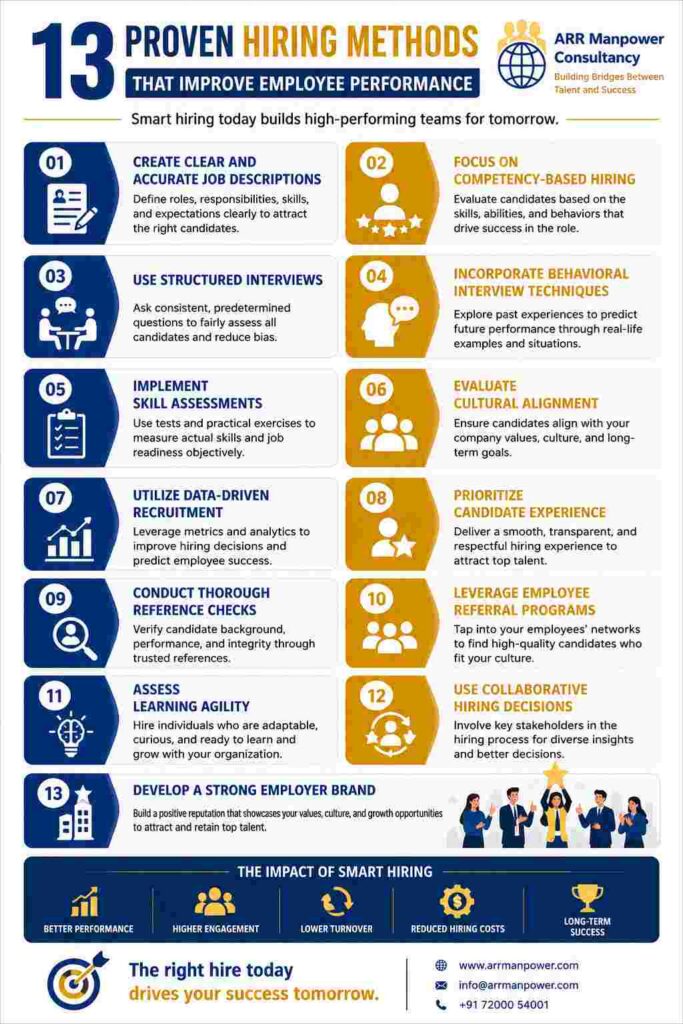
1. Create Clear and Accurate Job Descriptions
A well-written job description serves as the first step toward attracting suitable candidates. It should clearly define responsibilities, required qualifications, expected outcomes, and workplace expectations.
When applicants fully understand the role before applying, employers receive more relevant applications. This reduces mismatched hires and increases the likelihood of selecting candidates who can perform effectively from the beginning.
A strong job description should include:
- Primary duties and responsibilities
- Required skills and experience
- Performance expectations
- Reporting structure
- Company values and culture
Clarity at this stage helps both employers and candidates make informed decisions.
2. Focus on Competency-Based Hiring
Competency-based hiring emphasizes skills, behaviors, and abilities rather than relying solely on educational qualifications or previous job titles.
By identifying competencies that directly influence success in a role, organizations can evaluate applicants more effectively. Examples include:
- Communication skills
- Problem-solving ability
- Leadership potential
- Adaptability
- Team collaboration
Employees selected through competency-based assessments often demonstrate stronger workplace performance because their abilities align closely with job requirements.
3. Use Structured Interviews
Traditional interviews can be inconsistent and subjective. Structured interviews improve reliability by asking all candidates the same predetermined questions.
This method allows recruiters to compare applicants fairly while reducing unconscious bias.
Benefits include:
- Consistent evaluation criteria
- Improved decision-making
- Better prediction of job success
- Enhanced compliance with hiring standards
Structured interviews provide valuable insights into candidate capabilities and behavioral patterns.
4. Incorporate Behavioral Interview Techniques
Past behavior often serves as a strong indicator of future performance. Behavioral interviewing focuses on real-life examples from a candidate’s previous experiences.
Questions may include:
- Describe a challenge you faced at work and how you resolved it.
- Tell us about a time you handled a difficult customer.
- Explain a situation where you led a successful project.
These responses reveal practical skills, decision-making abilities, and workplace behaviors that contribute to future success.
5. Implement Skill Assessments
Resumes and interviews cannot always accurately measure a candidate’s actual abilities. Skill assessments provide objective evidence of competence.
Examples include:
- Technical tests
- Writing assignments
- Coding challenges
- Sales simulations
- Analytical exercises
Organizations that validate skills before making hiring decisions often experience higher employee productivity and fewer performance-related issues.
6. Evaluate Cultural Alignment
Technical expertise alone does not guarantee workplace success. Employees who align with organizational values and culture tend to integrate more effectively into teams.
Cultural alignment involves assessing whether candidates share attitudes and behaviors that complement the company’s mission and work environment.
Key areas to evaluate include:
- Collaboration style
- Professional ethics
- Communication preferences
- Commitment to organizational goals
Employees who fit well within company culture often demonstrate higher engagement and stronger long-term performance.
7. Utilize Data-Driven Recruitment
Modern recruitment increasingly relies on analytics to improve decision-making.
Data-driven hiring involves analyzing metrics such as:
- Candidate quality
- Time-to-hire
- Source effectiveness
- Employee retention rates
- Performance outcomes
Recruitment data helps organizations identify which hiring strategies produce the strongest performers.
Using measurable insights rather than assumptions allows companies to continuously refine their talent acquisition processes.
8. Prioritize Candidate Experience
The recruitment journey influences how candidates perceive an organization. A positive experience can attract stronger talent and enhance employer reputation.
Effective candidate experience includes:
- Timely communication
- Transparent hiring processes
- Respectful interactions
- Clear expectations
- Prompt feedback
Even unsuccessful applicants can become future candidates, customers, or brand advocates when treated professionally.
Organizations known for excellent candidate experiences often attract higher-quality applicants.
9. Conduct Thorough Reference Checks
Reference checks remain one of the most valuable yet underutilized recruitment tools.
Speaking with former supervisors or colleagues provides additional insights into:
- Work ethic
- Reliability
- Professional conduct
- Teamwork capabilities
- Leadership skills
Reference checks help verify information presented during interviews and identify potential concerns before employment begins.
This additional layer of validation reduces hiring risks and improves selection accuracy.
10. Leverage Employee Referral Programs
Current employees often understand the qualities needed for success within their organization.
Referral programs encourage staff members to recommend qualified candidates from their professional networks.
Advantages include:
- Faster recruitment
- Improved candidate quality
- Higher retention rates
- Reduced hiring costs
- Stronger cultural alignment
Referred candidates frequently perform well because they have realistic expectations about the organization before joining.
A structured referral program can become a valuable source of high-performing talent.
11. Assess Learning Agility
Work environments continue to evolve due to technological advancements and changing business requirements.
Learning agility refers to an individual’s ability to acquire new knowledge, adapt to change, and apply lessons effectively.
Candidates with strong learning agility often:
- Adapt quickly to new situations
- Embrace innovation
- Solve unfamiliar problems
- Develop skills continuously
Organizations that prioritize learning potential gain employees capable of growing alongside business needs.
This approach is particularly valuable when recruiting for rapidly changing industries.
12. Use Collaborative Hiring Decisions
Hiring decisions should not rely solely on one interviewer’s opinion.
Collaborative hiring involves multiple stakeholders participating in candidate evaluation, including:
- Hiring managers
- Team leaders
- Department representatives
- Human resources professionals
This method provides diverse perspectives and reduces the influence of personal bias.
Benefits include:
- More balanced evaluations
- Better team compatibility assessments
- Increased hiring confidence
- Improved onboarding support
When multiple decision-makers contribute, organizations are more likely to select candidates who can succeed across different workplace dimensions.
13. Develop a Strong Employer Brand
Top candidates often evaluate employers just as carefully as employers evaluate applicants.
A strong employer brand communicates:
- Organizational values
- Career development opportunities
- Workplace culture
- Employee success stories
- Business achievements
Companies with positive reputations attract larger pools of qualified candidates and experience stronger engagement throughout the recruitment process.
Employer branding can be strengthened through:
- Employee testimonials
- Social media presence
- Professional networking
- Career-focused content
- Community involvement
Candidates who connect with an organization’s reputation are often more motivated and committed after joining.
The Connection Between Hiring and Employee Performance
Effective recruitment directly impacts workplace outcomes. Employees selected through proven hiring methods are more likely to:
- Meet performance expectations
- Remain engaged
- Collaborate effectively
- Adapt to organizational changes
- Contribute to long-term growth
Poor hiring decisions can create significant costs through turnover, reduced productivity, training expenses, and decreased team morale.
By contrast, strategic recruitment establishes a foundation for sustainable success and operational excellence.
Common Hiring Mistakes That Affect Performance
Even experienced recruiters can make mistakes that negatively influence employee outcomes.
Common errors include:
Hiring Too Quickly
Pressure to fill vacancies often leads organizations to overlook warning signs or skip critical evaluation steps.
Overemphasizing Experience
Years of experience do not always translate into superior performance. Skills, adaptability, and attitude often matter more.
Ignoring Soft Skills
Communication, teamwork, and emotional intelligence significantly influence workplace success.
Failing to Define Success Metrics
Without clear performance expectations, recruiters may struggle to identify suitable candidates.
Neglecting Cultural Alignment
Employees who feel disconnected from workplace values often experience lower engagement and reduced productivity.
Avoiding these mistakes strengthens hiring accuracy and improves workforce performance.
Building a Long-Term Recruitment Strategy
Organizations that consistently hire high-performing employees treat recruitment as an ongoing strategic function rather than a reactive process.
An effective long-term strategy includes:
- Workforce planning
- Talent pipeline development
- Continuous employer branding
- Recruitment technology adoption
- Ongoing assessment improvements
Regular review of hiring outcomes helps identify which methods contribute most effectively to employee success.
Businesses that invest in recruitment excellence gain a competitive advantage through stronger teams and improved organizational performance.
Conclusion
Employee performance begins long before onboarding and training. It starts with selecting the right people through proven and structured hiring methods. From competency-based assessments and behavioral interviews to referral programs and data-driven recruitment, each strategy contributes to better hiring outcomes.
Organizations that prioritize effective recruitment practices are more likely to attract talented individuals who align with business goals, adapt to changing environments, and contribute meaningfully to long-term success.
By implementing these 13 proven hiring methods, companies can build stronger teams, improve productivity, reduce turnover, and create a workforce capable of driving sustained growth in an increasingly competitive business landscape.
Furthermore, organizations that continuously refine their recruitment processes gain valuable insights into the qualities that distinguish top performers from average employees. Investing in modern hiring practices not only improves workforce quality but also strengthens leadership pipelines, innovation, and customer satisfaction.
As labor markets become increasingly competitive, businesses must adopt a proactive approach to talent acquisition rather than relying on outdated recruitment methods. Every hiring decision has a lasting impact on organizational culture and operational efficiency. By combining strategic planning, objective evaluation techniques, and a commitment to finding the right fit, employers can create a resilient workforce that supports long-term business objectives and sustainable organizational success.