Introduction
In 2026, organizations across industries are facing unprecedented workforce challenges. Rapid technological advancements, evolving employee expectations, talent shortages, and changing market demands are reshaping the employment landscape. While many companies focus heavily on revenue generation, customer acquisition, and operational efficiency, one critical factor often determines long-term success: having the right people in the right roles at the right time.
When businesses fail to address workforce deficiencies, they create staffing gaps that negatively affect productivity, profitability, customer satisfaction, and overall growth. These gaps are not always immediately visible. They often develop gradually, causing delays, increased costs, employee burnout, and missed business opportunities.
Understanding the most dangerous staffing challenges can help organizations prepare proactive workforce strategies and maintain a competitive advantage. Below are ten significant workforce deficiencies that can hinder business expansion in 2026 and practical ways to address them.
https://arrmanpowerconsultancy.com
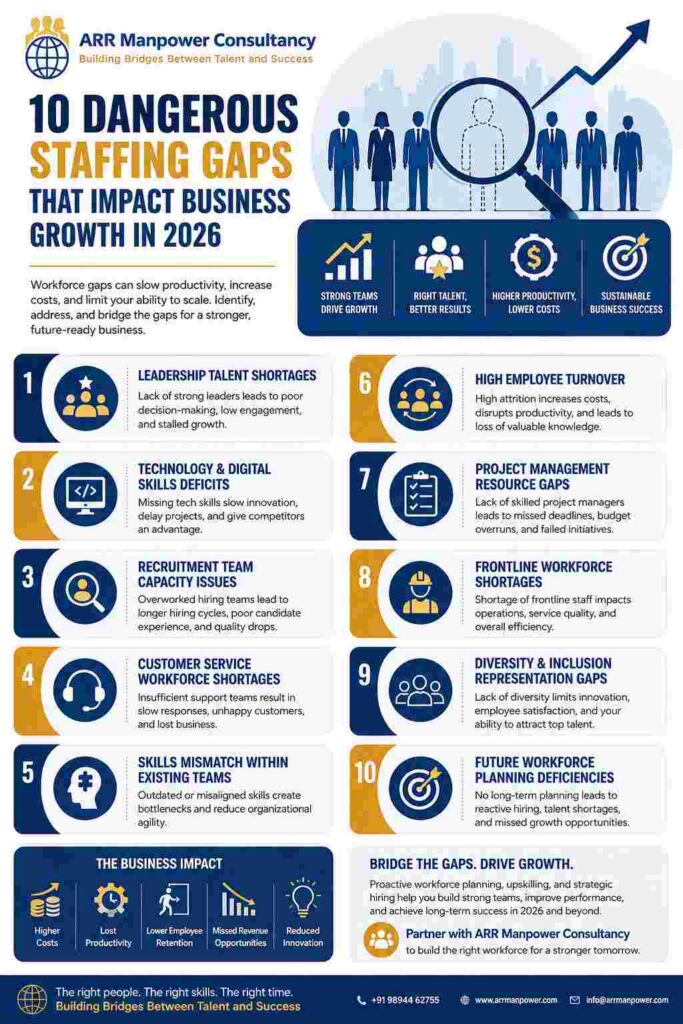
1. Leadership Talent Shortages Due To Staffing Gaps
One of the most damaging workforce deficiencies occurs at the leadership level. Many organizations struggle to find experienced managers capable of guiding teams through change, innovation, and growth.
Without strong leadership:
- Employee engagement decreases
- Decision-making becomes inconsistent
- Team performance suffers
- Strategic initiatives stall
As businesses expand, leadership requirements increase significantly. Organizations that fail to develop internal leadership pipelines often face succession challenges and operational disruptions.
Solution
Implement leadership development programs, mentorship initiatives, and succession planning strategies to prepare future leaders before vacancies arise.
2. Technology and Digital Skills Deficits
Digital transformation continues to accelerate across industries. Businesses increasingly depend on professionals skilled in:
- Artificial intelligence
- Cybersecurity
- Data analytics
- Cloud computing
- Software development
- Automation technologies
When organizations lack these capabilities, projects become delayed, innovation slows, and competitors gain market advantages.
The demand for technical talent remains significantly higher than supply, making recruitment increasingly competitive in 2026.
Solution
Invest in employee upskilling, partner with specialized recruitment firms, and create continuous learning opportunities to strengthen technical capabilities.
3. Recruitment Team Capacity Issues
Many organizations focus on hiring growth without strengthening their recruitment infrastructure. As hiring demands increase, internal talent acquisition teams become overwhelmed.
Consequences include:
- Longer hiring cycles
- Reduced candidate quality
- Poor applicant experiences
- Increased vacancy periods
When recruitment teams lack adequate resources, businesses struggle to attract qualified professionals efficiently.
Solution
Expand recruitment capacity through outsourcing, recruitment technology, and strategic workforce planning to manage hiring demands effectively.
4. Customer Service Workforce Shortages
Customer expectations continue to rise in every sector. Businesses that lack sufficient customer support personnel risk damaging their reputation and losing loyal customers.
Common consequences include:
- Slow response times
- Increased complaints
- Lower customer satisfaction
- Revenue loss
Poor service experiences can quickly spread through online reviews and social media, negatively affecting brand perception.
Solution
Develop customer support teams proactively, implement workforce forecasting, and use technology to enhance service efficiency while maintaining personalized interactions.
5. Skills Mismatch Within Existing Teams
Sometimes organizations have enough employees but lack the specific capabilities required to meet evolving business needs.
A skills mismatch occurs when:
- Employees possess outdated expertise
- New technologies require different competencies
- Business strategies change rapidly
This challenge creates productivity bottlenecks and reduces organizational agility.
Solution
Conduct regular skills assessments, identify capability gaps, and establish targeted training programs to align workforce competencies with business objectives.
6. High Employee Turnover
Employee retention remains a major concern in 2026. High turnover creates continuous workforce instability and increases recruitment expenses.
The hidden costs include:
- Lost institutional knowledge
- Reduced team morale
- Training expenses
- Productivity disruptions
Frequent departures can make it difficult to maintain consistent business performance and customer relationships.
Solution
Improve employee engagement through competitive compensation, career development opportunities, flexible work arrangements, and positive workplace cultures.
7. Project Management Resource Gaps
As organizations launch more initiatives, the need for experienced project managers grows significantly.
Without adequate project management expertise:
- Deadlines are missed
- Budgets exceed expectations
- Communication breaks down
- Business objectives remain unachieved
Poor project execution can delay growth initiatives and reduce return on investment.
Solution
Develop project management capabilities internally and recruit experienced professionals capable of coordinating complex organizational initiatives.
8. Frontline Workforce Shortages
Industries such as manufacturing, logistics, healthcare, retail, and construction continue experiencing frontline labor shortages.
These shortages often result in:
- Reduced production capacity
- Service delays
- Increased overtime costs
- Employee fatigue
Frontline workers form the backbone of operational performance. Insufficient staffing at this level can significantly impact organizational efficiency.
Solution
Strengthen workforce planning, improve employee retention strategies, and leverage specialized staffing partners to maintain operational continuity.
9. Diversity and Inclusion Representation Gaps
Modern organizations recognize the value of diverse teams in driving innovation and business success. However, many companies still struggle to achieve balanced workforce representation.
A lack of diversity can lead to:
- Limited perspectives
- Reduced creativity
- Lower employee engagement
- Difficulty attracting top talent
Research consistently shows that diverse organizations often outperform less diverse competitors.
Solution
Develop inclusive hiring practices, expand candidate sourcing channels, and establish measurable diversity objectives that align with organizational goals.
10. Future Workforce Planning Deficiencies
Many businesses focus on immediate hiring needs while neglecting long-term workforce planning.
Without future-oriented workforce strategies:
- Talent shortages become reactive crises
- Growth opportunities are missed
- Expansion plans face delays
- Competitive advantages diminish
Workforce planning is no longer optional in rapidly changing business environments.
Solution
Use workforce analytics, market forecasting, and strategic talent planning to anticipate future staffing requirements before shortages emerge.
The Financial Impact of Workforce Deficiencies
Staffing challenges affect more than human resources functions. They create measurable financial consequences throughout the organization.
Common impacts include:
Increased Recruitment Costs
Urgent hiring often requires premium salaries, recruitment fees, and accelerated onboarding investments.
Lost Productivity
Vacant positions reduce team output and place additional responsibilities on existing employees.
Higher Turnover Expenses
Replacing experienced employees typically costs significantly more than retaining them.
Missed Revenue Opportunities
Insufficient staffing limits the organization’s ability to serve customers, launch products, and pursue expansion initiatives.
Reduced Innovation
When teams operate under constant pressure, innovation and strategic thinking frequently become secondary priorities.
Organizations that proactively address workforce challenges often experience stronger financial performance and sustainable growth.
Why Workforce Challenges Are Increasing in 2026
Several trends contribute to the growing complexity of talent management.
Rapid Technological Change
New technologies require specialized expertise that many organizations currently lack.
Evolving Employee Expectations
Workers increasingly prioritize:
- Career development
- Work-life balance
- Flexibility
- Meaningful work
- Organizational culture
Companies unable to meet these expectations often struggle with recruitment and retention.
Global Talent Competition
Organizations are no longer competing solely within local markets. Remote work has expanded access to global talent pools, increasing competition for skilled professionals.
Aging Workforce Demographics
Many industries face significant retirements, creating knowledge gaps and succession challenges.
Economic Uncertainty
Market fluctuations require organizations to balance workforce investments with operational efficiency, making staffing decisions increasingly complex.
Building a Strong Workforce Strategy
Addressing workforce deficiencies requires a comprehensive and proactive approach.
Successful organizations focus on:
Workforce Forecasting
Predict future hiring needs based on business growth plans and market trends.
Employee Development
Invest continuously in training, reskilling, and professional growth opportunities.
Employer Branding
Build a strong reputation that attracts high-quality candidates and strengthens retention.
Talent Pipeline Development
Establish relationships with educational institutions, industry associations, and recruitment partners.
Data-Driven Decision Making
Use workforce analytics to identify risks and optimize staffing strategies.
Flexible Staffing Models
Combine permanent employees, contract professionals, and specialized staffing solutions to maintain operational agility.
Conclusion
Ultimately, addressing staffing gaps is no longer a reactive task but a strategic priority for organizations aiming to grow sustainably in 2026. Businesses that overlook critical workforce shortages often experience delayed projects, declining productivity, increased employee burnout, and missed revenue opportunities.
On the other hand, companies that proactively identify hiring challenges and implement effective workforce planning gain a significant competitive advantage. Investing in talent acquisition, employee development, succession planning, and retention strategies helps create a resilient workforce capable of adapting to changing market demands. Leveraging technology, data driven recruitment, and flexible staffing models can further strengthen operational efficiency and business continuity.
As industries continue to evolve, leaders must regularly evaluate workforce needs and close talent gaps before they become major obstacles. The most successful organizations will be those that view staffing as a growth driver rather than an administrative function. By building the right teams, fostering employee engagement, and maintaining workforce agility, businesses can reduce risks, improve performance, and position themselves for long term success. Taking action today ensures stronger growth, greater stability, and profitability.
Business growth in 2026 depends heavily on workforce readiness. Organizations that ignore critical staffing deficiencies risk reduced productivity, lower customer satisfaction, increased costs, and missed growth opportunities. Leadership shortages, technical skill deficits, recruitment bottlenecks, turnover challenges, and workforce planning failures can significantly impact organizational performance.
The most successful companies recognize that talent is a strategic asset rather than simply an operational requirement. By identifying workforce risks early and implementing proactive talent strategies, businesses can strengthen resilience, improve competitiveness, and support sustainable growth.
Organizations that prioritize workforce planning today will be better positioned to navigate future challenges, seize new opportunities, and achieve long-term success in an increasingly competitive marketplace.