Introduction
In today’s highly competitive business landscape, organizations are constantly battling to attract, hire, and retain top talent. The success of any company largely depends on the quality of its workforce, and that’s where recruitment becomes a strategic advantage rather than just an operational task. Businesses that fail to adapt their hiring methods often struggle with high turnover, low productivity, and missed growth opportunities.
Recruitment is no longer about posting job openings and waiting for candidates to apply. It has evolved into a sophisticated process involving data, technology, employer branding, and candidate experience. Companies that adopt modern recruitment strategies can build stronger teams, reduce hiring costs, and stay ahead of competitors.
This article explores ten powerful recruitment strategies that can help organizations outperform their competition. Each strategy is designed to enhance efficiency, attract better candidates, and improve overall hiring outcomes.
https://arrmanpowerconsultancy.com/
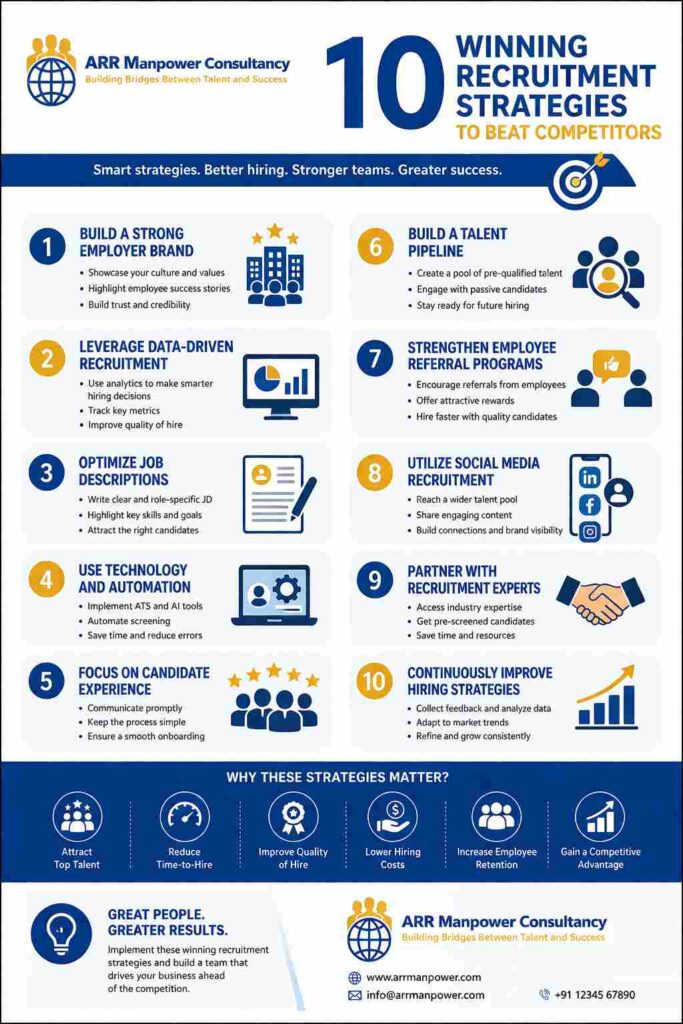
1. Build a Strong Employer Brand
Employer branding plays a crucial role in attracting high-quality candidates. Job seekers today research companies thoroughly before applying. They look at company culture, employee reviews, career growth opportunities, and workplace environment.
A strong employer brand communicates trust, credibility, and value. Companies with a positive image attract more qualified applicants and reduce hiring time.
How to Build Employer Branding
- Showcase company culture through social media and career pages
- Share employee testimonials and success stories
- Highlight benefits, learning opportunities, and work-life balance
- Maintain transparency in communication
Organizations that invest in branding not only attract better candidates but also retain employees for longer periods.
2. Leverage Data-Driven Recruitment
Data-driven hiring is transforming how companies make recruitment decisions. Instead of relying solely on intuition, businesses now use analytics to identify trends, measure performance, and improve hiring outcomes.
Benefits of Data-Driven Recruitment
- Better candidate selection
- Reduced hiring time
- Improved quality of hire
- Lower recruitment costs
Key Metrics to Track
- Time-to-hire
- Cost-per-hire
- Candidate conversion rate
- Employee retention rate
Using data allows organizations to refine their hiring process and eliminate inefficiencies.
3. Optimize Job Descriptions
A well-crafted job description can significantly impact the quality of applicants. Generic or unclear descriptions often attract unqualified candidates, wasting time and resources.
Tips for Writing Effective Job Descriptions
- Use clear and concise language
- Focus on key responsibilities and expectations
- Highlight growth opportunities
- Include relevant keywords for SEO
- Avoid unnecessary jargon
An optimized job description ensures that the right candidates apply, improving overall recruitment efficiency.
4. Use Technology and Automation
Technology has revolutionized recruitment. From applicant tracking systems to AI-based screening tools, automation helps streamline the hiring process.
Key Technologies in Recruitment
- Applicant Tracking Systems (ATS)
- AI-powered resume screening
- Chatbots for candidate engagement
- Video interviewing tools
Automation reduces manual effort, speeds up hiring, and improves accuracy in candidate selection.
5. Focus on Candidate Experience
Candidate experience is a critical factor in modern recruitment. A poor hiring experience can damage a company’s reputation and discourage top talent from joining.
Ways to Improve Candidate Experience
- Provide timely communication
- Simplify the application process
- Offer feedback after interviews
- Ensure a smooth onboarding process
A positive experience increases the likelihood of candidates accepting job offers and recommending the company to others.
6. Build a Talent Pipeline
A talent pipeline is a pool of potential candidates who are ready to fill future roles. Instead of starting from scratch every time, companies can rely on this pre-qualified group.
How to Build a Talent Pipeline
- Maintain a database of previous applicants
- Engage passive candidates through networking
- Use social media to connect with professionals
- Attend industry events and job fairs
Having a talent pipeline reduces hiring time and ensures business continuity.
7. Strengthen Employee Referral Programs
Employee referrals are one of the most effective recruitment methods. Referred candidates are often more reliable and better aligned with company culture.
Advantages of Referral Programs
- Faster hiring process
- Higher retention rates
- Better cultural fit
- Lower recruitment costs
How to Improve Referral Programs
- Offer incentives for successful referrals
- Simplify the referral process
- Encourage employees to participate actively
Referral hiring helps organizations find quality candidates quickly.
8. Utilize Social Media Recruitment
Social media platforms have become powerful tools for recruitment. Companies can reach a wider audience and engage with potential candidates directly.
Popular Platforms for Recruitment
- LinkedIn for professional networking
- Facebook for job postings and employer branding
- Instagram for showcasing company culture
Best Practices
- Share engaging content regularly
- Use targeted ads for job openings
- Interact with candidates through comments and messages
Social media recruitment increases visibility and attracts diverse talent.
9. Partner with Recruitment Experts
Collaborating with recruitment agencies or manpower consultancies can provide access to a broader talent pool. These experts specialize in sourcing, screening, and selecting candidates.
Benefits of Partnering with Experts
- Access to pre-screened candidates
- Industry-specific expertise
- Faster hiring process
- Reduced workload for internal teams
Recruitment partners can help organizations fill positions efficiently, especially for specialized roles.
10. Continuously Improve Hiring Strategies
Recruitment is an ongoing process that requires continuous improvement. Companies must regularly evaluate their strategies and adapt to changing market trends.
Ways to Improve Recruitment Strategies
- Gather feedback from candidates and hiring managers
- Analyze recruitment data and metrics
- Stay updated with industry trends
- Invest in training for HR teams
Continuous improvement ensures that recruitment processes remain effective and competitive.
Conclusion
In today’s highly competitive hiring landscape, recruitment is no longer just a support function—it has become a critical business strategy. Organizations that consistently attract, engage, and retain top talent gain a significant advantage over competitors that rely on outdated hiring methods. The difference between a thriving company and one that struggles to grow often comes down to the quality of its workforce and the effectiveness of its recruitment process.
The 10 recruitment strategies discussed in this article provide a strong foundation for building a sustainable talent acquisition framework. From strengthening your employer brand and leveraging employee referrals to embracing recruitment technology and improving candidate experiences, each strategy contributes to creating a more efficient and successful hiring process. When combined, these approaches help organizations identify the right candidates faster while reducing hiring costs and improving long-term employee retention.
One of the most important lessons for employers is that recruitment should always be proactive rather than reactive. Waiting until a vacancy becomes urgent can lead to rushed hiring decisions and missed opportunities. Companies that continuously build talent pipelines, maintain relationships with potential candidates, and monitor market trends are better positioned to secure high-quality professionals before competitors do. A proactive approach also enables organizations to adapt quickly to changing workforce demands and industry challenges.
Candidate expectations have also evolved significantly in recent years. Job seekers are looking for more than just competitive salaries; they want meaningful work, career development opportunities, flexibility, and a positive workplace culture. Businesses that understand these priorities and effectively communicate their value proposition stand out in crowded job markets. A transparent and engaging recruitment process can leave a lasting impression, even on candidates who are not ultimately selected, helping to strengthen the company’s reputation for future hiring efforts.
Technology continues to play a vital role in modern recruitment success. Artificial intelligence, applicant tracking systems, data analytics, and digital communication tools have transformed the way recruiters source and evaluate candidates. However, technology should complement human judgment rather than replace it. The most successful recruitment teams balance automation with personalized interactions to ensure candidates feel valued throughout their hiring journey.
Another key factor in staying ahead of competitors is continuous improvement. Recruitment strategies that worked a few years ago may not deliver the same results today. Organizations should regularly analyze hiring metrics, gather candidate feedback, and refine their processes to maintain a competitive edge. Tracking indicators such as time-to-hire, quality-of-hire, offer acceptance rates, and employee retention can provide valuable insights into areas for improvement.
Ultimately, winning the competition for talent requires commitment, innovation, and a long-term perspective. Businesses that invest in strong recruitment practices are not simply filling positions—they are building teams capable of driving growth, innovation, and organizational success. By implementing these 10 recruitment strategies consistently and adapting them to your unique business needs, your organization can attract top-performing professionals, strengthen its workforce, and secure a lasting advantage in an increasingly competitive marketplace.
The future belongs to companies that recognize talent as their most valuable asset. Start applying these recruitment strategies today, and you will be better prepared to attract exceptional candidates, outperform competitors, and achieve sustainable business success for years to come.
Winning the competition for top talent requires a strategic approach to recruitment. Organizations that adopt modern hiring techniques, leverage technology, and focus on candidate experience can gain a significant advantage.
The ten strategies discussed in this article provide a comprehensive framework for improving recruitment outcomes. From building a strong employer brand to using data-driven insights, each approach contributes to a more efficient and effective hiring process.
Businesses that implement these strategies will not only attract better candidates but also build a strong workforce capable of driving long-term success. In a world where talent is the key differentiator, investing in recruitment is one of the smartest decisions a company can make.