Introduction
Searching for a new job can be exciting, but it often comes with a fair share of obstacles. Whether you are a recent graduate, a professional seeking career growth, or someone re-entering the workforce, the process can feel overwhelming. Many candidates spend weeks or even months applying for positions without receiving responses, attending interviews that lead nowhere, or struggling to stand out in a competitive market.
The modern hiring landscape is constantly evolving. Employers use advanced screening tools, expectations continue to change, and competition has increased across many industries. As a result, job seekers frequently encounter challenges that can impact confidence and motivation.
The good news is that every challenge has a practical solution. Understanding common obstacles and learning effective strategies can help candidates navigate the process more efficiently and improve their chances of success.
In this guide, we explore eight frustrating job search challenges and solutions that can help transform your approach and increase your opportunities.
https://arrmanpowerconsultancy.com
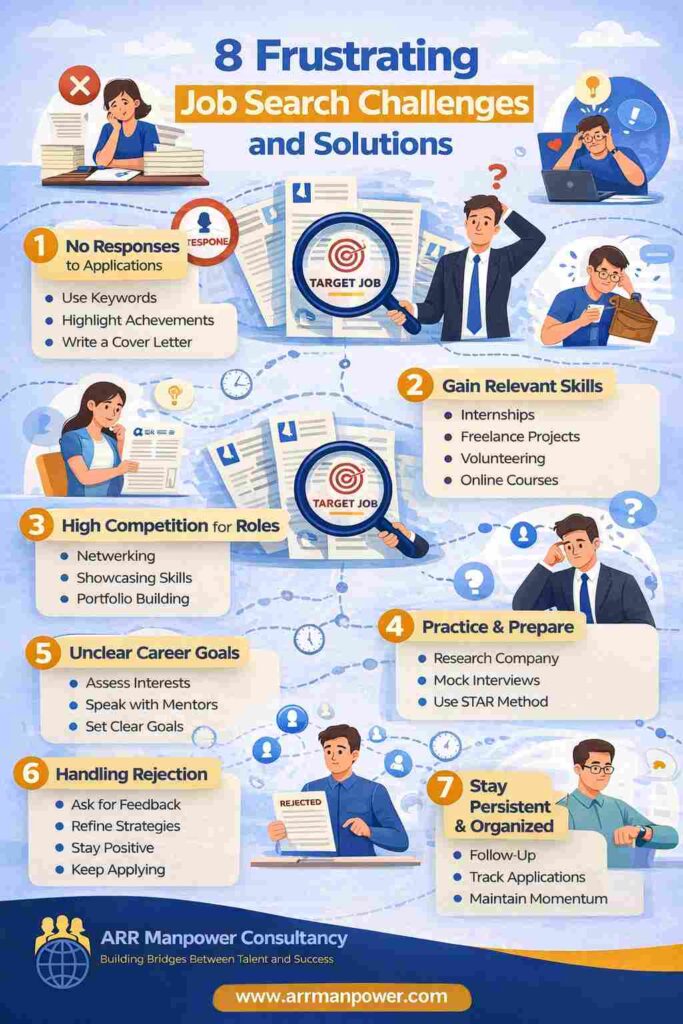
1. Receiving No Responses After Submitting Applications
The Challenge
One of the most common frustrations candidates experience is applying to dozens of positions without hearing back from employers. It can feel discouraging to spend hours tailoring applications only to receive silence.
Several factors may contribute to this issue:
- Generic resumes
- Incomplete applications
- Poor keyword optimization
- Applying for unsuitable positions
- High competition for popular roles
Many organizations use Applicant Tracking Systems (ATS) to screen resumes before a recruiter ever sees them. If your application does not align with the job description, it may be filtered out automatically.
The Solution
Start by customizing your resume for each position. Carefully review the job posting and identify important skills, qualifications, and responsibilities.
Additional strategies include:
- Use keywords from the job description naturally.
- Highlight measurable achievements.
- Keep formatting simple and ATS-friendly.
- Include relevant certifications and training.
- Write a compelling cover letter when requested.
Instead of sending hundreds of generic applications, focus on quality over quantity. A targeted approach often generates better results than mass submissions.
2. Lack of Relevant Experience
The Challenge
Many professionals encounter the classic problem of needing experience to get hired while needing a job to gain experience. This issue is particularly common among recent graduates and career changers.
Employers often seek candidates who can contribute immediately, making it difficult for newcomers to compete against experienced applicants.
The Solution
Remember that experience comes in many forms. Employers increasingly value transferable skills and practical achievements.
Consider these approaches:
- Participate in internships.
- Complete freelance projects.
- Volunteer for organizations.
- Build personal projects.
- Take online courses and certifications.
For example, a marketing graduate can create sample campaigns, manage social media pages, or assist local businesses. These activities demonstrate initiative and practical capabilities.
When writing your resume, focus on accomplishments rather than job titles. Show how your skills have produced results, regardless of where they were developed.
3. Intense Competition for Popular Roles
The Challenge
In many industries, a single vacancy can attract hundreds of applications. This level of competition makes it difficult to capture an employer’s attention.
Highly desirable positions often receive applications from candidates with diverse backgrounds, advanced qualifications, and extensive experience.
The Solution
Differentiation is essential.
Ways to stand out include:
- Building a strong professional brand.
- Creating an impressive online presence.
- Developing specialized skills.
- Networking with industry professionals.
- Showcasing a portfolio of work.
A well-maintained professional profile can significantly improve visibility. Recruiters often review online profiles before scheduling interviews.
Focus on demonstrating value rather than simply listing responsibilities. Employers want evidence that you can solve problems and contribute to organizational success.
Specialization can also be beneficial. Candidates with niche expertise often face less competition than generalists.
4. Struggling with Interview Anxiety
The Challenge
Even highly qualified candidates can struggle during interviews. Nervousness may lead to unclear answers, forgotten examples, or difficulty expressing achievements effectively.
Interview anxiety is common because candidates feel pressure to make a positive impression within a limited amount of time.
The Solution
Preparation is the most effective way to reduce anxiety.
Helpful techniques include:
- Research the company thoroughly.
- Review the job description carefully.
- Practice common interview questions.
- Conduct mock interviews.
- Prepare examples using the STAR method.
The STAR framework helps structure answers:
- Situation
- Task
- Action
- Result
This approach allows candidates to present experiences clearly and confidently.
Additionally, arrive early, dress appropriately, and ensure technology functions properly for virtual interviews. Small preparations can significantly increase confidence levels.
Remember that interviews are conversations, not interrogations. Employers are assessing whether there is a mutual fit.
5. Unclear Career Direction in Job Search Challenges
The Challenge
Many individuals begin searching for opportunities without a clear understanding of their career goals. This lack of direction can result in scattered applications and inconsistent messaging.
Candidates may apply for multiple unrelated positions, making it difficult to create a focused resume or explain career aspirations during interviews.
The Solution
Before beginning an extensive search, invest time in career planning.
Ask yourself:
- What industries interest me?
- Which skills do I enjoy using?
- What type of work environment suits me?
- What are my long-term goals?
- Which roles align with my strengths?
Conduct self-assessments and research different career paths. Speaking with mentors or industry professionals can also provide valuable insights.
Once you establish a clear direction, your applications become more focused and compelling.
A targeted strategy improves efficiency and increases the likelihood of finding a role that supports long-term growth.
6. Difficulty Building Professional Connections
The Challenge
Networking remains one of the most effective methods for discovering opportunities, yet many job seekers find it uncomfortable or intimidating.
Some candidates believe networking involves asking strangers for jobs, which can create unnecessary anxiety.
In reality, networking is about building professional relationships and exchanging valuable information.
The Solution
Approach networking as relationship building rather than job seeking.
Effective networking activities include:
- Attending industry events.
- Participating in webinars.
- Joining professional associations.
- Engaging in online communities.
- Connecting with alumni networks.
When meeting professionals, focus on learning from their experiences. Ask thoughtful questions and demonstrate genuine interest in their work.
Over time, these relationships may lead to referrals, recommendations, and valuable career advice.
Consistency is important. Building a strong network is a long-term process that produces benefits throughout your career.
7. Dealing with Rejection
The Challenge
Rejection is one of the most emotionally difficult aspects of searching for employment. Candidates may invest significant time preparing applications and interviews only to receive disappointing news.
Repeated rejection can lead to frustration, self-doubt, and reduced motivation.
The Solution
View rejection as part of the process rather than a reflection of your worth.
Employers make decisions based on many factors, including:
- Budget considerations
- Team dynamics
- Internal candidates
- Specific skill requirements
- Organizational priorities
Whenever possible, request constructive feedback.
Use rejection as an opportunity to evaluate:
- Resume quality
- Interview performance
- Skill gaps
- Application strategy
Maintain a record of lessons learned from each experience. Continuous improvement increases future success rates.
Most successful professionals have experienced numerous rejections before achieving their goals. Persistence often separates successful candidates from those who give up too soon.
8. Long Hiring Timelines and Lack of Communication
The Challenge
Modern recruitment processes can be lengthy. Candidates frequently wait weeks between application stages, interviews, and final decisions.
A lack of communication can create uncertainty and stress. Many applicants wonder whether they should continue waiting or move on to other opportunities.
The Solution
Maintain an active search while waiting for responses.
Best practices include:
- Continue applying for relevant positions.
- Follow up professionally after interviews.
- Track application progress.
- Set realistic expectations.
- Avoid relying on a single opportunity.
A polite follow-up message can demonstrate professionalism and enthusiasm without appearing pushy.
Create a job search tracking system that records:
- Company names
- Application dates
- Interview schedules
- Contact information
- Follow-up deadlines
Organization helps reduce uncertainty and ensures that opportunities do not slip through the cracks.
Remember that hiring delays often result from internal approvals, scheduling challenges, or business priorities rather than issues with your candidacy.
Additional Tips for a Successful Job Search
Beyond addressing specific challenges, several habits can improve overall effectiveness.
Keep Learning
Employers value candidates who demonstrate continuous development. Stay updated on industry trends and pursue opportunities to expand your knowledge.
Strengthen Your Personal Brand
Your professional reputation extends beyond your resume. Ensure your online presence reflects your skills, achievements, and career goals.
Set Realistic Goals
Establish weekly targets for applications, networking activities, and skill development. Structured goals create momentum and help maintain motivation.
Stay Organized
Managing multiple opportunities can become complicated. Use spreadsheets, applications, or project management tools to track progress.
Prioritize Quality
A personalized application generally performs better than a generic one. Focus on positions that align with your qualifications and interests.
Maintain a Positive Mindset
Searching for employment can be demanding, but persistence is essential. Celebrate small victories, such as securing interviews or expanding your network.
Every step forward contributes to long-term success.
Conclusion
The path to securing a new role is rarely straightforward. Candidates often face obstacles such as limited responses, lack of experience, intense competition, interview anxiety, unclear career goals, networking challenges, rejection, and lengthy hiring processes.
While these difficulties can feel discouraging, they are common experiences shared by professionals across industries. The key is to approach each challenge strategically and focus on actions within your control.
By tailoring applications, developing relevant skills, strengthening professional relationships, preparing thoroughly for interviews, and maintaining resilience, job seekers can significantly improve their chances of success.
Every application, conversation, and interview provides an opportunity to learn and grow. With patience, persistence, and the right approach, even the most frustrating job search challenges can become stepping stones toward a rewarding career opportunity.
The journey may take time, but the right position is often found by those who continue improving, adapting, and moving forward.
In case you have blonde hair, blue eyes, and pale skin, exploring the best clothing colors can really enhance your inherent beauty. [url=https://best-hair-colors.top]virtual hair color try on free[/url] Classic cool summer hair colors, such as muted summer or vibrant summer hair color shades, blend wonderfully alongside the true cool summer color palette, supporting you in achieving a light and well-rounded look. Exploring hair color analysis aids in identifying the best hair colors for classic cool summer individuals, which often includes cool winter hair colors as well.
For anyone eager to trying something new without commitment, a simulated hair color try on zero-cost tool can be a fantastic start to envision your new appearance before doing anything permanent. There are countless options for the most reliable virtual hair color try on apps that introduce you to cool summer hair color concepts and assist in finding the best colors for light-skinned blonde individuals. Browse some fantastic resources for hair tone evaluation and the best clothing colors for golden blonde hair, blue eyes, delicate skin here: .
If you have blonde hair, blue eyes, and pale skin, discovering the most suitable clothing colors can absolutely boost your natural features. [url=https://best-hair-colors.top]best clothing colors for blonde hair, blue eyes fair skin[/url] Light cool summer hair colors, such as gentle summer or deep summer hair color shades, blend wonderfully alongside the cool summer color palette, allowing you to create a fresh and balanced look. Understanding hair color analysis assists in selecting the most flattering hair colors for classic cool summer individuals, which frequently encompasses cool winter hair colors as well.
For people who want to exploring possibilities without commitment, a digital hair color try on no-cost tool can be a excellent start to imagine your potential transformation before doing anything permanent. There are countless options for the most reliable virtual hair color try on tools that walk you through cool summer hair color concepts and help identify the top shades for pale-skinned blondes. Check out some helpful resources for color analysis for hair and the perfect apparel colors for golden blonde hair, blue eyes, pale skin here: .
Hey folks! [url=https://directflightdeals.top]дешевые авиабилеты из берлина[/url] I’m a budget traveler on a pretty strict budget, and I’ll be traveling from Brussels for the holidays in the near future. I’ve been trying to track down consistently cheap flights but get buried with all the sites and apps out there, and honestly, I’m not sure which ones are worth using for long-term use. I recently came across a newsletter that sends out amazing flight deals, which looks encouraging but I wanted to hear from others — what tools or tips do you use to follow or snag cheap flights departing from Brussels? I’m welcoming suggestions that help me save without spending hours searching. Also happy to pass along any good deals I find along the way. Thank you for any advice you can share! Here’s the link to the newsletter I mentioned if anyone wants to look it up.
Hello people, I’m working to plan a family trip from Munich during the coming school holidays, but it’s been pretty challenging to find budget-friendly flights in this peak season. Prices continue to skyrocket, and with kids to worry about, staying within budget is especially important for us. I’ve come across some selected lists of affordable flight alerts and strategies which seem valuable, like this one [url=https://cheapflightsfinder.top]vuelos baratos desde alicante[/url] , but I’m still eager if anyone has tips or additional approaches to booking budget tickets around busy holiday times. Any advice to help ease the price pressure would be sincerely appreciated. Thanks in beforehand for your thoughts!