Introduction
The recruitment landscape has evolved significantly over the past decade. Organizations no longer rely solely on intuition, manual screening, or traditional hiring practices to identify the best candidates. Today, data has become one of the most valuable assets in talent acquisition, helping employers make informed decisions, reduce hiring risks, and improve workforce quality.
As competition for skilled professionals continues to grow, businesses need recruitment strategies that are accurate, efficient, and measurable. By leveraging analytics and recruitment metrics, hiring teams can better understand candidate behavior, optimize hiring processes, and improve overall hiring outcomes.
Data-driven hiring enables organizations to identify trends, evaluate performance, predict future workforce needs, and enhance the candidate experience. Instead of making assumptions, recruiters can rely on measurable insights to support their decisions.
In this article, we explore nine effective ways organizations can use data to improve hiring efficiency, attract qualified candidates, and make better talent acquisition decisions.
https://arrmanpowerconsultancy.com
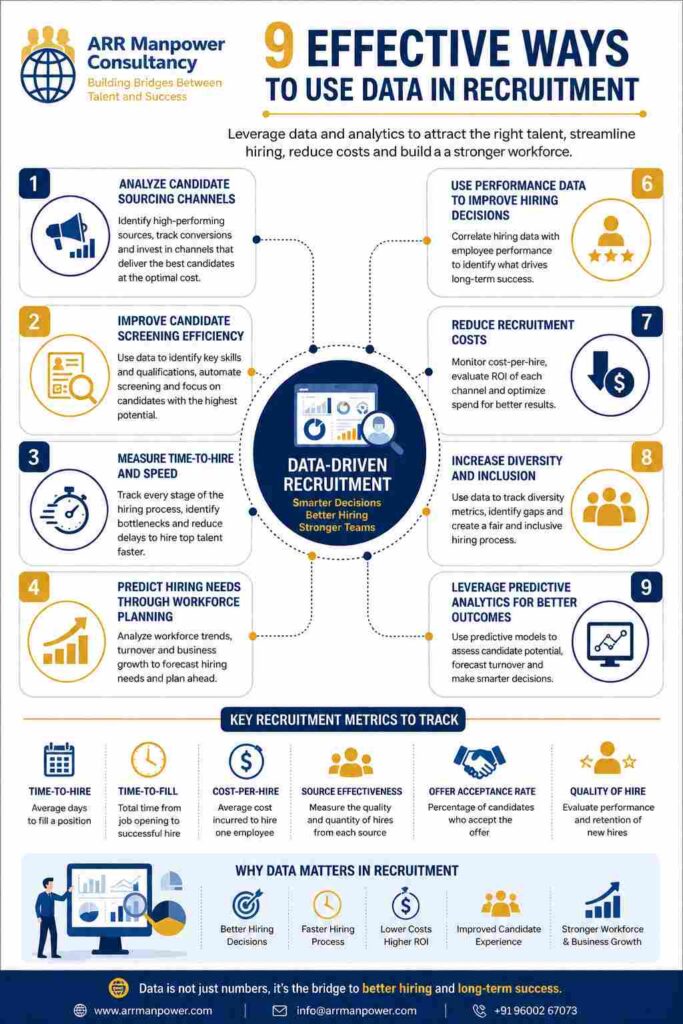
1. Analyze Candidate Sourcing Channels
One of the most valuable applications of data in recruitment is evaluating the effectiveness of sourcing channels.
Recruiters often use multiple platforms to attract candidates, including job boards, company websites, social media platforms, employee referrals, recruitment agencies, and professional networking sites. However, not every source produces the same quality of applicants.
By tracking sourcing metrics, organizations can determine:
- Which channels generate the most applications
- Which sources produce qualified candidates
- Where top-performing employees originate
- Cost per hire from each source
- Conversion rates at each stage
For example, if employee referrals consistently result in successful hires while a paid job board generates low-quality applications, hiring teams can allocate resources more effectively.
Data helps organizations focus their recruitment efforts on channels that deliver the best results while reducing unnecessary spending.
2. Improve Candidate Screening Efficiency
Resume screening can be time-consuming, especially when recruiters receive hundreds of applications for a single position.
Using data and analytics tools allows organizations to streamline the screening process by identifying key qualifications, skills, certifications, and experiences that correlate with successful employees.
Historical hiring data can reveal patterns among high-performing team members, such as:
- Educational background
- Technical skills
- Industry experience
- Leadership abilities
- Certifications
Recruiters can then use these insights to create more effective screening criteria.
Data-supported screening helps reduce bias, increase consistency, and ensure candidates are evaluated using objective standards rather than subjective opinions.
This approach enables hiring teams to focus their attention on the most suitable applicants while improving overall efficiency.
3. Measure Time-to-Hire and Recruitment Speed
Time-to-hire is one of the most important recruitment metrics.
A lengthy hiring process can result in losing qualified candidates to competitors. Monitoring recruitment timelines helps organizations identify bottlenecks and improve hiring speed.
Key stages that can be measured include:
- Job posting duration
- Resume review time
- Interview scheduling delays
- Assessment completion rates
- Offer approval processes
- Candidate acceptance periods
By analyzing recruitment timelines, employers can determine where delays occur and implement improvements.
For example, if interview scheduling consistently slows the process, organizations can adopt automated scheduling systems or improve communication between departments.
Reducing hiring time not only improves efficiency but also enhances the candidate experience and increases offer acceptance rates.
4. Predict Hiring Needs Through Workforce Planning
Data plays a critical role in workforce planning and future hiring strategies.
Organizations can analyze historical trends to anticipate staffing requirements before talent shortages occur.
Useful workforce planning metrics include:
- Employee turnover rates
- Retirement projections
- Business growth forecasts
- Department expansion plans
- Seasonal hiring patterns
- Internal promotion rates
For example, a company experiencing rapid growth may use workforce data to forecast future talent requirements several months in advance.
Predictive analytics helps organizations prepare recruitment campaigns, allocate budgets, and develop talent pipelines before urgent hiring needs arise.
This proactive approach reduces disruptions and ensures business continuity.
5. Enhance Candidate Experience
Candidate experience has become a major factor in employer branding and recruitment success.
Data helps organizations understand how applicants interact with the hiring process and identify opportunities for improvement.
Recruiters can monitor:
- Application completion rates
- Candidate feedback surveys
- Interview satisfaction scores
- Career page engagement
- Communication response times
- Offer acceptance rates
If a significant number of candidates abandon applications midway, it may indicate that the process is too complicated or time-consuming.
Similarly, feedback surveys can highlight areas where communication, interview structure, or onboarding procedures need improvement.
By analyzing candidate experience data, organizations can create a smoother and more engaging hiring journey.
A positive experience strengthens employer reputation and increases the likelihood that candidates will recommend the company to others.
6. Use Performance Data to Improve Hiring Decisions
One of the most powerful uses of data is connecting hiring outcomes with employee performance.
Organizations can evaluate whether recruitment decisions lead to successful long-term hires by comparing hiring information with performance metrics.
This analysis may include:
- Productivity levels
- Performance review scores
- Retention rates
- Promotion frequency
- Training completion rates
- Leadership potential
For example, if employees hired through referral programs consistently outperform those from other sources, recruiters can prioritize referral initiatives.
Similarly, organizations can identify candidate attributes that are strongly associated with success in specific roles.
This evidence-based approach improves hiring accuracy and supports better talent acquisition strategies over time.
7. Reduce Recruitment Costs
Recruitment can be expensive when organizations rely on ineffective sourcing methods or inefficient hiring processes.
Data enables hiring teams to monitor expenses and optimize recruitment budgets.
Important cost-related metrics include:
- Cost per hire
- Advertising expenses
- Agency fees
- Technology investments
- Interview costs
- Onboarding expenses
By evaluating these metrics, organizations can determine which recruitment activities generate the highest return on investment.
For example, a company may discover that employee referral programs deliver stronger hiring outcomes at a lower cost compared to external agencies.
Using data to monitor spending helps organizations allocate resources strategically while maintaining hiring quality.
Lower recruitment costs contribute directly to improved operational efficiency and profitability.
8. Increase Diversity and Inclusion Efforts
Diversity and inclusion have become essential priorities for modern organizations.
Data provides valuable insights into whether hiring practices support diverse candidate representation and equal opportunity.
Recruitment analytics can help organizations monitor:
- Diversity across applicant pools
- Interview participation rates
- Hiring outcomes
- Promotion trends
- Candidate progression through hiring stages
These insights allow employers to identify potential barriers or disparities within the recruitment process.
For example, if certain groups are consistently eliminated during specific hiring stages, organizations can investigate possible causes and implement corrective measures.
Using measurable data supports fair hiring practices and helps create a more inclusive workplace environment.
A diverse workforce often contributes to improved innovation, broader perspectives, and stronger organizational performance.
9. Leverage Predictive Analytics for Better Hiring Outcomes
Predictive analytics represents one of the most advanced applications of data in recruitment.
By analyzing historical hiring information and workforce trends, predictive models can estimate future outcomes and support decision-making.
Predictive analytics can help organizations:
- Forecast candidate success
- Anticipate turnover risks
- Estimate hiring demand
- Identify high-potential talent
- Improve workforce planning
- Support succession strategies
For example, predictive models may reveal characteristics shared by employees who remain with the organization for extended periods.
Recruiters can then prioritize candidates with similar attributes while maintaining fair and objective evaluation standards.
Although predictive analytics should not replace human judgment, it can provide valuable guidance that strengthens hiring decisions.
Organizations that effectively combine data insights with recruiter expertise often achieve stronger recruitment results and workforce stability.
Best Recruitment Metrics to Track
To maximize the value of recruitment data, organizations should consistently monitor key performance indicators.
Some of the most important metrics include:
Time-to-Hire
Measures the number of days required to fill a position.
Time-to-Fill
Tracks the total duration between opening a vacancy and successfully hiring a candidate.
Cost-per-Hire
Calculates the average expense associated with each new employee.
Source Effectiveness
Evaluates which sourcing channels produce successful hires.
Offer Acceptance Rate
Measures the percentage of candidates who accept job offers.
Candidate Satisfaction
Assesses applicant experience throughout the hiring process.
Quality of Hire
Evaluates employee performance and retention after recruitment.
Retention Rate
Measures how long employees remain with the organization.
Tracking these metrics enables continuous improvement and supports more informed hiring strategies.
Common Challenges When Using Recruitment Data
While data offers significant advantages, organizations may encounter several challenges during implementation.
Data Quality Issues
Incomplete or inaccurate information can lead to misleading conclusions and poor hiring decisions.
Technology Integration Problems
Organizations often use multiple recruitment systems that may not communicate effectively with each other.
Privacy and Compliance Concerns
Recruiters must ensure candidate information is collected, stored, and processed in accordance with applicable regulations.
Overreliance on Analytics
Data should support decision-making rather than replace human judgment.
Resistance to Change
Some hiring teams may be hesitant to adopt new technologies or analytical approaches.
Addressing these challenges requires proper training, strong data management practices, and a balanced recruitment strategy.
The Future of Data-Driven Recruitment
As technology continues to evolve, the role of data in recruitment will become even more significant.
Artificial intelligence, machine learning, predictive analytics, and advanced automation tools are transforming how organizations identify, assess, and hire talent.
Future recruitment systems may provide:
- More accurate candidate matching
- Improved workforce forecasting
- Enhanced talent pool management
- Real-time recruitment insights
- Better candidate engagement
- Stronger hiring outcomes
Organizations that embrace data-driven hiring practices today will be better positioned to compete for top talent in the future.
The ability to make informed, evidence-based hiring decisions will remain a critical competitive advantage across industries.
Conclusion
Data has become an essential component of modern recruitment strategies. Organizations that effectively use analytics can improve sourcing decisions, streamline candidate screening, reduce hiring costs, enhance candidate experiences, and make more accurate talent acquisition decisions.
From measuring recruitment performance to predicting future workforce needs, data provides valuable insights that help organizations operate more efficiently and hire with greater confidence. By tracking meaningful metrics and continuously refining recruitment processes, businesses can achieve stronger hiring outcomes and build high-performing teams.
As the talent market becomes increasingly competitive, organizations that leverage data effectively will gain a significant advantage in attracting, selecting, and retaining top professionals. Adopting a data-driven approach is no longer simply an option—it is a strategic necessity for long-term recruitment success.