Hiring the right talent has always been the backbone of business success. However, the way companies recruit employees is evolving rapidly. Technological advancements, global workforce mobility, and changing employee expectations are reshaping the recruitment landscape. As businesses compete for skilled professionals, staying updated with modern hiring trends is no longer optional—it is essential.
In 2026, recruitment is becoming more strategic, data-driven, and globally connected. Employers are no longer limited to local talent pools; they are exploring international opportunities and adopting innovative hiring practices to find the right candidates faster and more efficiently.
For organizations looking to scale globally, partnering with experienced manpower agencies such as ARR Manpower Consultancy can provide valuable access to skilled professionals and streamlined recruitment solutions.
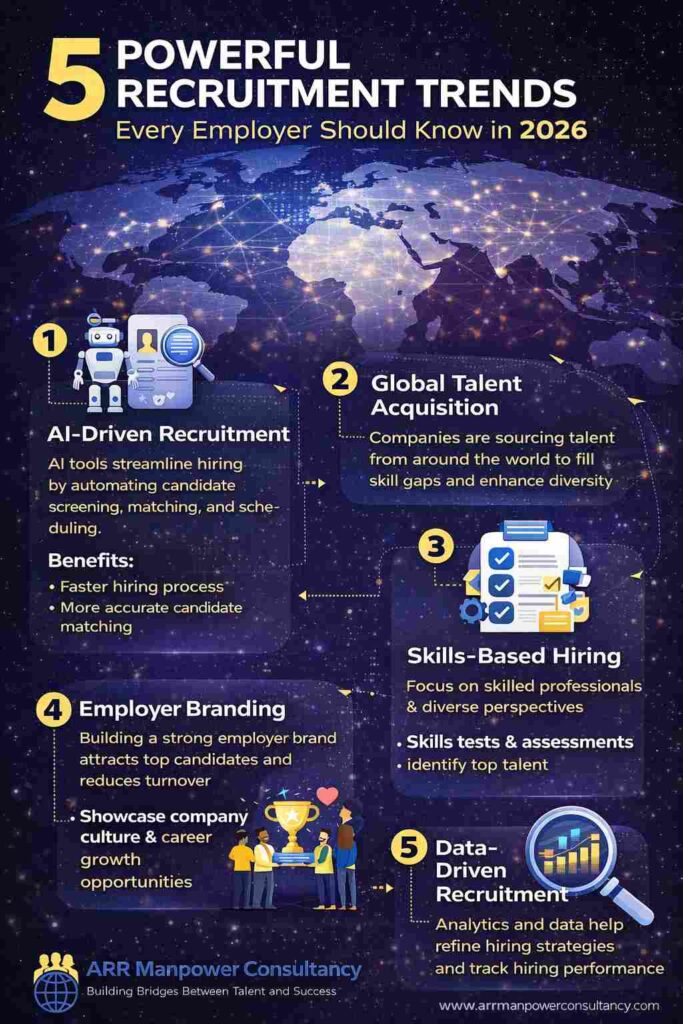
This article explores five powerful recruitment trends every employer should know in 2026 and how businesses can adapt their hiring strategies to remain competitive in the global market.
https://arrmanpowerconsultancy.com/
Why Recruitment Trends Matter for Employers
Recruitment trends are not just industry buzzwords. They reflect deeper changes in how businesses operate and how employees expect to work. Organizations that ignore these trends often struggle to attract top talent, while those that adapt quickly gain a competitive advantage.
Modern recruitment focuses on efficiency, candidate experience, and global talent access. Employers now prioritize digital tools, workforce diversity, and flexible work environments. Understanding these trends helps businesses create stronger hiring strategies and build teams capable of driving long-term growth.
Let’s explore the key recruitment trends shaping the future of hiring in 2026.
1. AI-Driven Recruitment Is Transforming Hiring Processes
Artificial intelligence is revolutionizing recruitment across industries. AI-powered tools help employers automate repetitive tasks, analyze candidate data, and identify the most suitable applicants within minutes.
Traditional recruitment methods often involve reviewing hundreds of resumes manually. This process can be time-consuming and prone to bias. AI technology simplifies the process by scanning resumes, identifying relevant skills, and ranking candidates based on predefined criteria.
Many organizations now use AI-driven platforms for resume screening, candidate matching, and interview scheduling. These tools significantly reduce hiring time while improving accuracy.
AI also enhances candidate communication through automated responses and chatbots. Applicants receive quicker updates about their application status, improving the overall candidate experience.
For employers, this means faster recruitment cycles and better hiring decisions. However, successful implementation still requires human oversight. Recruitment professionals must evaluate AI recommendations carefully to ensure fairness and alignment with organizational goals.
As AI continues to evolve, businesses that integrate intelligent recruitment systems will gain a major advantage in attracting high-quality talent.
2. Global Talent Acquisition Is Becoming the New Standard
The modern workforce is no longer confined by geographical boundaries. Companies are increasingly hiring professionals from different countries to fill skill gaps and expand their operations.
Global talent acquisition allows organizations to access a wider pool of skilled professionals. This approach is especially valuable in industries experiencing talent shortages, such as healthcare, engineering, IT, and construction.
Employers are now partnering with international recruitment agencies to identify qualified candidates who are ready to work abroad. These agencies manage essential processes such as candidate screening, visa documentation, and onboarding support.
Global hiring not only helps companies secure specialized expertise but also introduces cultural diversity and fresh perspectives into the workplace.
However, international recruitment requires careful planning. Employers must comply with immigration regulations, employment laws, and cultural considerations when hiring foreign professionals.
With the right strategy and recruitment partners, global talent acquisition can significantly strengthen an organization’s workforce.
3. Skills-Based Hiring Is Replacing Traditional Qualification Requirements
For many years, employers relied heavily on academic degrees and formal qualifications when selecting candidates. While education remains important, organizations are now focusing more on practical skills and real-world experience.
Skills-based hiring evaluates a candidate’s ability to perform specific tasks rather than simply reviewing their educational background. This approach helps companies identify individuals who can deliver results immediately.
Employers are increasingly using skill assessments, technical tests, and practical assignments during the hiring process. These evaluations provide a clearer understanding of a candidate’s capabilities.
This trend also expands opportunities for talented individuals who may not possess traditional qualifications but have developed valuable skills through experience, training programs, or certifications.
Skills-based hiring benefits employers by creating more diverse talent pipelines and reducing recruitment biases. Companies can focus on measurable competencies that directly contribute to job performance.
As industries evolve and new technologies emerge, skills-based recruitment will continue to gain importance in 2026 and beyond.
4. Employer Branding Is Becoming a Critical Recruitment Strategy
In today’s competitive job market, candidates evaluate companies just as carefully as employers evaluate applicants. Professionals prefer organizations with strong reputations, positive work environments, and clear career development opportunities.
Employer branding refers to how a company presents itself to potential employees. It includes the organization’s culture, values, leadership style, and employee benefits.
Businesses with strong employer brands attract higher-quality candidates and experience lower turnover rates. Job seekers often research companies through websites, social media platforms, and employee reviews before applying for a position.
Organizations are investing more resources in showcasing their workplace culture through online content, employee testimonials, and career development programs.
Transparency also plays a major role in employer branding. Candidates appreciate companies that communicate clearly about job roles, expectations, and growth opportunities.
Employers that build positive reputations as great places to work will find it easier to attract talented professionals in 2026.
5. Data-Driven Recruitment Is Improving Hiring Decisions
Data analytics is becoming an essential component of modern recruitment strategies. Employers now rely on recruitment metrics to evaluate hiring performance and identify areas for improvement.
Data-driven recruitment uses analytics to track key indicators such as time-to-hire, cost-per-hire, candidate conversion rates, and employee retention levels.
These insights help organizations refine their recruitment strategies and allocate resources more effectively.
For example, analytics may reveal which job platforms generate the best candidates or which recruitment channels produce the highest retention rates. With this information, companies can focus on the most effective hiring methods.
Data-driven recruitment also helps reduce unconscious bias by providing objective insights into candidate evaluation processes.
By using analytics to guide decision-making, employers can build more efficient recruitment systems and improve overall workforce quality.
How Employers Can Prepare for Recruitment Trends in 2026
Adapting to evolving recruitment trends requires strategic planning and continuous improvement. Employers should focus on several key actions to stay ahead of the competition.
First, organizations should invest in modern recruitment technologies that automate repetitive tasks and improve candidate management. These tools enhance efficiency and reduce hiring timelines.
Second, businesses should expand their talent search beyond local markets. International recruitment partnerships can provide access to highly skilled professionals from diverse backgrounds.
Third, companies should prioritize employee development and skill-building programs. A workforce that continuously improves its capabilities remains competitive in rapidly changing industries.
Finally, employers should strengthen their employer brand by promoting positive workplace culture and career growth opportunities. Candidates are more likely to join organizations that value employee well-being and professional development.
By implementing these strategies, businesses can successfully navigate the future of recruitment.
The Role of Recruitment Consultancies in Modern Hiring
As recruitment becomes more complex, many organizations rely on specialized manpower consultancies to manage their hiring processes.
Recruitment consultancies provide expertise in candidate sourcing, screening, and workforce planning. They maintain extensive talent databases and industry networks that allow them to identify suitable candidates quickly.
For companies expanding internationally, consultancies also assist with visa processing, compliance requirements, and relocation support.
Partnering with experienced recruitment professionals saves time, reduces hiring risks, and ensures that businesses find the right candidates for critical roles.
Organizations seeking efficient and reliable recruitment solutions often benefit from the guidance of trusted manpower consultants.
The Future of Recruitment Beyond 2026
Recruitment will continue evolving as technology advances and workforce expectations change. Emerging technologies such as virtual reality interviews, blockchain-based credential verification, and predictive hiring analytics may further transform the hiring landscape.
Additionally, remote work and hybrid employment models are expected to remain popular, enabling organizations to recruit talent from virtually anywhere in the world.
Companies that remain flexible, innovative, and open to new recruitment strategies will thrive in the future workforce environment.
The key to long-term success lies in combining technology, human expertise, and strategic planning to build strong, adaptable teams.
Conclusion
Recruitment in 2026 is defined by innovation, global connectivity, and strategic decision-making. Employers who stay informed about emerging trends can attract better talent and build stronger organizations.
The five powerful recruitment trends discussed in this article—AI-driven hiring, global talent acquisition, skills-based recruitment, employer branding, and data-driven decision-making—are reshaping the future of workforce management.
Businesses that embrace these trends will not only streamline their hiring processes but also create dynamic teams capable of driving sustainable growth.
As the competition for skilled professionals intensifies, forward-thinking employers must adopt modern recruitment strategies and collaborate with experienced manpower partners to secure the best talent available.
By staying proactive and adaptable, organizations can confidently navigate the evolving world of recruitment and build a workforce ready for the opportunities of tomorrow.